The Drum · Weekly AI news, freeSubscribe →

Share
Four Baltimore County teens were handcuffed at gunpoint after an AI gun detector mistook a Doritos bag for a weapon, and a canceled alert still triggered police. Their lawsuit asks what happens when humans stop checking the machine.
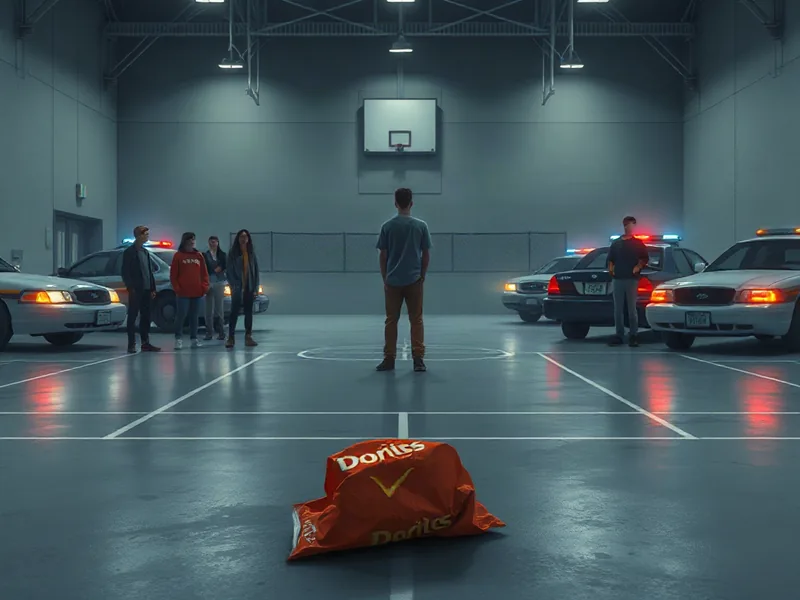
Picture the most ordinary part of a teenager's day: practice ends, friends share a snack, everyone waits for a ride. That mundane scene is exactly what four Black high school students in Baltimore County were living through last October when an AI gun detection system looked at a bag of Cool Ranch Doritos and decided it was looking at a firearm.
School officials reviewing the security footage figured out the mistake fast. Within two minutes, they recognized the chip bag for what it was and canceled the alert, a cancellation meant to tell everyone, including the Baltimore County Police Department, that no response was needed. That should have been the end of it. It wasn't.
According to a lawsuit filed by students Taki Allen, Yui-Osa Ogbeide, Devon Thompson Jr., and Keith Winfield III, a mix of "technological and human errors" led school officials to call police anyway. Six patrol cars arrived with lights flashing. Some officers had their guns drawn. The teens say they froze, cooperated, and had no idea what was happening to them.
"No one told the students what they were suspected of," the lawsuit states. Officers separated the boys, ordered them to their knees on concrete, handcuffed them, and searched their belongings. Only after finding no gun did the students learn the cause: Omnilert, the AI system Baltimore County Public Schools had installed to detect weapons on campus.
The lawsuit alleges that one officer could be heard muttering "stupid AI cameras" and "fucking Omnilerts." Another reportedly told the teens, "AI is not the best," as if that settled the matter after they had already been through the worst of it. One officer, releasing the boys, offered this: "Hey, thanks for not running away, that would have been a real problem." Another joked they should "be careful with your chip bags." The students say officers also implied they were guilty "by association" simply for standing near the boy who was flagged.
Think of Omnilert's alert system like a fire drill switch that's supposed to have an off button everyone can see. In this case, the off button worked, technically. The alert was reviewed and canceled within two minutes, exactly as the system is designed to allow. But a later investigation by the Maryland Office of the Inspector General for Education found that the "delegation of authority" process at Kenwood High School didn't actually stop the principal, Kate Smith, from separately noticing the alert, missing the fact it had been canceled, and texting a school resource officer to send police anyway, fifteen minutes after the original alert. In that same text, she reportedly acknowledged the object was "maybe not" a gun.
Smith had never been trained on the Omnilert system, according to the OIG report. That detail matters more than it might first appear. A tool built to reduce false alarms still depends entirely on the humans positioned to act on it understanding how it works, and in this case, that training gap turned a canceled alert into a police response with guns drawn.
The OIG's report found no evidence of algorithmic "bias" in Omnilert's detection itself. But it did recommend that BCPS reduce the number of people who receive gun alerts, conduct biannual staff training, and switch officials over to using the dedicated Omnilert app rather than text message notifications, since a text alert is easy to glance at, enlarge, and act on without noticing a follow-up cancellation. The report also noted something striking: more than 99 percent of Omnilert alerts in Baltimore County Public Schools have been false positives requiring no police response at all. That statistic alone suggests a system where the default outcome should be caution, not escalation.
Omnilert's vice president of marketing, Blake Mitchell, told Ars Technica the company is reviewing the complaint and said the organization is "truly sorry for the fear" the students and their families experienced. He maintained that the technology performed as designed, sending a possible firearm image to trained reviewers who canceled it within two minutes. "That is exactly why human review matters," Mitchell said, "and why a canceled alert must stay canceled." It's a fair point about the technology, but it also underscores the lawsuit's central claim: the failure wasn't the AI, it was everything built around it.
Damon Hewitt, president of the Lawyers' Committee for Civil Rights Under Law, which is representing the students, put it plainly: "Overreliance on artificial intelligence technology mixed with inept communication and coordination among key officials is a toxic mix." His colleague Len Kamdang told the New York Times the case is "ultimately about how human beings allowed AI to substitute for their judgment."
The students are asking a court to bar BCPS from using Omnilert until adequate protocols and training are in place. Their complaint alleges the school's failures amounted to "deliberate indifference" to their constitutional rights, pointing out that none of the responding officers reviewed camera footage before arriving, and none who knew the alert had been canceled stepped in to stop the response.
BCPS declined to comment directly on the lawsuit, instead pointing to a statement issued to parents promising "ongoing counseling and emotional support." The statement does not include a direct apology to the students.
The numbers in a report can't capture what it feels like to kneel on concrete with your hands cuffed behind your back because of a snack. Taki Allen, the student initially flagged, no longer feels safe waiting for rides after school and now pays for private car services instead. Keith Winfield, whose house sits close to the school, calls his mother repeatedly after practice just to confirm she's on her way. His mother, Frieda Winfield, told a local news outlet she was angry and fearful, "because they're young men. Young Black men, and they were at school, and they didn't understand why what was happening, happened to them."
That fear is not incidental to the story, it is the story. As schools and police departments race to adopt AI tools promising near-zero false positives, this case is a reminder that the promise only holds if the humans behind the system stay trained, attentive, and willing to trust their own eyes over an algorithm's alarm. Four teenagers sharing chips after practice paid the price for finding out what happens when that trust breaks down.
Tags
Original Sources
Traumatized teens sue school, cops after Doritos bag triggers AI gun alert
↗ https://arstechnica.com/tech-policy/2026/11/traumatized-teens-sue-school-cops-after-doritos-bag-triggers-ai-gun-alert
About the author
Amara's entry point into AI was an epidemiology role at a London research hospital, where she spent five years studying how digital health tools reached — or conspicuously failed to reach — underserved communities. Watching early algorithmic systems in healthcare quietly entrench existing inequalities, she redirected her career toward the systemic consequences of AI at scale. She covers AI through an unflinching lens: who benefits, who bears the cost, and what evidence actually says versus what the press release claims. Her writing is calm and precise, but she doesn't mistake balance for neutrality.
More from The Steward →This Week's Edition
20 November 2026
29 articles
Related Articles
A Wave of Unrelated Outages Points to a Common Cause: AI-Accelerated Infrastructure Strain
Security & Risk · 5 min

Thousands of "Uncensored" AI Models Are One Download Away, Study Finds
Security & Risk · 6 min

National Academies Report Calls for Faster, Tougher Retraction Standards
Models & Research · 5 min
Related Articles
A Wave of Unrelated Outages Points to a Common Cause: AI-Accelerated Infrastructure Strain
Security & Risk · 5 min
Thousands of "Uncensored" AI Models Are One Download Away, Study Finds
Security & Risk · 6 min
National Academies Report Calls for Faster, Tougher Retraction Standards
Models & Research · 5 min
More Stories
© 2026 Cedar & Bloom. All rights reserved.
