The Drum · Weekly AI news, freeSubscribe →

Share
A new nonprofit report warns that focusing on GPUs alone hides the true scale of AI's coming waste problem, one measured not in server racks but in millions of tonnes of discarded infrastructure with nowhere safe to go.
Picture a line of shipping containers stretching from your front door, around the planet, six times over. That is the scale of electronic waste that a new report warns the AI boom could leave behind by 2050, and it is a far bigger mess than most of us have been led to believe.
We have grown used to hearing about AI's appetite for electricity and water. Those numbers are alarming enough on their own. But according to a report from the Basel Action Network (BAN), a nonprofit dedicated to preventing the dumping of hazardous waste on poorer countries, we have been ignoring a whole other category of harm: what happens to all the physical stuff once it is obsolete.
The report, titled "How Big Is the AI Waste Wave?", argues that most existing waste estimates have made a basic error. They count the GPUs and servers, the flashy chips everyone talks about, and stop there. But those components make up just 13 percent of a datacenter's equipment by weight. The rest, the power systems, cooling infrastructure, networking gear, and backup batteries, gets left out of the math entirely. Once you add it back in, BAN says, the true waste total could run 40 to 60 times higher than the most widely cited academic projections.
Think of it like estimating the environmental cost of a car by only counting the engine. You would miss the tires, the battery, the frame, the wiring, everything that eventually needs replacing or scrapping too. That is essentially what BAN says has happened with AI infrastructure forecasting.
BAN's model breaks datacenter equipment into five categories: networking gear, power distribution systems, backup power, servers and accelerators, and cooling. Added together, a reference 100 megawatt AI facility, roughly the size needed to train and run large models, contains about 7,000 metric tons of hardware. Much of that will need replacing as the facility gets upgraded to keep pace with newer, more power-hungry AI chips.
The numbers add up fast. BAN estimates that AI infrastructure worldwide could generate between 395 million and 617 million tonnes of e-waste from 2025 through 2050. Translated into shipping containers, that is somewhere between 15 million and 23 million of them. Lined up end to end, 20 million containers would stretch roughly 244,000 kilometers, about six times the circumference of the Earth.
Why so much, so fast? Part of the answer lies in how quickly AI hardware becomes outdated. GPUs and other AI accelerators get swapped out every two to three years, BAN says, compared with five to seven years for a typical general-purpose server. And when a facility upgrades to a new generation of Nvidia chips, operators often replace entire servers rather than individual parts, largely because the hardware arrives from manufacturers as complete, preconfigured systems rather than something you can easily upgrade piece by piece.
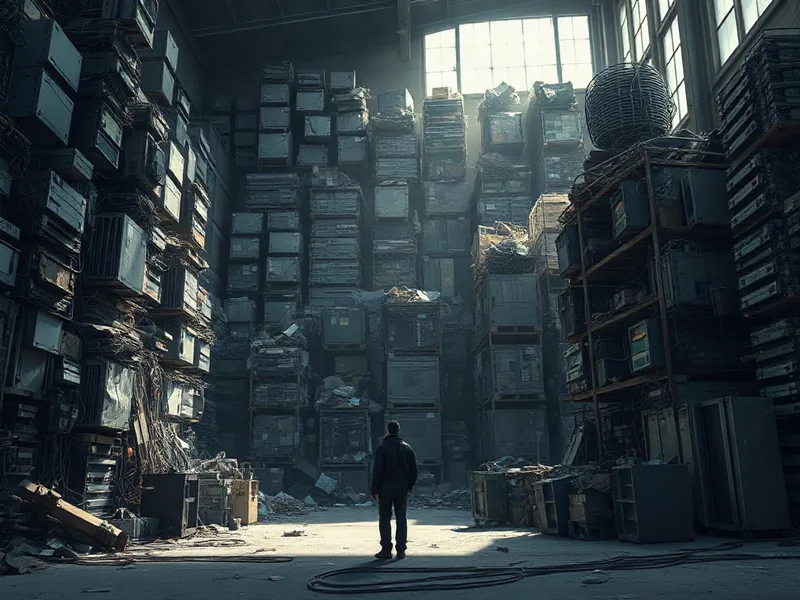
The physical infrastructure around those chips wears out too, just on different clocks. Networking equipment typically lasts three to four years. Power distribution systems last about eight. Backup power and cooling systems each run roughly five years before needing replacement. And the upgrade cycle itself creates waste beyond simple wear and tear. When a datacenter shifts from racks drawing 5 to 15 kilowatts to the 50 to 140 kilowatt racks that AI workloads demand, much of the power infrastructure has to be torn out and rebuilt from scratch. A single 100 megawatt facility contains roughly 2,700 tonnes of copper in its cabling and busbars alone, copper that either gets recycled responsibly or ends up as part of the problem.
It is worth being clear about what this report is and is not. BAN's figures are modeled projections built from the industry's own stated expansion plans, not a measured accounting of waste already sitting in landfills. The assumptions, particularly around how quickly hardware gets replaced and whether entire systems get swapped rather than repaired, are the load-bearing walls of the whole estimate. Reasonable people could argue those cycles will stretch longer as the industry matures, or that reuse and refurbishment will absorb more of the volume than BAN assumes. That is precisely the question the group says it will tackle in its next report, which will look at how reuse and repurposing might shrink the waste stream. A third installment will examine how toxic that waste actually is, including the risk of contamination from PFAS, the so-called "forever chemicals" that resist breaking down in the environment. A fourth will focus on solutions.
Here is the part that should worry anyone paying attention to how our stuff gets disposed of once we are done with it: nobody appears to have a plan. BAN's report states plainly that no hyperscaler, no government, and no international regulatory body has published a strategy for handling e-waste at the scale this buildout implies. And the infrastructure we already have cannot process the electronic waste we generate today, let alone a wave many times larger.
This is not an abstract concern confined to spreadsheets and shipping containers. Electronic waste that is not properly processed tends to end up in the same places hazardous waste always has, shipped to countries with fewer environmental protections and weaker enforcement, where workers often dismantle it by hand without adequate safety equipment. Copper, cooling chemicals, and circuit board components carry real health risks when they are burned, buried, or leached into soil and water rather than recycled properly.
"To date the environmental debate around AI has focused on electricity, carbon and water while largely overlooking what happens to the hardware itself," said Jim Puckett, BAN's founder and chief of strategic direction. His warning is blunt: without planning now, the AI buildout could become, in his words, "an even more cataclysmic toxic waste crisis than we are already experiencing."
That framing matters because the AI industry's biggest players are still in expansion mode, breaking ground on new facilities and racing to deploy the next generation of chips. Every choice made now about hardware design, recycling partnerships, and equipment lifespan will shape how much of this waste ends up safely processed versus dumped on communities least equipped to handle it. The window for building that plan is closing at roughly the same pace as the datacenters going up around us.
Tags
Original Sources
AI boom could leave an e-waste trail that wraps 6 times around Earth
↗ https://www.theregister.com/off-prem/2026/09/19/ai-boom-could-leave-an-e-waste-trail-that-wraps-6-times-around-earth/5297451
About the author
Amara's entry point into AI was an epidemiology role at a London research hospital, where she spent five years studying how digital health tools reached — or conspicuously failed to reach — underserved communities. Watching early algorithmic systems in healthcare quietly entrench existing inequalities, she redirected her career toward the systemic consequences of AI at scale. She covers AI through an unflinching lens: who benefits, who bears the cost, and what evidence actually says versus what the press release claims. Her writing is calm and precise, but she doesn't mistake balance for neutrality.
More from The Steward →This Week's Edition
20 September 2026
20 articles
Related Articles

Stanford HAI's Fall 2026 Seminar Lineup Zeroes In On World Models, AI Measurement, and Workforce Anxiety
Models & Research · 5 min

The Uncanny Valley Isn't Going Away, and Maybe It Shouldn't
Models & Research · 5 min

Obama Says Government "Has to Be Regulating" AI, Warns Against Waiting Too Long
Policy & Regulation · 5 min
Related Articles
Stanford HAI's Fall 2026 Seminar Lineup Zeroes In On World Models, AI Measurement, and Workforce Anxiety
Models & Research · 5 min
The Uncanny Valley Isn't Going Away, and Maybe It Shouldn't
Models & Research · 5 min
Obama Says Government "Has to Be Regulating" AI, Warns Against Waiting Too Long
Policy & Regulation · 5 min
More Stories
© 2026 Cedar & Bloom. All rights reserved.
