The Drum · Weekly AI news, freeSubscribe →

Share
Beijing's proposal to restrict 12 solar manufacturing technologies, folded into a broader AI and biotech export review, signals a strategic effort to protect its manufacturing edge just as rivals try to build around it.
China's commerce ministry on Friday proposed export controls on 12 technologies used in solar equipment manufacturing, citing national security concerns. The move is part of a larger revision to the country's export-control catalogue that also touches artificial intelligence and biotechnology, and it extends a pattern of behavior that has been building for months.
The stated rationale is defense-related. The ministry said solar technologies are increasingly used in sensitive applications, including aerospace and national defense, and that greater oversight is warranted. The language in the ministry's statement framed the controls as protective rather than punitive, aiming to "guard against the risks of technologies from running out of control or being improperly disseminated, while safeguarding normal international exchanges and cooperation in science and technology."
That framing deserves scrutiny. China controls roughly 80% of global solar manufacturing capacity across the supply chain, from polysilicon to finished modules. A national security justification is not implausible, but it also happens to align neatly with industrial policy objectives. The two are not mutually exclusive.
The proposal draws a clear line between outright bans and lighter restrictions. Technologies used to make certain thin wafers, perovskite cells, and tandem solar cells would be banned from export entirely. So would large-scale fluidized-bed polysilicon production technology, a process that is cheaper and more energy-efficient than the dominant Siemens method currently used across most of the industry.
Perovskite and tandem cell technology represent the next frontier in solar efficiency. Perovskite materials offer the potential for higher conversion rates than traditional silicon cells, and tandem designs stack perovskite and silicon layers to capture a broader slice of the solar spectrum. These are not legacy technologies being phased out. They are the ones most likely to define competitive advantage over the next decade.
Advanced cell manufacturing technologies, including TOPCon, HJT, and XBC, face restriction rather than prohibition under the proposal. That distinction matters for companies trying to plan around the rules. A restricted export can still happen, subject to review and licensing. A banned one cannot.
In the interim period before the catalogue is formally updated, exporters must register certain overseas technology transfers. Public consultation on the proposal runs through November 15, which gives industry players roughly a month to lobby for changes before the rules take a more permanent shape.
This is not China's first move in this direction. Reuters reported in April that Chinese officials had opened initial talks with domestic manufacturers about curbing exports of advanced solar-panel manufacturing technology. That earlier discussion carried direct implications for US companies, including Tesla, which had been in talks to purchase roughly $2.9 billion worth of Chinese solar equipment as part of plans to expand production domestically. Beijing has also curbed solar-manufacturing technology exports to India, where factories have reportedly idled as the country struggles to shake its reliance on Chinese equipment despite a government push to build domestic capacity.
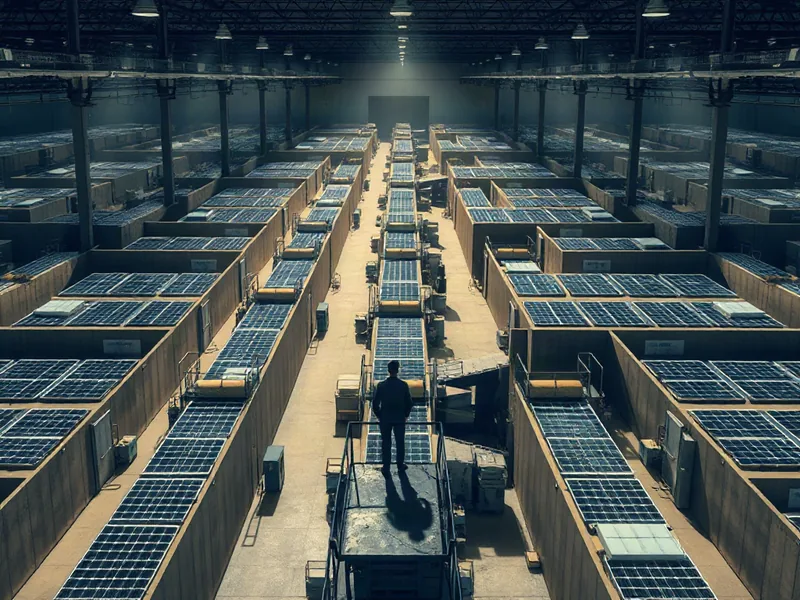
The common thread across these episodes is straightforward. China built its solar dominance over roughly two decades through state-backed investment, scale economics, and aggressive cost reduction. Any country trying to replicate that now, whether the US, India, or others, needs either time, capital, or access to Chinese know-how. Export controls remove the third option and make the first two more expensive.
For US and Indian solar manufacturers, the practical effect is to slow the diffusion of frontier technology at precisely the moment domestic capacity-building efforts are gaining political momentum. Tesla's reported equipment purchase plans illustrate the dependency directly: even a company with Tesla's capital access was looking to Chinese suppliers for next-generation manufacturing tools rather than developing them independently or sourcing from elsewhere.
For policymakers in Washington and New Delhi, the controls reinforce an argument that's been circulating in trade and energy policy circles for years: that reshoring clean energy manufacturing capacity requires more than subsidies and tariffs. It requires either technology transfer agreements that Beijing is unlikely to grant freely, or a longer runway for domestic innovation to catch up organically.
The risk for China is overreach. Export controls that are too aggressive could accelerate the very outcome Beijing is trying to prevent, pushing competitors toward faster, more determined efforts to develop independent capacity. India's experience so far suggests mixed results. Factories there have idled due to equipment constraints, which supports Beijing's leverage in the near term, but it also sharpens the political incentive in New Delhi to close the gap regardless of cost.
Investors in solar supply chains, particularly those with exposure to Chinese equipment makers such as Suzhou Maxwell Technologies, Laplace Renewable Energy Technology, and Shenzhen S.C New Energy Technology, should watch how the final catalogue differs from this proposal. A one-month consultation window is short, and the gap between banned and merely restricted categories will likely be where the real industry impact lands.
The November 15 consultation deadline is the first checkpoint. Watch for lobbying outcomes that might shift perovskite, tandem cell, or fluidized-bed polysilicon technology from an outright ban to a restricted category, since that would signal Beijing is calibrating controls to balance security concerns against trade relationships. Also worth tracking: any retaliatory or accelerated domestic-investment response from the US or India, since either could reshape capital flows into non-Chinese solar equipment makers faster than currently priced into the sector. Finally, watch whether Tesla or other US firms adjust previously reported equipment procurement plans in light of the proposed restrictions, as that would be a concrete signal of how binding these controls turn out to be in practice.
Tags
Original Sources
China proposes export controls on solar-manufacturing technologies
↗ https://www.reuters.com/business/autos-transportation/china-proposes-export-controls-solar-manufacturing-technologies-2026-10-18
About the author
Marcus began tracking AI's market implications in 2016, noticing AI-related patent filings accelerating ahead of earnings upgrades before most of the sell-side had caught on. A former fixed-income quantitative analyst, he spent two decades building models that priced risk across emerging markets before pivoting to cover the economic impact of AI full-time. His writing translates opaque technical developments into clear risk/reward terms — and he's rarely diplomatic about the gap between AI valuations and underlying fundamentals. He believes most market participants still underestimate AI's long-run deflationary effect on knowledge work.
More from The Analyst →This Week's Edition
18 October 2026
24 articles
Related Articles

German Bishops Back Child-Friendly AI Standards, Citing Papal Call on Human Dignity
Policy & Regulation · 5 min

Meta Walks Back Terms That Seemed to Permit AI Scraping of Business Websites
Policy & Regulation · 5 min

AI Is Reshaping Climate Risk and Opportunity, But the UN's Main Climate Treaty Hasn't Caught Up Yet
Policy & Regulation · 5 min
Related Articles
German Bishops Back Child-Friendly AI Standards, Citing Papal Call on Human Dignity
Policy & Regulation · 5 min
Meta Walks Back Terms That Seemed to Permit AI Scraping of Business Websites
Policy & Regulation · 5 min
AI Is Reshaping Climate Risk and Opportunity, But the UN's Main Climate Treaty Hasn't Caught Up Yet
Policy & Regulation · 5 min
More Stories
© 2026 Cedar & Bloom. All rights reserved.
