The Drum · Weekly AI news, freeSubscribe →

Share
In a world where cooking is as diverse as it is complex, researchers have created Epicure, an AI that maps the intricate connections between ingredients across seven languages.
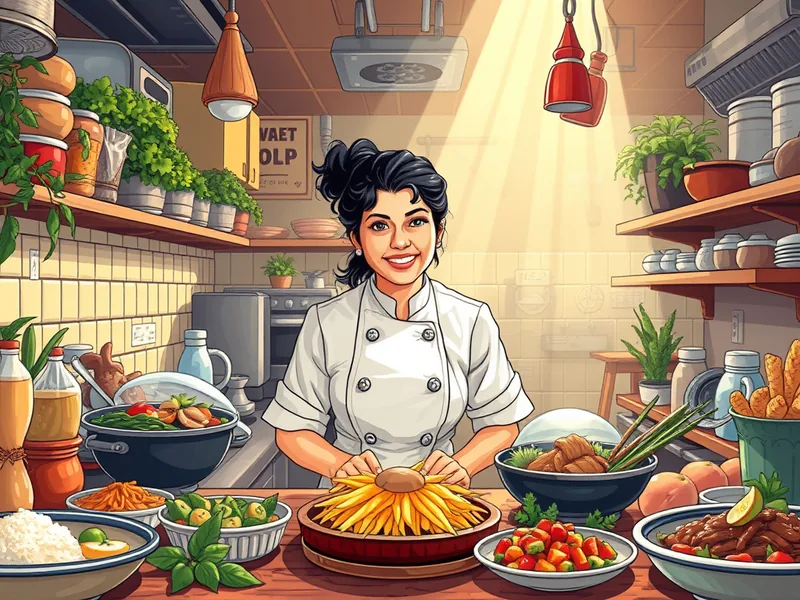
In a bustling kitchen in Santa Cruz, California, Chef Maria Lopez prepares her signature dish: a fusion of traditional Mexican flavors with hints of Chinese cuisine. Today, she’s experimenting with a new ingredient suggested by Epicure, an AI tool developed by researchers Jakub Radzikowski and Josef Chen. As she stirs the pot, the aroma fills the air, a testament to the power of technology to enhance culinary creativity.
Epicure is more than just a recipe finder; it's a sophisticated system that understands the intricate relationships between ingredients from around the world. By training on 4.14 million recipes in seven languages, English, Chinese, Russian, Vietnamese, Spanish, Turkish, Indonesian, German, and Indian-English, the AI has created a detailed map of ingredient interactions. This map is not just a list; it’s a network of connections that reveals how ingredients complement each other, both in flavor and chemistry.
The researchers used a technique called skip-gram to create three types of ingredient embeddings: Cooc, Chem, and Core. Each type focuses on different aspects of the ingredient relationships. Cooc looks at how often ingredients appear together in recipes, Chem explores the chemical compounds that give ingredients their unique flavors, and Core blends both approaches for a more holistic view.
At the heart of Epicure is an 80,019-edge typed FlavorDB ingredient-compound graph, which contains 2,247 compound nodes across 15 categories. This graph serves as the foundation for the Metapath2Vec variants that power the AI. By walking through these complex networks, the models learn to predict not just what ingredients go well together but why.
For Chef Maria, this means she can explore new flavor combinations with confidence. "Epicure has opened up a whole new world of possibilities," she says. "It’s like having a culinary expert by my side, guiding me through uncharted territory." The AI suggests ingredients based on both traditional pairings and innovative twists, allowing her to create dishes that are both familiar and exciting.
The impact of Epicure extends beyond professional kitchens. Home cooks can benefit from the same level of insight, making it easier for them to experiment with new recipes and techniques. For those who might be hesitant to try unfamiliar ingredients, Epicure provides a bridge between the known and the unknown, fostering creativity and confidence in the kitchen.
The potential applications of Epicure are vast. Beyond enhancing culinary experiences, the AI could play a role in food innovation, helping researchers develop new products that appeal to diverse palates. It could also aid in nutritional planning by suggesting ingredient combinations that meet specific dietary needs.
For Jakub Radzikowski and Josef Chen, the real excitement lies in the future possibilities. "We see Epicure as a tool for democratizing culinary knowledge," says Radzikowski. "By making this information accessible to everyone, we can foster a global community of food enthusiasts who are constantly learning and innovating."
As Chef Maria continues to explore new flavors with the help of Epicure, she embodies the spirit of what this AI represents: a blend of tradition and innovation, guided by the power of technology. The future of cooking is not just about following recipes; it’s about creating something truly unique and delicious, one ingredient at a time.
Original Sources
Epicure: Navigating the Emergent Geometry of Food Ingredient Embeddings
↗ https://arxiv.org/abs/2605.22391?utm_source=tldrai
About the author
Lena spent a decade working in international development before AI tools began showing up in the field programmes she was running — first as curiosity, then as something that genuinely changed outcomes. She writes about the moments where AI stops being a headline and starts being a lifeline: the early cancer detection in a rural clinic, the flood model that gave a village three extra days to evacuate, the translation tool that let a child speak to a doctor for the first time. She is not naive about the risks, but she believes the stories of AI doing real good deserve the same rigour and airtime as the cautionary ones.
More from The Optimist →This Week's Edition
8 June 2026
18 articles
Related Articles

IEEE Expands Smart City Advisory Services as Municipal Tech Budgets Grow
Products & Applications · 5 min

Christina Applegate's MS Misdiagnosis Reveals a Painful Diagnostic Gap in Neurology
Health & Science · 5 min

Robot Infants Are Being Built to Study Human Emotion. Should They Look So Real?
Products & Applications · 5 min
Related Articles
IEEE Expands Smart City Advisory Services as Municipal Tech Budgets Grow
Products & Applications · 5 min
Christina Applegate's MS Misdiagnosis Reveals a Painful Diagnostic Gap in Neurology
Health & Science · 5 min
Robot Infants Are Being Built to Study Human Emotion. Should They Look So Real?
Products & Applications · 5 min
More Stories
© 2026 Cedar & Bloom. All rights reserved.
