The Drum · Weekly AI news, freeSubscribe →

Share
A five-year, $2 billion agreement positions GlobalFoundries as the first US source of silicon interposers, a critical bottleneck component in advanced AI chip packaging, with TSMC as its anchor customer.
GlobalFoundries has secured a $2 billion agreement with TSMC to manufacture silicon interposers, a component that has quietly become one of the tightest chokepoints in AI chip production. The deal, announced Thursday, will see GlobalFoundries expand capacity at its Malta, New York facility specifically to serve TSMC's advanced packaging needs.
Shares of GlobalFoundries rose roughly 4% in premarket trading on the news. That reaction tells you something about how investors are pricing scarcity in the AI supply chain right now. Packaging capacity, not just raw chip fabrication, has emerged as a gating factor for how fast AI accelerators can ship.
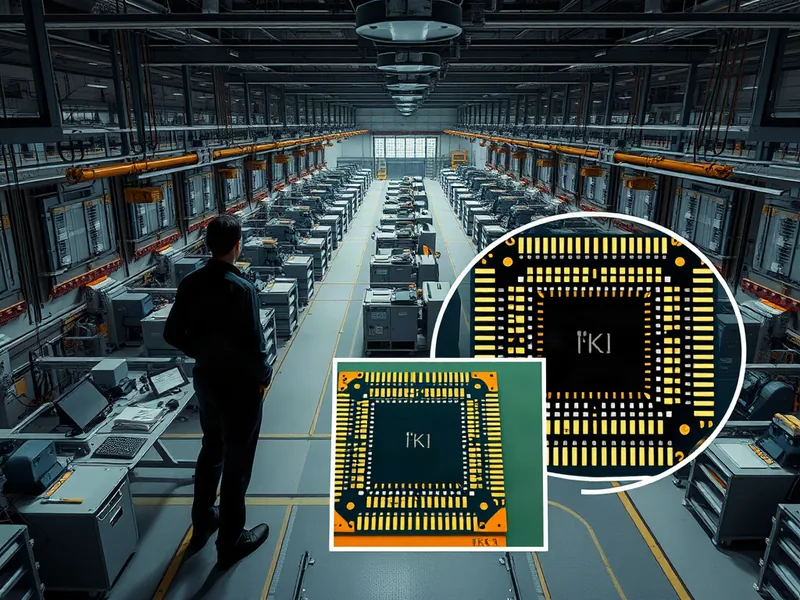
Silicon interposers sit beneath processors and memory chips in advanced AI packages. Their job is unglamorous but essential: they let processors and memory communicate at the high speeds AI workloads demand. Without enough interposer capacity, even the most advanced logic chips sit idle waiting for packaging.
Advanced packaging has become the binding constraint on AI chip output. Demand for the technology now exceeds available manufacturing capacity industry-wide, a dynamic that has persisted even as fabs ramp up leading-edge logic production. TSMC, which dominates contract chipmaking globally, has been racing to add packaging capacity through its own CoWoS lines and now through partners like GlobalFoundries.
This is a five-year agreement, not a one-off purchase order. That structure matters. It gives GlobalFoundries a multi-year revenue base tied to TSMC's AI packaging roadmap, and it gives TSMC a geographic hedge against concentration risk in Taiwan. The Malta facility is expected to become the first US-based source of silicon interposers used in advanced chip packaging, according to the company. That's a meaningful claim: it suggests a genuine first-mover position domestically, not just incremental capacity addition.
Volume production is not expected to ramp until the first half of 2028. That's a long runway. It reflects both the capital intensity of standing up new fab capacity and the qualification cycles that advanced packaging requires before customers like TSMC commit to volume. Investors should read the 2028 timeline as a signal that this is infrastructure investment, not a near-term earnings catalyst.
The deal also provides what GlobalFoundries describes as a framework for future capacity expansion. In plain terms, this is a foot in the door. If AI demand continues to outstrip packaging supply, as it has for the past several quarters, TSMC has an incentive to lean further on GlobalFoundries rather than build everything in-house or in Taiwan alone.
For GlobalFoundries, this is a strategic pivot worth watching closely. The company has spent recent years positioning itself around specialty and mature-node manufacturing, areas like automotive, RF, and IoT chips, rather than competing head-on with TSMC or Samsung at the leading edge. Winning a packaging role inside TSMC's own AI supply chain is a different kind of business: it ties GlobalFoundries' fortunes more directly to the AI capex cycle than its core franchise historically has.
The arrangement is not without exposure. A five-year, single-customer-anchored deal concentrates risk. If TSMC's own AI packaging buildout, including CoWoS and other in-house lines, outpaces demand for outsourced interposer capacity before 2028, the framework for expansion could remain just that: a framework, not realized volume.
There's also execution risk on the capital side. Expanding a US fab to produce a component that has historically been dominated by Asian supply chains is not trivial. GlobalFoundries will need to hit qualification milestones on TSMC's timeline, and any slippage pushes revenue recognition further out.
Geopolitics cuts both ways here. The US has pushed hard for domestic semiconductor capacity, and this deal fits neatly into that narrative, a first US-based source of silicon interposers is exactly the kind of headline policymakers want. But that same political tailwind could just as easily become a dependency: subsidy timelines, export controls, and trade friction between the US and Taiwan remain live variables that could affect how aggressively TSMC diversifies its packaging footprint stateside.
Finally, the 2028 ramp timeline leaves a two-year gap during which AI packaging demand dynamics could shift materially. If GPU architectures evolve toward different packaging approaches, or if competitors close the capacity gap faster than expected, the economics underpinning this deal could look different by the time volume production actually begins.
This deal is a sensible, incremental step for both parties rather than a transformative one. For TSMC, it diversifies a critical packaging bottleneck outside Taiwan without ceding control of its core AI chip production. For GlobalFoundries, it's a $2 billion, five-year revenue anchor that pulls the company further into the AI infrastructure story, a narrative that has rewarded nearly every company able to credibly attach itself to it this year.
Investors should treat the premarket 4% pop as a reasonable, proportionate reaction rather than a reason to chase the stock. The real test comes in 2028, when volume production is supposed to ramp. Between now and then, watch for qualification milestones, any expansion of the "framework" into firmer capacity commitments, and signs of whether advanced packaging scarcity persists or eases as competitors, including TSMC's own internal lines, add supply. The structural story, AI chip production constrained by packaging rather than logic, remains intact for now. This deal is one data point confirming it, not a reason to assume the bottleneck is resolved.
Tags
Original Sources
GlobalFoundries to make key AI chip component for TSMC in $2 billion deal
↗ https://www.reuters.com/world/asia-pacific/globalfoundries-make-key-ai-chip-component-tsmc-2026-10-08
About the author
Marcus began tracking AI's market implications in 2016, noticing AI-related patent filings accelerating ahead of earnings upgrades before most of the sell-side had caught on. A former fixed-income quantitative analyst, he spent two decades building models that priced risk across emerging markets before pivoting to cover the economic impact of AI full-time. His writing translates opaque technical developments into clear risk/reward terms — and he's rarely diplomatic about the gap between AI valuations and underlying fundamentals. He believes most market participants still underestimate AI's long-run deflationary effect on knowledge work.
More from The Analyst →This Week's Edition
9 October 2026
34 articles
Related Articles

Vitalize Raises $31M Series A to Automate Hospital Labor Management
Finance & Markets · 5 min

Healthleap Raises $38M to Scale AI-Driven Diagnostic Screening Beyond Malnutrition
Finance & Markets · 5 min
Digital Health Funding Stays Robust as AI Infrastructure Plays Dominate October Rounds
Finance & Markets · 5 min
Related Articles
Vitalize Raises $31M Series A to Automate Hospital Labor Management
Finance & Markets · 5 min
Healthleap Raises $38M to Scale AI-Driven Diagnostic Screening Beyond Malnutrition
Finance & Markets · 5 min
Digital Health Funding Stays Robust as AI Infrastructure Plays Dominate October Rounds
Finance & Markets · 5 min
More Stories
© 2026 Cedar & Bloom. All rights reserved.
