The Drum · Weekly AI news, freeSubscribe →

Share
A new FDA rule and $88 million in NIH funding signal a real shift away from animal testing toward lab-grown tissues and computer models, raising hopes for faster, more human-relevant drug safety science.
Every new drug that reaches a pharmacy shelf carries a hidden history: years of testing on mice, rats, dogs, or monkeys before a single human ever takes it. For decades that has been the price of admission for proving a medicine is safe. But that price, both ethical and scientific, is starting to look less fixed than it once did.
This week, the Department of Health and Human Services took its second major step this year to loosen that requirement and steer drug development toward methods that don't rely on animals at all. The changes come from two directions at once, one regulatory and one financial, and together they mark one of the more concrete efforts yet to modernize how new medicines get vetted for safety.
The Food and Drug Administration issued a final rule stating that researchers can use methods other than animal testing when those methods are "appropriate" for determining whether a drug or biologic is safe. The rule itself is almost deceptively simple. It replaces the terms "animal tests" and "animal studies" throughout FDA regulations with the more neutral phrase "nonclinical tests" and "nonclinical studies."
That may sound like a small wording change, but language in regulation tends to shape behavior. Think of it like a building code that no longer specifies "wood beams" but instead says "structural supports meeting safety standards." The switch doesn't ban wood, but it opens the door to steel, concrete, or anything else that does the job just as well. By dropping "animal" from the rule's core vocabulary, the FDA is signaling that other approaches can satisfy the same safety bar, without singling out animal studies as the default or the gold standard.
At the same time, the National Institutes of Health rolled out a companion set of initiatives aimed at building the infrastructure this shift will need. The agency announced $88 million in funding spread across 10 infrastructure projects nationwide, all designed to expand the use of what researchers call "new approach methodologies."
Those methodologies include cell-based assays, which test how living human cells respond to a drug in a dish rather than in a whole animal. They include organs-on-a-chip, small devices lined with human cells that mimic how a real organ, like a lung or a liver, functions and reacts to chemical exposure. And they include computer models that simulate how a drug might behave in the human body based on its molecular structure, essentially running a kind of biological weather forecast before any physical testing begins.
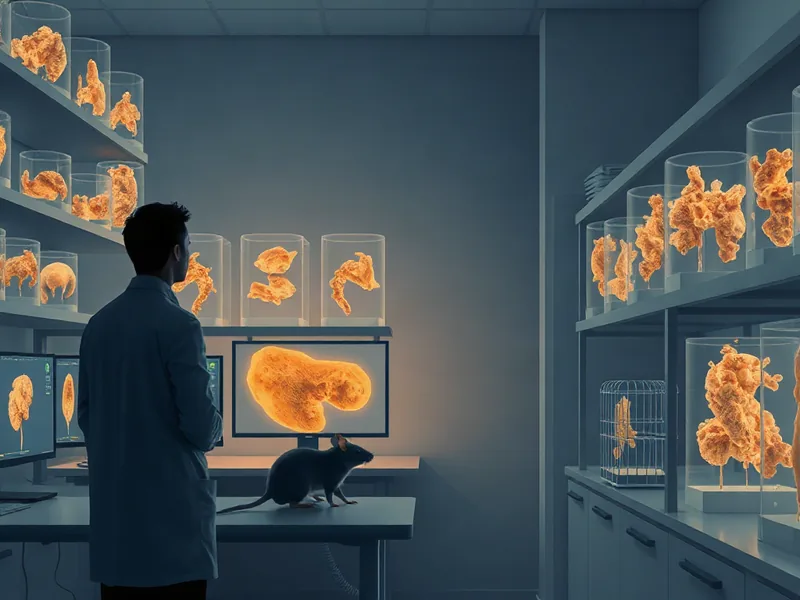
Each of these tools has a distinct advantage over traditional animal studies: they are built from, or modeled directly on, human biology. A mouse liver and a human liver share plenty of similarities, but they are not identical, and that gap has been blamed for drugs that looked safe in animals but caused serious harm in people, or conversely, promising treatments that were shelved because they failed in animals despite potential benefit for humans. Organs-on-a-chip and human cell assays aim to close that gap directly, rather than trying to extrapolate across species.
The public health stakes here are real, if a little abstract to those outside the drug-approval world. Faster, more human-relevant safety testing could mean treatments reach patients sooner. It could also mean fewer costly late-stage failures, when a drug that passed animal testing turns out to behave differently in human trials, a problem that has plagued the pharmaceutical industry for years and driven up the price tag of bringing new medicines to market.
There's also an ethical dimension that has animated public debate for decades. Animal testing has long been a flashpoint for bioethicists, animal welfare advocates, and increasingly, scientists who argue the practice is not just a moral compromise but a scientific limitation. The NIH's new investments and the FDA's rule change don't eliminate animal testing outright. Nothing in the rule bans it, and researchers can still use animal models when nonclinical alternatives aren't yet appropriate or validated. But the direction of travel is unmistakable.
This isn't the administration's first move in this arena this year. HHS has now announced two separate rounds of initiatives in 2026 aimed at reducing reliance on animal models, suggesting a sustained policy priority rather than a one-off gesture. That consistency matters. Regulatory shifts that arrive as isolated announcements often stall without follow-through funding or enforcement clarity. Pairing a rule change at the FDA with dollars for infrastructure at the NIH suggests officials are trying to build both the legal permission and the practical capacity for labs to actually make the switch.
Skeptics will rightly ask how quickly these new methods can scale, and whether they can reliably catch safety problems that animal studies have historically been good at flagging, such as certain types of organ toxicity or effects that only show up over a long exposure period. Alternative methods are advancing quickly, but they are not yet a wholesale replacement for every kind of safety question a drug developer needs answered. The $88 million in infrastructure funding is a signal that regulators recognize this gap and want to close it methodically, not by mandate alone.
For patients waiting on new treatments, and for the researchers and technicians who have long wrestled with the ethical weight of animal studies, this shift offers a glimpse of a different future for drug safety science. It's not an overnight transformation, and animal testing won't disappear from labs anytime soon. But when a federal agency changes the very language it uses to describe scientific evidence, it's rewriting the rules of what counts as proof. That kind of change tends to ripple outward slowly, then all at once, reshaping not just how drugs are tested, but how quickly, and how humanely, they might one day reach the people who need them.
Tags
Original Sources
HHS unveils new initiatives to reduce animal testing in drug development
↗ https://www.statnews.com/pharmalot/2026/09/22/hhs-initiatives-reduce-animal-testing-in-drug-development
About the author
Amara's entry point into AI was an epidemiology role at a London research hospital, where she spent five years studying how digital health tools reached — or conspicuously failed to reach — underserved communities. Watching early algorithmic systems in healthcare quietly entrench existing inequalities, she redirected her career toward the systemic consequences of AI at scale. She covers AI through an unflinching lens: who benefits, who bears the cost, and what evidence actually says versus what the press release claims. Her writing is calm and precise, but she doesn't mistake balance for neutrality.
More from The Steward →This Week's Edition
23 September 2026
29 articles
Related Articles

Epic's Mortality Model and the Widening Ambitions of Health Tech's Product Roadmaps
Health & Science · 5 min

Amgen's Dazodalibep Clears Key Sjögren's Hurdle, Setting Up Race With Novartis
Health & Science · 5 min

OpenEvidence Adds Memorial Sloan Kettering's Cancer Genomics Database to AI Platform Used by Over a Million Clinicians
Health & Science · 6 min
Related Articles
Epic's Mortality Model and the Widening Ambitions of Health Tech's Product Roadmaps
Health & Science · 5 min
Amgen's Dazodalibep Clears Key Sjögren's Hurdle, Setting Up Race With Novartis
Health & Science · 5 min
OpenEvidence Adds Memorial Sloan Kettering's Cancer Genomics Database to AI Platform Used by Over a Million Clinicians
Health & Science · 6 min
More Stories
© 2026 Cedar & Bloom. All rights reserved.
