The Drum · Weekly AI news, freeSubscribe →
Share
A pediatric cardiac intensivist explains how an AI-powered monitoring hub is designed to catch warning signs nurses and doctors might miss, as staffing shortages leave critically ill children more vulnerable than ever.
Picture a hospital ward full of the sickest children in the building, kids recovering from open-heart surgery, hooked to monitors that beep constantly, cared for by nurses who are stretched across five, six, sometimes seven beds at once. Now picture one of those children beginning to slip, quietly, subtly, three beds down from where the nursing team's attention is currently locked. That gap, the space between "vertical" care for one patient and the "horizontal" awareness needed for an entire unit, is where children can be lost.
Dr. Ricardo Munoz has spent two decades in pediatric cardiac intensive care units, from Columbia and Miami to Boston, Pittsburgh, Washington, D.C., and now South Texas. Writing for Driscoll Children's Hospital, he describes a problem that will sound familiar to anyone who has followed the ongoing crisis in American nursing: exceptional clinicians, spread too thin, working inside a system that structurally cannot watch every patient at once. Layer a national shortage of nurses and pediatric cardiac critical care specialists on top of that, and you get what Munoz calls "the perfect storm." Every second counts. The smallest change in a vital sign can spiral into a code blue before anyone at the bedside notices.
The question Munoz has spent years chasing is deceptively simple. What if clinicians could see trouble coming before it arrives? What if a computer could scan for the faint signals of deterioration across dozens of patients simultaneously, the kind of pattern a single overworked human eye might miss?
The answer, according to Munoz, is a centralized operations center he calls an "Intelligence Hub," something like an air traffic control tower for a cardiac ICU. Instead of one controller watching one plane, the Hub pulls in data from every bedside device across the unit: heart monitors, electronic medical records, imaging, even video feeds. That data streams to the cloud every five to ten seconds, where an algorithm flags abnormal trends before they become emergencies.
A dedicated team, nurses, cardiac intensivists, cardiologists, and neurologists, staffs the Hub around the clock. Their job isn't to replace the bedside team. It's to interpret what the algorithm surfaces and relay that "horizontal view" back to the floor through telemedicine carts, giving frontline clinicians a heads-up before a crisis fully unfolds. Munoz first built this system at a large academic urban hospital with what he describes as strong results, and he is now preparing to launch an updated version at Driscoll Children's Hospital in South Texas.
Think of it less like a replacement for the nursing staff and more like a second set of eyes that never blinks. A senior nurse sitting in the Hub can watch a junior nurse's patient in real time and step in with guidance before a small problem becomes a big one, essentially mentoring from a distance. That matters enormously in a field where experience often determines whether a subtle warning sign gets caught or missed.
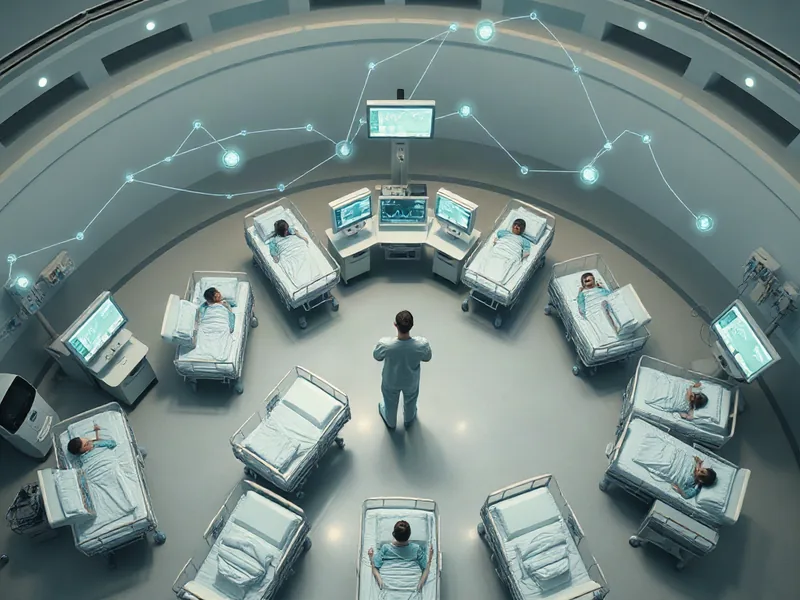
Munoz is careful, and rightly so, to frame this as augmentation rather than automation. Artificial intelligence in medicine tends to provoke anxiety, and understandably: patients and families want to know a human being, not an algorithm, is making decisions about their child's heart. Munoz insists the technology is built to amplify clinical judgment, not substitute for it. The compassion, the nuanced read of a frightened parent's question, the wisdom that comes from years at the bedside: none of that gets automated. What the Hub offers instead is bandwidth. It gives clinicians more information, sooner, so their expertise can be applied earlier in the course of a child's decline rather than after a crisis has already begun.
That distinction matters for a broader reason too. Reporting elsewhere in health policy this year has shown how uneven and rushed AI rollouts in medicine can go, including scrutiny of a federal pilot program using AI for Medicare prior authorization that critics say launched before the kinks were worked out. The lesson isn't that AI has no place in health care. It's that implementation matters just as much as innovation, and that clinical oversight has to remain built into the design from the start rather than bolted on afterward. Munoz's model, with its multidisciplinary human team sitting between the algorithm and the bedside, seems designed with that lesson already in mind.
There's also a regional context worth naming. Driscoll Children's Hospital serves South Texas, including families near the southern border who often face long drives, tight finances, and cultural barriers to accessing specialized pediatric cardiac care. For a family driving hours to reach a CICU, knowing that every bed is under continuous, AI-assisted surveillance, not just periodic nurse checks, offers a kind of reassurance that geography and income shouldn't have to buy.
Pediatric cardiac patients can deteriorate with startling speed. A child who looks stable in the morning can be crashing by afternoon, and the physiological cushion that adults have simply isn't there for a two-year-old recovering from heart surgery. Anything that shortens the gap between "something is wrong" and "someone noticed" has the potential to save lives, not through a leap in clinical treatment but through a leap in when clinicians see the problem coming.
That's ultimately the promise here: not a smarter doctor, but a faster warning system tied to the same doctors and nurses who already know how to act on it. Munoz frames the Hub as a "win-win," protecting patients while easing the load on a workforce already buckling under shortages. Whether that promise holds up at scale, particularly as the model expands beyond the first academic hospital where it was piloted, will depend on rigorous, transparent outcome data over time, not just anecdote.
Still, the underlying instinct feels right. In a system where nurses and doctors are being asked to do more with less, technology that extends their vision rather than replacing their judgment deserves a serious look. For the smallest, most fragile patients in any hospital, an extra ten seconds of warning can be the difference between a scare and a tragedy.
Tags
Original Sources
A new chapter in pediatric critical care: How AI is empowering us to protect our most vulnerable patients
↗ https://www.statnews.com/sponsor/2026/09/15/a-new-chapter-in-pediatric-critical-care-how-ai-is-empowering-us-to-protect-our-most-vulnerable-patients
About the author
Amara's entry point into AI was an epidemiology role at a London research hospital, where she spent five years studying how digital health tools reached — or conspicuously failed to reach — underserved communities. Watching early algorithmic systems in healthcare quietly entrench existing inequalities, she redirected her career toward the systemic consequences of AI at scale. She covers AI through an unflinching lens: who benefits, who bears the cost, and what evidence actually says versus what the press release claims. Her writing is calm and precise, but she doesn't mistake balance for neutrality.
More from The Steward →This Week's Edition
16 September 2026
31 articles
Related Articles
Related Articles
More Stories
© 2026 Cedar & Bloom. All rights reserved.