The Drum · Weekly AI news, freeSubscribe →

Share
A 20-year-old founder in Bengaluru wants aircraft to stay airborne for months by mimicking albatross flight. The physics checks out on paper, but real-world validation remains the open question for investors.
Solo investor Lachy Groom has put $2.5 million behind a bet that most venture investors would dismiss as science fiction: an aircraft that can stay in the sky for more than a year without refueling.
The company is Alteon, a Bengaluru-based startup founded by Samay Sanghvi, who is 20 years old. The pre-seed round was led by Groom, with participation from Together Fund. Sanghvi told TechCrunch that Groom decided he wanted to invest within the first 30 minutes of their first meeting. That kind of conviction, on an unproven technology, is worth unpacking.
The core idea borrows from nature. Albatrosses use a technique called dynamic soaring to extract energy from wind shear, gliding between air layers moving at different speeds to stay aloft for extended periods without flapping their wings. Alteon is trying to replicate that maneuver in a small, fixed-wing autonomous aircraft. The plan: a roughly 3-meter-wingspan drone flies close to the ocean surface, climbs and turns through faster-moving air, then repeats the cycle to harvest energy from the wind. Eventually, the company wants to run its propellers as turbines, converting harvested energy into electricity to recharge onboard batteries.
If it works, the applications are broad. Sanghvi's initial target is maritime surveillance, giving governments continuous, real-time visibility into their coastal waters without the cost of manned patrol aircraft or satellite constellations. "Once you build airplanes that can stay in the air for more than a year, there are millions of things you can do with them," he told TechCrunch.
Here is the problem: Alteon has not yet proven the core claim. The company has demonstrated autonomous flight control, not sustained energy harvesting.
In a recent test over the Bay of Bengal, Alteon's aircraft autonomously completed seven O-shaped cycles at more than 62 miles per hour, flying within 1 meter of the water's surface. That is a meaningful engineering milestone. It confirms the aircraft can execute the maneuver pattern required for dynamic soaring at low altitude, which is itself a nontrivial control problem.
What it does not confirm is the energy equation. Sanghvi calls the next milestone "energy-neutral dynamic soaring," the point at which the aircraft can fly continuously with propulsion switched off, extracting enough wind energy to remain airborne indefinitely. That has not happened yet.
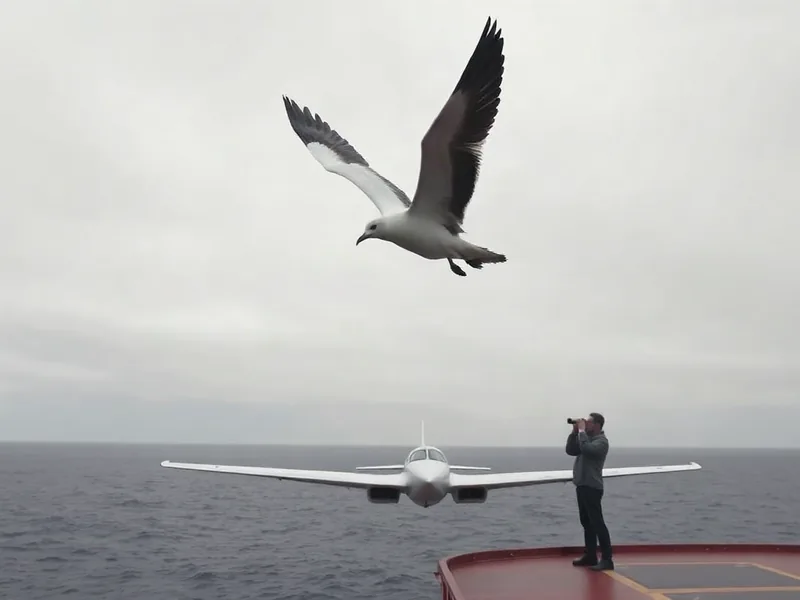
Independent experts are cautiously supportive but flag the difficulty ahead. Dr. Gabriel Bousquet, a Silicon Valley aerospace and robotics engineer who studied dynamic soaring during his PhD at MIT, called the low-altitude flight test a "promising first result." But he was clear that the harder challenge is proving the aircraft can reliably extract sufficient energy from real-world winds over extended periods. Flying that close to the ocean surface means contending with turbulence, waves, spray, rain, and shifting light conditions, all while continuously sensing and reacting to a moving surface. That is a materially harder engineering problem than a seven-cycle demonstration flight.
Dr. Bharath Swaminathan, who earned his PhD from IIT Madras studying the stability of dynamic soaring, offered a similar assessment. The underlying physics, he said, is well established, and Alteon's effort is commendable. Even keeping an aircraft aloft for several days using this technique would be "a very big step, and a big achievement." But large-scale wind patterns being predictable does not mean local wind shear and turbulence behave the same way. Swaminathan noted that variability at that scale could complicate continuous energy extraction, and some of these issues may only surface through further flight testing.
That gap between demonstrated capability and stated goal is the central risk in this deal. A year of continuous flight is the ambition. Seven O-shaped cycles at low altitude is the current proof point. The distance between those two things is where most of the capital, and most of the execution risk, will be spent.
Groom, for his part, does not dispute the risk. "Ambitious problems are always going to come with risks," he told TechCrunch. "For me, it came down to believing Samay and the Alteon team are the ones to figure them out." That is a bet on team execution over near-term technical validation, a pattern familiar to early-stage deep tech investing but one that carries real downside if the physics proves harder to industrialize than the lab math suggests.
Sanghvi's path to this point is unconventional. He began working on what became Alteon straight out of high school in 2023, teaching himself aircraft design by building, and crashing, radio-controlled models before moving to early prototypes. He formally founded the company in 2025, with early backing from Emergent Ventures and 1517. Alteon now runs a 20-person team out of a 10,000-square-foot facility in Bengaluru, building four to five aircraft a week for testing. The company has run more than 200 test flights in the past 30 days alone, a testing cadence that suggests real operational momentum, even if the headline milestone remains unmet.
The near-term signal to track is straightforward: does Alteon achieve energy-neutral dynamic soaring, even briefly? A demonstrated flight of days, not months, using only harvested wind energy would validate the physics in practice and materially de-risk the thesis. Absent that, the surveillance use case, government contracts for maritime monitoring, offers a pragmatic fallback business even if year-long flight remains aspirational.
The capital at risk here is modest by venture standards, $2.5 million at pre-seed. The technical claim is not modest at all. For investors watching the deep tech space, Alteon is a useful test case for how much conviction in a young founder and a strong testing cadence should substitute for proof of the core technical breakthrough. Groom's bet says quite a lot. The physics, according to independent researchers, says the jury is still out.
Tags
Original Sources
Lachy Groom backs Indian startup aiming to keep aircraft aloft for a year | TechCrunch
↗ https://techcrunch.com/2026/08/31/lachy-groom-backs-indian-startup-aiming-to-keep-aircraft-aloft-for-a-year
About the author
Marcus began tracking AI's market implications in 2016, noticing AI-related patent filings accelerating ahead of earnings upgrades before most of the sell-side had caught on. A former fixed-income quantitative analyst, he spent two decades building models that priced risk across emerging markets before pivoting to cover the economic impact of AI full-time. His writing translates opaque technical developments into clear risk/reward terms — and he's rarely diplomatic about the gap between AI valuations and underlying fundamentals. He believes most market participants still underestimate AI's long-run deflationary effect on knowledge work.
More from The Analyst →This Week's Edition
3 September 2026
29 articles
Related Articles
Related Articles
More Stories
© 2026 Cedar & Bloom. All rights reserved.