The Drum · Weekly AI news, freeSubscribe →

Share
Nearly 10,000 union members at Micron's Taiwan plants are ready to walk out, demanding a slice of record AI-driven profits. The standoff could ripple through the global chip supply chain.
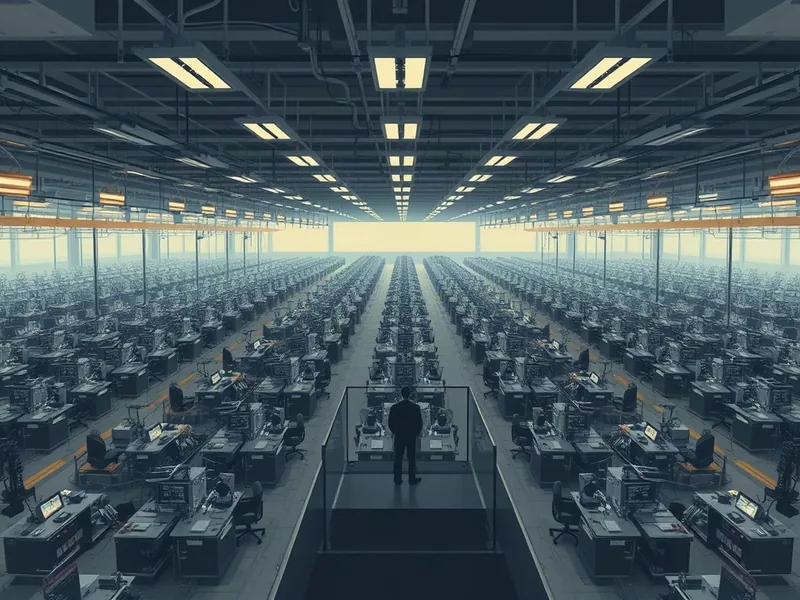
For the tens of thousands of people who keep Taiwan's chip factories running around the clock, the AI boom has meant longer hours, tighter production schedules, and record profits for the companies they work for. What it hasn't meant, according to labor unions at Micron Technology, is a fair share of that windfall.
Unions representing Micron workers in Taoyuan and Taichung said Tuesday they are moving toward a possible strike unless the U.S. memory-chip maker rewrites its bonus system. In a written statement to Reuters, the unions said they count nearly 10,000 members among Micron's roughly 15,000 employees across the two cities. That's not a fringe group grumbling in a break room. That's most of the workforce.
An internal survey conducted in August found that more than 80% of participating members backed strike action. When four out of five workers say they're willing to walk off the job, it's a signal that something in the pay structure feels broken, not just imperfect.
Micron's Taiwan office pushed back, telling Reuters that this year's performance-bonus payout would be the highest in company history. The company said it would keep talking with employees through existing channels while respecting legal processes. But "highest ever" is a relative measure, and the unions argue that Micron's payouts haven't kept pace with what rivals in South Korea are now offering their own workers.
Think of a bonus system like a thermostat. Workers want one that's calibrated to actual company profit, rising and falling in step with how much money Micron makes. The unions say the current system, known as the Incentive Pay Plan, doesn't work that way. It blends company and individual performance metrics, but the unions say Micron hasn't fully explained how the company-performance number is calculated. Their suspicion: it tracks revenue growth more closely than it tracks actual profit, which would mean workers see smaller gains even when the company's bottom line surges.
For fiscal 2026, the unions want a one-time bonus payment on top of existing pay, roughly equivalent to 83 months' salary per employee spread across the workforce, they say. Starting in fiscal 2027, they want the entire Incentive Pay Plan replaced with a formula that sets aside 15% of operating profit for bonuses, paid out quarterly instead of once a year. Quarterly payouts matter because they tie compensation more directly to the company's real-time performance rather than waiting a full year to see whether workers benefited from a good stretch.
Micron, for its part, says its pay structure already goes beyond a single bonus check. The company points to base salary, annual performance incentives, operational bonuses, and equity programs including stock-purchase and restricted-stock plans as parts of a broader compensation package. According to the unions, though, Micron has indicated it plans to keep this year's bonuses under the existing plan while pushing negotiations on the bigger changes down the road. Delay is its own kind of answer, and workers appear to be reading it that way.
The backdrop here is hard to ignore. Micron reported record revenue of $41.46 billion and net income of $28.24 billion for its fiscal third quarter, which ended May 28, as demand for memory chips used in AI hardware has tightened global supply and lifted profits across the sector. The company's market value sat at roughly $1.10 trillion on Tuesday, making Micron one of the most valuable chipmakers on earth. When a company crosses into trillion-dollar territory on the back of a product boom, it becomes harder to argue that there isn't more room at the table for the people building that product.
Taiwan is not a side note in this story. It's Micron's largest manufacturing base, and authorities in Taipei say the company has invested NT$1.4 trillion, or about $43.9 billion, on the island, producing DRAM and high-bandwidth memory chips there. A strike would land at the center of that operation, not on its periphery. The government-run Central Taiwan Science Park administration said last month it was closely monitoring the dispute and had assigned staff to help facilitate contact between Micron and the unions, warning that a stoppage could affect workers' livelihoods, Micron's operations, and potentially the broader semiconductor supply chain and economy. It said it could step in with negotiations or mediation if needed.
This isn't happening in isolation. It closely mirrors a standoff earlier this year at Samsung Electronics in South Korea, where a planned 18-day strike involving as many as 48,000 union members was called off in May after last-minute talks. That deal created a special bonus pool worth 10.5% of the chip division's operating profit, tied to profitability targets. Micron's Taiwanese unions say arrangements like that, along with similar profit-sharing at SK Hynix, have widened the gap between what Micron pays its Taiwan workforce and what South Korean chipmakers now offer theirs. In an industry where talent can move between countries and companies, that gap becomes a recruiting and retention problem, not just a fairness issue.
President Lai Ching-te weighed in Tuesday as well, saying Taiwan's semiconductor sector had been built through specialization and long-term cooperation, and that the island had consistently supplied the global market and honored its commitments. That kind of reassurance matters to global buyers watching Taiwan's labor climate closely, especially as the country works to reinforce its reputation as a reliable hub for chip production.
Workers powering one of the most profitable booms in modern industry are asking a simple question: when does the profit trickle down? The answer will shape not just Micron's labor relations, but how other chipmakers across Asia handle similar pressure as AI-driven demand keeps rewriting what "record profit" even means. For the people on the factory floor, that answer isn't abstract. It's the difference between sharing in a boom and simply building it for someone else.
Tags
Original Sources
Micron's Taiwan unions threaten strike over bonus dispute
↗ https://www.reuters.com/business/world-at-work/microns-taiwan-unions-threaten-strike-over-bonus-dispute-2026-09-01
About the author
Amara's entry point into AI was an epidemiology role at a London research hospital, where she spent five years studying how digital health tools reached — or conspicuously failed to reach — underserved communities. Watching early algorithmic systems in healthcare quietly entrench existing inequalities, she redirected her career toward the systemic consequences of AI at scale. She covers AI through an unflinching lens: who benefits, who bears the cost, and what evidence actually says versus what the press release claims. Her writing is calm and precise, but she doesn't mistake balance for neutrality.
More from The Steward →This Week's Edition
5 September 2026
29 articles
Related Articles

Ottawa Expands AI Funding for Northern Ontario Businesses, Aims to Close the Regional Tech Gap
Job Market & Society · 6 min

AI Is Lowering the Cost of Starting a Business. It's Not Lowering the Cost of Running One.
Job Market & Society · 6 min

Iambic Therapeutics Raises $150 Million in IPO to Fund AI-Designed Cancer Drugs
Finance & Markets · 5 min
Related Articles
Ottawa Expands AI Funding for Northern Ontario Businesses, Aims to Close the Regional Tech Gap
Job Market & Society · 6 min
AI Is Lowering the Cost of Starting a Business. It's Not Lowering the Cost of Running One.
Job Market & Society · 6 min
Iambic Therapeutics Raises $150 Million in IPO to Fund AI-Designed Cancer Drugs
Finance & Markets · 5 min
More Stories
© 2026 Cedar & Bloom. All rights reserved.
