The Drum · Weekly AI news, freeSubscribe →
Share
Researchers at the University of Toronto have uncovered a Rowhammer vulnerability in Nvidia’s RTX A6000 GPUs, marking the first time this type of attack has affected discrete graphics hardware and raising serious data integrity concerns.
Nvidia has issued a performance-degrading mitigation for its RTX A6000 GPU product line in response to a newly discovered Rowhammer vulnerability. This marks the first time a discrete GPU has fallen victim to this class of attack, which exploits physical weaknesses in DRAM chip modules to alter or corrupt data stored in memory.
Rowhammer attacks have traditionally been confined to CPU memory chips, but researchers at the University of Toronto have now demonstrated that GPUs are also susceptible. This is particularly concerning given the widespread use of Nvidia's RTX A6000 in high-performance computing (HPC) and cloud services. The vulnerability could allow hackers to sabotage critical workloads, compromise data integrity, and potentially cause broader security breaches.
Rowhammer attacks exploit the physical characteristics of DRAM by rapidly accessing-or "hammering"-specific rows of memory cells. This rapid access can induce bit flips in adjacent rows, where a digital zero is converted to a one or vice versa. Until now, such attacks have been limited to CPU memory chips used for general computing tasks.
However, the researchers' proof-of-concept exploit, dubbed GPUHammer, successfully demonstrated that Rowhammer can be applied to GPUs. They targeted Nvidia's RTX A6000, a popular choice for HPC and AI applications, including deep neural networks for autonomous driving, healthcare, and medical imaging.
The implications of this vulnerability are significant. In their demonstration, the researchers were able to flip a single bit in the exponent of a model weight used in machine learning tasks. This seemingly minor change can have catastrophic effects on model accuracy. For instance, flipping a single bit in y, where a floating point is represented as x times 2y, can increase the exponent value by 16. This results in an alteration of the model weight by a factor of 216, reducing accuracy from 80 percent to just 0.1 percent.
Gururaj Saileshwar, an assistant professor at the University of Toronto and co-author of the academic paper, described this effect as "inducing catastrophic brain damage in the model." The potential for such dramatic degradation in performance underscores the severity of the vulnerability.
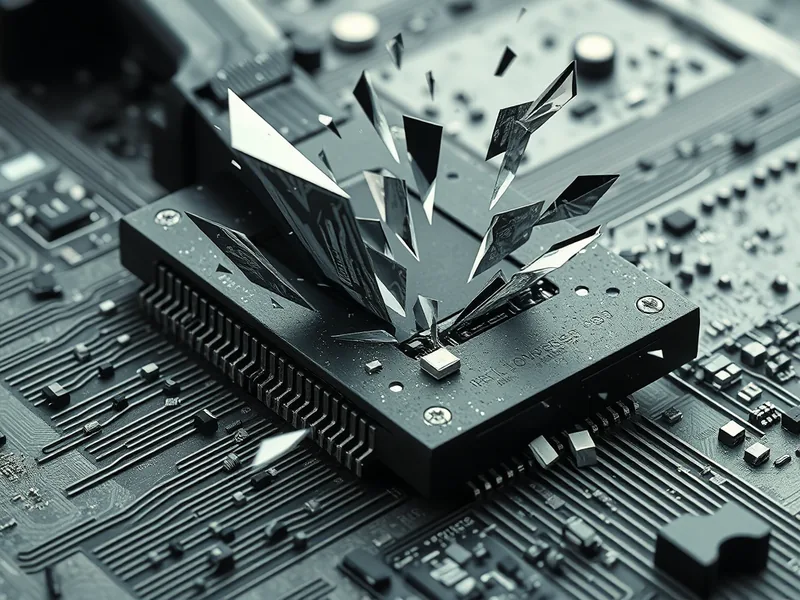
The primary risks associated with GPUHammer include:
While the vulnerability poses significant risks, it also presents an opportunity for Nvidia and the broader tech industry to enhance security measures. The discovery of GPUHammer highlights the need for more robust memory protection mechanisms and continuous monitoring for emerging threats.
Nvidia's response, while performance-degrading, demonstrates a commitment to user safety. However, there is room for innovation in developing less intrusive mitigation strategies that balance security with performance.
The emergence of Rowhammer attacks on GPUs marks a new frontier in cybersecurity. As Nvidia and other GPU manufacturers continue to innovate, it is crucial to prioritize security alongside performance. The potential risks to data integrity and system security are too significant to ignore, and proactive measures must be taken to mitigate these threats.
Tags
Original Sources
About the author
Marcus began tracking AI's market implications in 2016, noticing AI-related patent filings accelerating ahead of earnings upgrades before most of the sell-side had caught on. A former fixed-income quantitative analyst, he spent two decades building models that priced risk across emerging markets before pivoting to cover the economic impact of AI full-time. His writing translates opaque technical developments into clear risk/reward terms — and he's rarely diplomatic about the gap between AI valuations and underlying fundamentals. He believes most market participants still underestimate AI's long-run deflationary effect on knowledge work.
More from The Analyst →This Week's Edition
15 July 2025
29 articles
Related Articles
Seattle Children's Network Turns Data Trust Into Preventive Care Gains, With Lessons for Security Teams
Security & Risk · 6 min
Anthropic Gives Outside Safety Researchers the Same Access as Its Own Staff
Security & Risk · 5 min

Fitch Puts a Number on AI Risk: New Stress Test Flags Credit Exposure Across Four Sectors
Security & Risk · 5 min
Related Articles
Seattle Children's Network Turns Data Trust Into Preventive Care Gains, With Lessons for Security Teams
Security & Risk · 6 min
Anthropic Gives Outside Safety Researchers the Same Access as Its Own Staff
Security & Risk · 5 min
Fitch Puts a Number on AI Risk: New Stress Test Flags Credit Exposure Across Four Sectors
Security & Risk · 5 min
More Stories
© 2026 Cedar & Bloom. All rights reserved.
