The Drum · Weekly AI news, freeSubscribe →

Share
Despite intense competition, Nvidia continues to lead the machine learning market, but Intel's advancements are narrowing the gap. Investors should pay close attention to the evolving landscape.
Nvidia has once again demonstrated its leadership in the machine learning (ML) arena, according to the latest MLPerf benchmark results. The company's GPUs have consistently outperformed competitors, maintaining their position at the top of the industry. However, Intel is making significant strides and is rapidly closing the gap, which could have important implications for investors and the broader technology sector.
The dominance of Nvidia in machine learning is not just a matter of technical superiority; it has profound business implications. The company's GPUs are widely used in data centers, cloud computing, and various AI applications, driving significant revenue growth. In the latest quarter, Nvidia reported a 61% year-over-year increase in data center revenue, reaching $4.28 billion.
Intel's progress, however, should not be underestimated. The company has been investing heavily in its AI capabilities, particularly with its Xeon and upcoming Sapphire Rapids processors. Intel's advancements in hardware and software optimizations are starting to show results, as evidenced by their improved performance in the MLPerf benchmarks. This competition is likely to accelerate innovation and drive down costs for consumers and businesses alike.
The market dynamics between Nvidia and Intel also reflect broader trends in the semiconductor industry. As demand for AI and machine learning applications continues to grow, both companies are vying for a larger share of this lucrative market. The success or failure in this domain could determine their long-term strategic positions and financial performance.
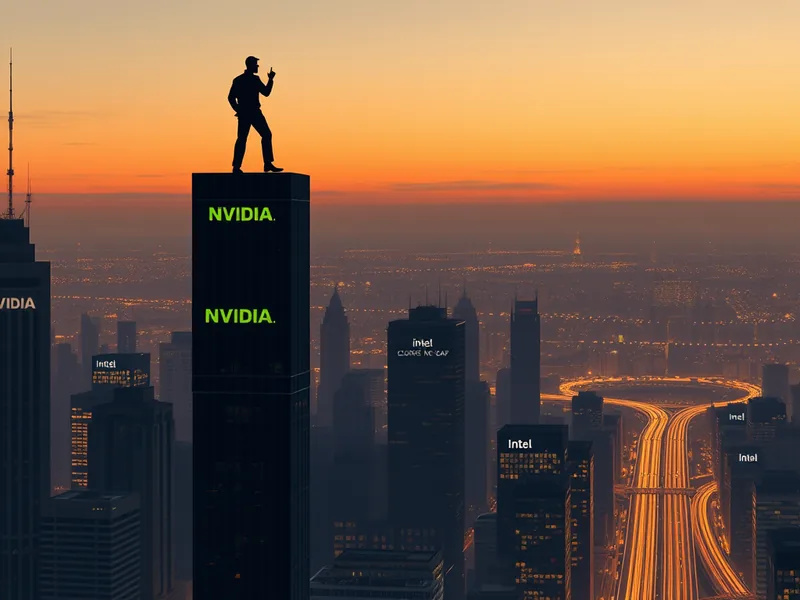
For investors, the ongoing competition between Nvidia and Intel presents both opportunities and risks. Nvidia's current leadership position is supported by its robust ecosystem and strong market presence, making it a relatively safe bet for those looking to capitalize on the AI boom. However, the company's valuation is already high, with a price-to-earnings (P/E) ratio of 45.7 as of the latest financial reports.
Intel, on the other hand, offers a more contrarian investment opportunity. While it lags behind Nvidia in the machine learning space, its broader portfolio and recent advancements suggest potential for significant gains if it can catch up. Intel's P/E ratio is currently lower at 12.8, indicating that the market may be undervaluing its AI capabilities.
Investors should also consider the broader ecosystem and partnerships each company has built. Nvidia's collaborations with cloud providers like AWS and Microsoft Azure have solidified its position in the data center market. Intel, meanwhile, is focusing on integrating AI into its existing product lines and forming strategic alliances to enhance its offerings.
While Nvidia remains the clear leader in machine learning, Intel's rapid progress should not be overlooked. Investors who are willing to take a long-term view may find value in both companies, depending on their risk tolerance and investment strategy. The evolving landscape of AI and machine learning will continue to shape the semiconductor industry, presenting opportunities for those who can navigate the complexities of this dynamic market.
Tags
Original Sources
Nvidia Still on Top
↗ https://spectrum.ieee.org/mlperf/nvidia-still-on-top
About the author
Marcus began tracking AI's market implications in 2016, noticing AI-related patent filings accelerating ahead of earnings upgrades before most of the sell-side had caught on. A former fixed-income quantitative analyst, he spent two decades building models that priced risk across emerging markets before pivoting to cover the economic impact of AI full-time. His writing translates opaque technical developments into clear risk/reward terms — and he's rarely diplomatic about the gap between AI valuations and underlying fundamentals. He believes most market participants still underestimate AI's long-run deflationary effect on knowledge work.
More from The Analyst →This Week's Edition
20 July 2026
29 articles
Related Articles
Related Articles
More Stories
© 2026 Cedar & Bloom. All rights reserved.