The Drum · Weekly AI news, freeSubscribe →
Share
As OpenAI prepares for its initial public offering, the company is making strategic hires to solidify its position in the competitive AI market. The additions include Noam Shazeer from Google DeepMind and Dean Ball, a former Trump administration AI policy official.
OpenAI, the leading artificial intelligence research lab, has taken significant steps to bolster its leadership team as it prepares for an initial public offering (IPO). In a strategic move, the company has recently welcomed Transformer co-inventor Noam Shazeer from Google DeepMind and Dean Ball, a former AI policy official under the Trump administration. These hires come at a crucial time when the AI market is facing increased scrutiny over valuations and demand.
The addition of these high-profile individuals signals OpenAI's commitment to maintaining its edge in the rapidly evolving AI landscape. Noam Shazeer, known for his groundbreaking work on the Transformer architecture, brings deep technical expertise that will be invaluable as OpenAI continues to innovate. Dean Ball, with his policy background, adds a layer of strategic insight into navigating regulatory and ethical challenges.
OpenAI's decision to bring in these experts is not just about strengthening its technical capabilities; it’s also about positioning the company for long-term success. The AI market has seen significant growth, but it has also faced questions over whether current valuations are sustainable. According to Interactive Brokers, a soaring stock price alone does not necessarily indicate a robust business model or earnings potential. OpenAI's IPO will be closely watched by investors and analysts who are eager to see if the company can deliver on its promises.
The timing of these hires is particularly significant as the market for AI stocks remains strong despite rising interest rates and valuation concerns. CNBC reports that demand for AI technologies continues to grow, driven by applications in various sectors such as healthcare, finance, and automotive. However, investors are becoming more discerning, looking beyond hype to identify companies with solid fundamentals.
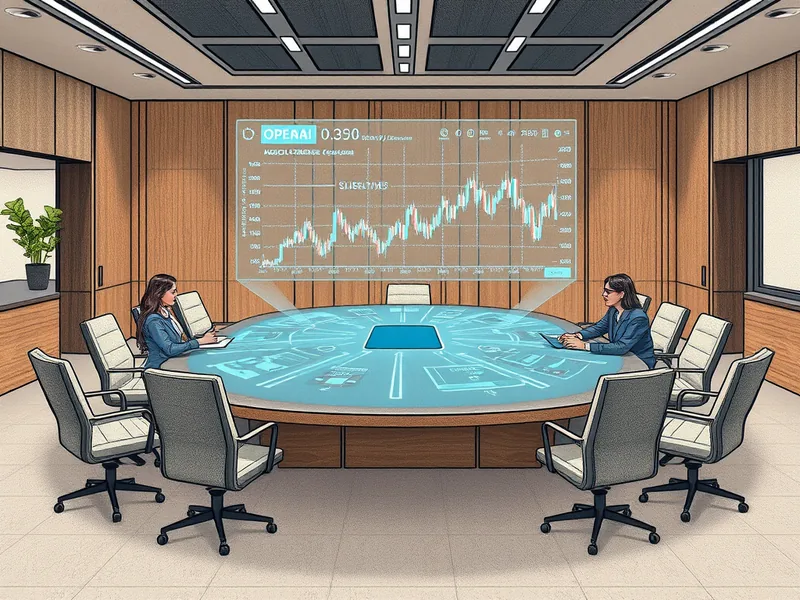
For potential investors, OpenAI's strategic hires offer several key takeaways. First, the company is demonstrating a proactive approach to building a well-rounded leadership team that can navigate both technical and regulatory challenges. This could be crucial in maintaining investor confidence as the market becomes more selective about which AI stocks to back.
Second, the addition of Noam Shazeer underscores OpenAI's commitment to innovation. The Transformer architecture has been pivotal in advancing natural language processing (NLP) and other AI applications. By bringing Shazeer on board, OpenAI is reinforcing its position as a leader in cutting-edge AI research and development.
Finally, Dean Ball’s policy expertise will be instrumental in addressing the growing regulatory landscape. As governments around the world begin to implement stricter guidelines for AI, companies that can effectively manage these challenges will have a competitive advantage. Ball's background will help OpenAI stay ahead of potential regulatory hurdles and ensure compliance with emerging standards.
OpenAI's strategic hires are a clear indication of its readiness to meet the demands of both the market and investors. As the company prepares for its IPO, these additions provide a strong foundation for sustained growth and innovation in the highly competitive AI sector.
Tags
Original Sources
OpenAI is bringing on some big guns in the lead-up to its IPO | TechCrunch
↗ https://techcrunch.com/2026/06/18/openai-is-bringing-on-some-big-guns-in-the-lead-up-to-its-ipo
About the author
Marcus began tracking AI's market implications in 2016, noticing AI-related patent filings accelerating ahead of earnings upgrades before most of the sell-side had caught on. A former fixed-income quantitative analyst, he spent two decades building models that priced risk across emerging markets before pivoting to cover the economic impact of AI full-time. His writing translates opaque technical developments into clear risk/reward terms — and he's rarely diplomatic about the gap between AI valuations and underlying fundamentals. He believes most market participants still underestimate AI's long-run deflationary effect on knowledge work.
More from The Analyst →This Week's Edition
29 June 2026
29 articles
Related Articles

Oura Prices IPO at Up to $15.6 Billion Valuation, Betting on AI-Driven Preventive Health
Finance & Markets · 5 min
Digital Health Funding Stays Robust as Capital Concentrates in AI-Native Platforms
Finance & Markets · 5 min
Anthropic's Claude Opus 5.5 Ships as Five Models in One, Tuning Intelligence Against Cost
Models & Research · 5 min
Related Articles
Oura Prices IPO at Up to $15.6 Billion Valuation, Betting on AI-Driven Preventive Health
Finance & Markets · 5 min
Digital Health Funding Stays Robust as Capital Concentrates in AI-Native Platforms
Finance & Markets · 5 min
Anthropic's Claude Opus 5.5 Ships as Five Models in One, Tuning Intelligence Against Cost
Models & Research · 5 min
More Stories
© 2026 Cedar & Bloom. All rights reserved.
