The Drum · Weekly AI news, freeSubscribe →
Share
A year of jaw-dropping AI results in mathematics has repeatedly collided with messy rollouts, unhappy researchers, and unresolved questions about credit, process, and whether the field can keep pace with the output.
OpenAI has spent 2024 and 2025 racking up results that would have been unthinkable for a language model a few years ago: solved open problems across number theory, group theory, and dynamics, a Millennium Prize problem, and now entries in computer science and physics too. Technically, this is a big deal. Practically, the rollout has been a mess, and the mathematics community is getting tired of it.
The pattern is consistent enough to set your watch by. OpenAI announces a result or a batch of results. Mathematicians scramble to verify them. Someone raises a procedural or ethical concern, usually around attribution, training data provenance, or the sheer scale of what just got dumped on the field. OpenAI apologizes, adjusts, and promises to do better. Then it happens again.
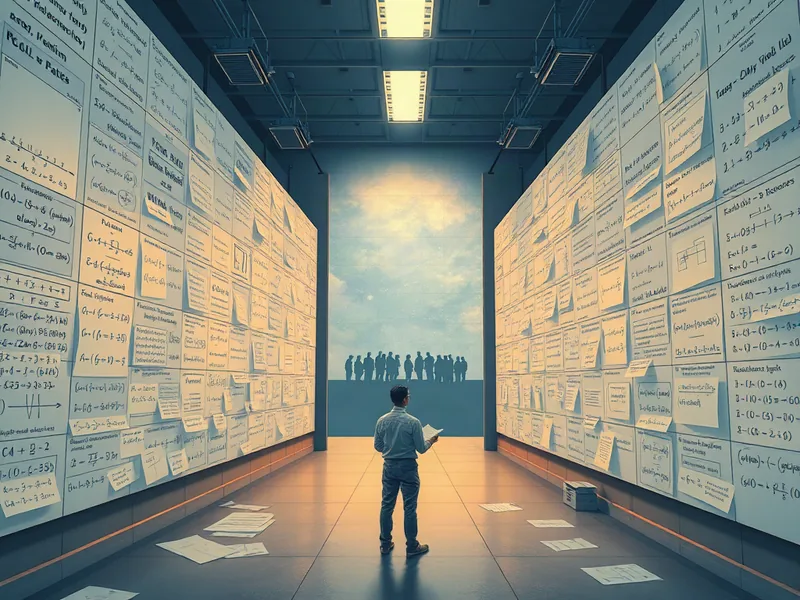
The most recent instance came this week, when OpenAI announced breakthroughs in math, computer science, and physics, this time with what it's calling expert "shepherds" guiding how the results get communicated. On paper, that's a direct response to the fallout from early October, when the company released 722 manuscripts covering 372 "result families" with almost no warning, a dump so large that researchers told The Verge it could take years just to understand what was in it.
The scale of the October release is worth sitting with. OpenAI said the papers came from an unreleased frontier model and that the "average result" consumed roughly three hours of ChatGPT Pro-equivalent compute. The company claimed the model had resolved more than 100 long-standing open problems across most areas of mathematics. That's not a cherry-picked headline result, like the single proof or two labs have trumpeted in the past. It's an assembly line.
Here's where the technical story turns into a governance story, and where it gets genuinely interesting for anyone tracking how AI labs interact with expert communities.
For the math result in this week's announcement, OpenAI said its shepherds advised against gatekeeping access and instead recommended releasing the raw AI output for the broader research community to work through on its own. For the computer science and physics results, OpenAI opted for a more curated approach, with external experts guiding the presentation before publication.
That split matters, because it's essentially OpenAI running two different governance experiments in parallel and seeing which one draws less backlash. And the backlash arrived almost immediately. AGMAI, the independent panel of elite mathematicians OpenAI itself helped assemble in September to advise on exactly these kinds of releases, published guidance just a day before this week's announcement explicitly recommending against designating certain people or groups to receive results first. Their stated concerns: unequal access, "borrowed reputation" for the chosen reviewers, and selection bias in who gets to be the first voice on a result.
Instead, AGMAI's recommendation is a more standardized, low-ceremony pipeline:
That last point is already partially happening. On October 15th, OpenAI committed $5 million to a $15 million initiative led by the Simons Foundation, with Anthropic also contributing, specifically to help mathematicians make sense of AI-generated research. It's a tacit admission that generating proofs faster than anyone can verify them isn't actually progress, it's just debt with better PR.
The deeper issue, though, predates any of this year's specific dumps. Back in September, mathematician Andreas Thom raised a pointed question on Mastodon: did ChatGPT's interactions with him and colleagues on "non-sofic groups" before OpenAI's announcement actually feed into the model's eventual success on that exact problem? OpenAI had already acknowledged the result built heavily on prior work by Thom and Gábor Kun. Thom's accusation went further, alleging a lack of transparency about training data origins that, if true, would complicate any clean narrative of a model reasoning its way to a novel proof from first principles.
And then there's the September episode that crystallized the community's unease: OpenAI's claimed resolution of a Millennium Prize problem, announced in circumstances OpenAI itself admitted were "complicated" by the fact that the company had pursued the specific problem after hearing other researchers discuss it. For a one-million-dollar class of unsolved problems that has historically rewarded years, sometimes decades, of dedicated human effort, that's a sensitive origin story.
The framing that's emerged from mathematicians interviewed across these episodes is consistent: this isn't really about whether the proofs are correct. It's about motive and method. As one mathematician put it to The Verge back in September, mathematicians want to advance the field; OpenAI wants to win. Those aren't always the same objective, and the tooling and norms built around the former don't automatically transfer to the latter.
Tags
Original Sources
All the drama around AI’s takeover of mathematics
↗ https://www.theverge.com/ai-artificial-intelligence/1004933/ai-math-openai-breakthrough-solution
About the author
Kai built ML infrastructure at a Bay Area startup before developing an obsession with transformer architectures and inference optimisation that eventually pulled him out of product work entirely. A stint at a compute research lab sharpened his instinct for what actually matters in a model release versus what is marketing. He writes from the inside — from the perspective of someone who has debugged the systems he is describing at three in the morning. He is allergic to hype and instinctively drawn to the unglamorous plumbing questions that everyone else skips over.
More from The Engineer →This Week's Edition
28 October 2026
30 articles
Related Articles

Google's Genie 4 world model adds audio, longer scenes, and real-time editing
Models & Research · 5 min

OpenAI and Anthropic Models Claim to Refute a Foundational Complexity Theory Assumption
Models & Research · 5 min
OpenAI Picks "Shepherds" to Vet Its Latest Math, Physics, and CS Claims, and Researchers Aren't Thrilled
Models & Research · 6 min
Related Articles
Google's Genie 4 world model adds audio, longer scenes, and real-time editing
Models & Research · 5 min
OpenAI and Anthropic Models Claim to Refute a Foundational Complexity Theory Assumption
Models & Research · 5 min
OpenAI Picks "Shepherds" to Vet Its Latest Math, Physics, and CS Claims, and Researchers Aren't Thrilled
Models & Research · 6 min
More Stories
© 2026 Cedar & Bloom. All rights reserved.
