The Drum · Weekly AI news, freeSubscribe →
Share
A new grant from Stanford HAI aims to revolutionize medical education by creating a comprehensive, annotated database of point-of-care ultrasound images, providing real-time feedback to trainees.
The field of medical education is about to get a significant boost thanks to a seed research grant from the Stanford Institute for Human-Centered Artificial Intelligence (Stanford HAI). The project, co-funded with the Stanford Center for Digital Health, focuses on improving training for point-of-care ultrasound (POCUS) using AI-enhanced datasets. POCUS allows clinicians to perform real-time assessments at the patient's bedside, but current training methods are often inconsistent and resource-intensive.
The primary investigator, Dr. Andre Kumar from the School of Medicine’s Department of Hospital Medicine, aims to create a first-of-its-kind database that will address these challenges. The project will collect and annotate 7,500 ultrasound clips covering heart, lung, and abdominal imaging-three of the most common clinical applications of POCUS. Unlike existing datasets that focus primarily on disease detection, this new database will include dual annotations: one for measuring the quality of image acquisition and another for identifying potential pathology.
The unique aspect of this project lies in its dual annotation approach. Each ultrasound clip will be annotated not only to identify potential pathologies but also to assess the quality of the acquisition. This means that common errors in technique, such as improper probe placement or insufficient gel application, will be flagged. By doing so, the dataset can serve as a training tool that simulates expert faculty guidance, providing real-time, personalized feedback to learners.
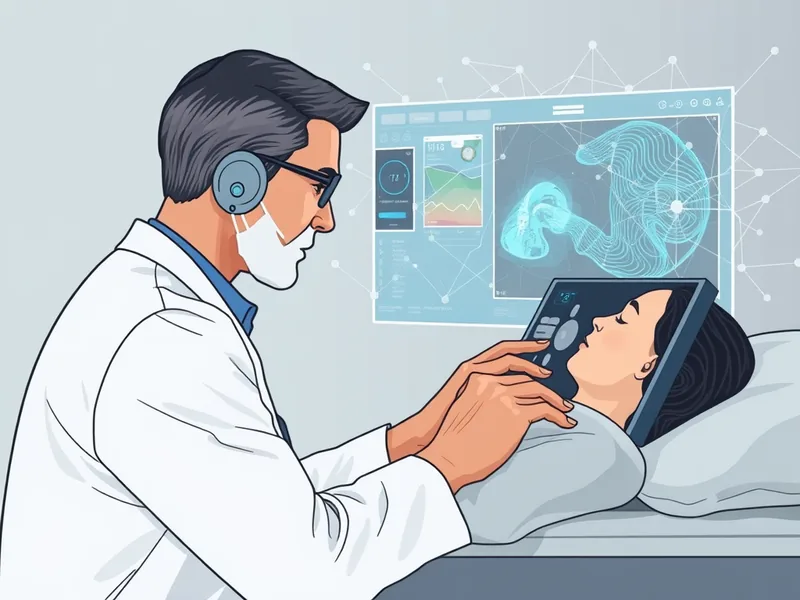
This dual annotation approach is crucial because it addresses a significant gap in current POCUS training. Many medical students and residents learn with minimal supervision, which can compromise patient care. By providing immediate feedback on both the quality of the image and any potential issues, the AI system will help trainees improve their skills more effectively.
The implications of this project extend beyond just improving POCUS training. The publicly released database has the potential to accelerate medical education research globally. Future applications could include educational dashboards that track trainee progress and provide personalized learning paths. These tools could transform how ultrasound is taught, ensuring that AI augments rather than replaces human clinical judgment.
Dr. Kumar’s project also addresses broader issues in the field of learning sciences. Historically, there has been a significant gap between research and practice, making it challenging for practitioners to obtain actionable evidence for instructional methods that apply to their unique contexts. By creating a robust, annotated dataset, this project could help bridge that gap, providing a foundation for more rigorous testing of instructional methods.
The Fall 2026 cohort for Stanford HAI and the Stanford d.school’s Human-Centered AI for Social Impact program will further contribute to these efforts by fostering interdisciplinary collaboration and innovation in AI applications. With initiatives like Dr. Kumar's POCUS project, the future of medical education looks promising, as AI continues to play a crucial role in enhancing both teaching and patient care.
Tags
Original Sources
Seed Research Grants | Stanford HAI
↗ https://hai.stanford.edu/research/grant-programs/seed-research-grants?section=2025-recipients
About the author
Kai built ML infrastructure at a Bay Area startup before developing an obsession with transformer architectures and inference optimisation that eventually pulled him out of product work entirely. A stint at a compute research lab sharpened his instinct for what actually matters in a model release versus what is marketing. He writes from the inside — from the perspective of someone who has debugged the systems he is describing at three in the morning. He is allergic to hype and instinctively drawn to the unglamorous plumbing questions that everyone else skips over.
More from The Engineer →This Week's Edition
24 August 2026
25 articles
Related Articles
Stanford Convenes Researchers to Rethink Empirical Methods for the AI Era
Models & Research · 5 min

A Stochastic Parrots Author Clarifies: The Paper Was About LLMs, Not All of AI
Models & Research · 5 min

DARPA's RSGS Program Aims to Put a Repair Robot in Geosynchronous Orbit
Products & Applications · 5 min
Related Articles
Stanford Convenes Researchers to Rethink Empirical Methods for the AI Era
Models & Research · 5 min
A Stochastic Parrots Author Clarifies: The Paper Was About LLMs, Not All of AI
Models & Research · 5 min
DARPA's RSGS Program Aims to Put a Repair Robot in Geosynchronous Orbit
Products & Applications · 5 min
More Stories
© 2026 Cedar & Bloom. All rights reserved.
