The Drum · Weekly AI news, freeSubscribe →
Share
Five new Stanford research teams are using artificial intelligence to decode brain signals, from depression biotypes to the neuroscience of smell, in a push toward more personalized, less trial-and-error medicine.
If you've ever watched a loved one cycle through antidepressant after antidepressant, hoping something finally sticks, you already understand the core problem this research is trying to solve. Depression isn't one disease. It's a collection of overlapping conditions that happen to share a name and a diagnostic checklist, which is part of why treatment so often feels like guesswork.
Stanford's Institute for Human-Centered Artificial Intelligence, working with the Wu Tsai Neurosciences Institute, has selected five projects for its 2026 partnership grants. Each pairs AI researchers with neuroscientists and clinicians, and together they're chasing a shared goal: using artificial intelligence not to replace human judgment in medicine, but to finally give psychiatry and neuroscience the kind of precise, biological tools that other fields of medicine have had for decades.
Take the lead project, led by Cammie Rolle of Psychiatry and Behavioral Sciences and Ellen Kuhl of Mechanical Engineering. Researchers already know that brain scans, specifically functional MRI, can sort depression into biological "biotypes" that predict which treatments are likely to work for a given patient. Think of it like knowing someone's blood type before a transfusion, rather than discovering compatibility through trial and error. The trouble is that a cheaper, more portable technology, EEG, which measures electrical activity through sensors on the scalp, has developed its own separate system for identifying biotypes. Nobody knows if the two methods are describing the same underlying biology or picking up on entirely different things.
Using a rare dataset collected at Stanford that pairs EEG, MRI, fMRI, and real clinical outcomes, Rolle and Kuhl's team will test whether EEG can reliably stand in for fMRI at the individual patient level. If it can, that matters enormously, because EEG machines are far cheaper and more widely available than MRI scanners. The team also wants to know whether combining both types of brain data produces more stable, clinically useful categories than either one alone, and whether those categories can predict who will respond to brain stimulation therapy.
A second project, led by Corey Keller and Manish Saggar, both in Psychiatry and Behavioral Sciences, tackles a gap that might surprise people outside the field: we know almost nothing about what actually happens in the brain during talk therapy. Millions of people benefit from it every year, yet researchers have never had a detailed, real-time map of brain activity while a therapy session is actually happening.
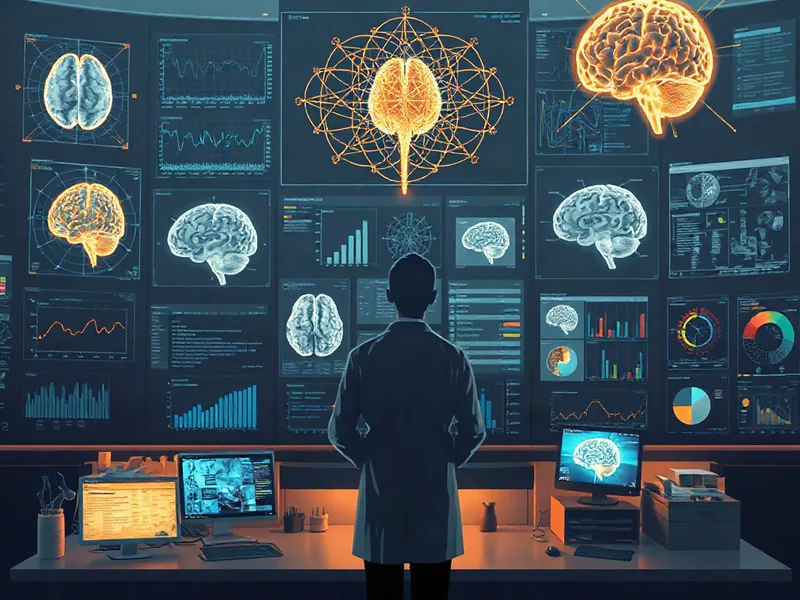
This team found an unusual opportunity. Some epilepsy patients have electrodes temporarily implanted in their brains to monitor seizures, and a subset of these patients also have depression. While these patients receive therapy during their hospital stay, researchers will record brain activity with millisecond precision, a level of detail impossible to get from outside the skull. They'll then use AI language models to analyze the therapy conversations themselves, flagging which techniques therapists use and what symptoms come up, and pair that with a mathematical method called topological data analysis to detect patterns in brain activity that would otherwise stay invisible. The hope is to eventually predict, from early brain signals, who is likely to improve.
A related project led by Todd Coleman in Bioengineering and Emily Fox in Statistics and Computer Science explores something more sensory: smell. AI can already predict how a molecule will smell to the average person based on its chemical structure. But smell is deeply personal. The scent of vanilla might call up a childhood memory for one person and nothing at all for another. Using brain recordings from epilepsy patients, again taking advantage of implanted electrodes placed for medical reasons, this team will study what happens in the brain when people smell something and describe what it evokes, whether that's a single word or a vivid memory. Combining those brain signals with AI language models could reveal how the brain links raw sensation to personal meaning, and whether AI systems can learn to do something similar.
Two more projects push into different territory entirely. Marius Wernig of Pathology and Anshul Kundaje of Genetics and Computer Science are trying to crack the genetic "rulebook" that tells a developing brain cell which of thousands of neuron types to become. By systematically switching regulatory genes on and off in human cells and training AI models on the results, alongside large public databases of brain cell types, they hope to predict which combinations of proteins are needed to reliably produce specific neurons in the lab. That could be a meaningful step toward cell-based therapies for neurological disease, since many clinically important neuron types are currently very hard to produce on demand.
The fifth project, led by Cameron Ellis, Michael Frank, and Dan Yamins, all in Psychology, with Yamins also in Computer Science, looks at how infants learn to see the world with so little data compared to modern AI systems. Infants don't encounter a random sample of faces and scenes. They mostly see the same small circle of caregivers, again and again, yet somehow generalize to recognize entirely new people later on. Using a rich longitudinal dataset that includes one infant's actual experiences, brain responses, and visual development over time, the team will train an AI model guided by that infant's brain activity. The payoff could go both ways: a better understanding of how human learning works, and possibly a blueprint for building AI systems that need far less data, and therefore carry a lighter environmental and ethical cost.
What ties these five projects together isn't just AI or neuroscience alone. It's the conviction that mental health care, cell therapy, and even our understanding of human development have been stuck using blunt instruments for too long. Psychiatry in particular has long lacked the kind of precise diagnostic tools that guide treatment in cardiology or oncology. If this research delivers even partial answers, patients could eventually get treatments matched to their actual biology rather than their symptoms alone. That shift, from trial-and-error to something closer to precision medicine, carries real stakes for the hundreds of millions of people living with depression and other brain-based conditions worldwide.
Tags
Original Sources
HAI and Wu Tsai Neuro Partnership Grant | Stanford HAI
↗ https://hai.stanford.edu/research/grant-programs/hai-and-wu-tsai-neuro-partnership-grant?section=2026-grant-recipients
About the author
Amara's entry point into AI was an epidemiology role at a London research hospital, where she spent five years studying how digital health tools reached — or conspicuously failed to reach — underserved communities. Watching early algorithmic systems in healthcare quietly entrench existing inequalities, she redirected her career toward the systemic consequences of AI at scale. She covers AI through an unflinching lens: who benefits, who bears the cost, and what evidence actually says versus what the press release claims. Her writing is calm and precise, but she doesn't mistake balance for neutrality.
More from The Steward →This Week's Edition
20 November 2026
29 articles
Related Articles
Merck Taps Isomorphic Labs for AI-Designed Oncology Drug in Latest Pharma-AI Tie-Up
Health & Science · 5 min
FDA Approves First Drug to Treat Brain Symptoms of Type 3 Gaucher Disease
Health & Science · 6 min

National Academies Report Calls for Faster, Tougher Retraction Standards
Models & Research · 5 min
Related Articles
Merck Taps Isomorphic Labs for AI-Designed Oncology Drug in Latest Pharma-AI Tie-Up
Health & Science · 5 min
FDA Approves First Drug to Treat Brain Symptoms of Type 3 Gaucher Disease
Health & Science · 6 min
National Academies Report Calls for Faster, Tougher Retraction Standards
Models & Research · 5 min
More Stories
© 2026 Cedar & Bloom. All rights reserved.
