The Drum · Weekly AI news, freeSubscribe →

Share
The AI infrastructure buildout is generating demand in unexpected corners of the economy, from steel-toe boots to construction payrolls, revealing how capital spending on data centers is translating into real, measurable labor market activity.
The AI trade has a new indicator, and it doesn't trade on Nasdaq. It's sold in nearly 600 stores across the country, mostly to people who will never write a line of code.
Boot Barn, the western-wear retailer, told investors this week that a growing share of its bulk workwear orders now trace back to data-center construction. CEO John Hazen made the disclosure at the Goldman Sachs Global Consumer and Retail Conference in New York on Tuesday. The company has long supplied oil and gas firms and construction outfits looking to kit out entire crews at once. Increasingly, those bulk orders are coming from a different kind of buyer.
"More and more often, those are data centers," Hazen said.
That's a notable admission from a company whose brand identity is built around cowboy boots, not compute. It's also a useful data point for anyone trying to size the real-economy footprint of the AI spending wave. Boot Barn has posted comparable sales growth in its work-boot segment for five straight quarters. The company didn't respond to a request for revenue figures tied specifically to data-center demand, so investors are left triangulating from commentary rather than hard numbers. Still, the signal is directionally clear.
Boot Barn isn't alone in seeing this. Brunt Workwear, a smaller apparel maker, told Reuters its strongest demand is coming from California and Texas, two states drawing some of the largest AI infrastructure investment in the country. CEO Eric Girouard said the company is "pushing hard" to keep pace with orders tied to data-center builds. Two independent workwear suppliers, in two different regions, pointing to the same driver. That's not proof of a trend, but it's more than anecdote.
The labor market data backs up the retail anecdotes. U.S. construction employment rose in August, with the sector adding 22,000 jobs, according to the Labor Department's nonfarm payrolls report. That's not a blockbuster number in isolation, but it comes at a time when broader hiring has been uneven. Data-center construction has become one of the more reliable pockets of labor demand in an otherwise choppy jobs picture.
This matters for a simple reason: it extends the AI investment story beyond chipmakers and hyperscalers into industries most portfolio managers don't screen for AI exposure. Nvidia and the cloud giants get the headlines. Boot Barn does not typically appear in anyone's AI thematic basket. But if data-center buildouts are driving five consecutive quarters of comp growth in a specific product category, that's a real economic signal, not a marketing anecdote.
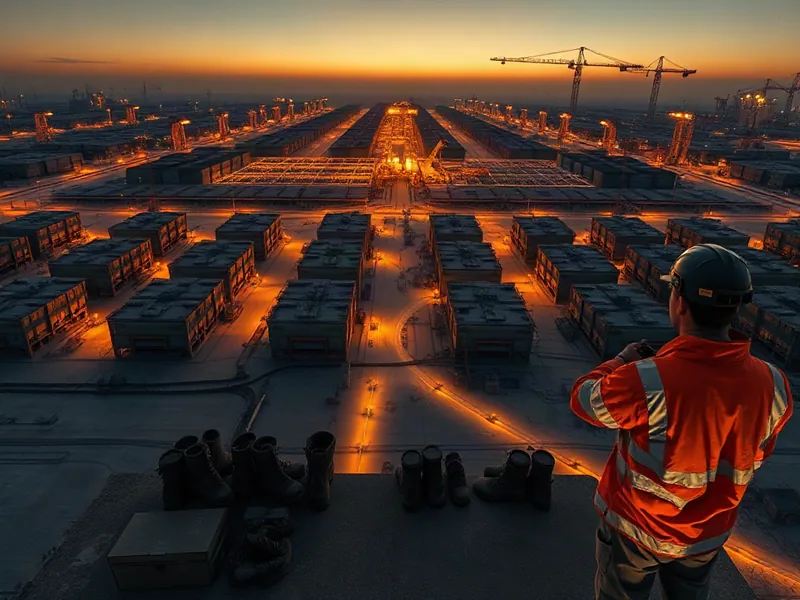
There's a practical dimension too. Boot Barn now tracks the progress of nearby data-center projects to decide what to stock in local stores. Early-stage construction, clearing dirt and grading land, calls for regular work boots. Once crews start "building the four walls," as Hazen put it, demand shifts to steel-toe boots required for structural work. That's granular, project-level intelligence feeding into inventory decisions at a retail chain. It's a small but telling example of how deeply the AI capital expenditure cycle has embedded itself into ordinary commercial planning.
The scale of the buildout is the real story here. Hyperscalers have committed hundreds of billions of dollars to data-center capacity, and Microsoft alone has pledged an additional $4 billion for a Wisconsin campus, on top of prior commitments, bringing that project's total to roughly $7 billion. Money at that scale doesn't stay contained to server racks and cooling systems. It flows into concrete, steel, skilled trades, and yes, work boots.
Key risks accompany this story, and they're worth stating plainly. Some AI executives have recently urged caution about the pace of development, a notable shift in tone from an industry that has spent years talking up acceleration rather than restraint. Communities near proposed data centers are pushing back against the energy and water demands these facilities impose, and that friction could slow permitting and construction timelines in ways that ripple back to suppliers like Boot Barn and Brunt Workwear. New York's recent proposal to require $1 million per megawatt in community investment for data centers is one concrete sign of that pushback translating into policy. If local opposition or regulatory friction slows the buildout, the derivative demand for workwear, and the construction jobs behind it, slows with it.
There's also a data quality problem for investors trying to size this trade. Boot Barn didn't provide specific revenue figures tied to data-center demand, and that gap makes it hard to quantify how large this piece of the business actually is relative to its legacy customer base in energy and general construction. Anecdotal CEO commentary at an investor conference is directional, not definitive. Investors should treat this as a leading indicator worth monitoring, not a fully quantified thesis.
The AI infrastructure boom is proving to be a broader economic event than the narrow universe of semiconductor and hyperscaler stocks suggests. Construction payrolls, workwear orders, and regional demand patterns in Texas and California all point to a capital expenditure cycle with real spillover into blue-collar labor markets. Boot Barn's five quarters of comp growth in work boots, alongside the 22,000 construction jobs added in August, offer tangible, if partial, evidence of that spillover.
For investors, the takeaway isn't that Boot Barn is now an AI stock. It's that the AI capex cycle has grown large enough to show up in unexpected places, and tracking those secondary indicators, construction employment data, regional workwear demand, community pushback over energy and water use, may offer a more grounded read on the durability of the AI buildout than sentiment around any single chipmaker's earnings call. Watch construction employment figures and local zoning battles over data centers closely. They may say more about the health of this cycle than the next round of AI hype.
Tags
Original Sources
The AI gold rush has a dress code: steel-toe boots
↗ https://www.reuters.com/business/retail-consumer/ai-gold-rush-has-dress-code-steel-toe-boots-2026-09-15
About the author
Marcus began tracking AI's market implications in 2016, noticing AI-related patent filings accelerating ahead of earnings upgrades before most of the sell-side had caught on. A former fixed-income quantitative analyst, he spent two decades building models that priced risk across emerging markets before pivoting to cover the economic impact of AI full-time. His writing translates opaque technical developments into clear risk/reward terms — and he's rarely diplomatic about the gap between AI valuations and underlying fundamentals. He believes most market participants still underestimate AI's long-run deflationary effect on knowledge work.
More from The Analyst →This Week's Edition
16 September 2026
31 articles
Related Articles

HCA Healthcare Closes Acquisition of Texas Nursing College, Deepening Vertical Play on Labor Supply
Job Market & Society · 5 min

AI Now Writes Half of Code for 42% of Developers, But Saved Hours Go to Review, Not Rest
Job Market & Society · 6 min

Most Voters Now Oppose AI Data Centers, and Both Parties Are Listening
Job Market & Society · 5 min
Related Articles
HCA Healthcare Closes Acquisition of Texas Nursing College, Deepening Vertical Play on Labor Supply
Job Market & Society · 5 min
AI Now Writes Half of Code for 42% of Developers, But Saved Hours Go to Review, Not Rest
Job Market & Society · 6 min
Most Voters Now Oppose AI Data Centers, and Both Parties Are Listening
Job Market & Society · 5 min
More Stories
© 2026 Cedar & Bloom. All rights reserved.
