The Drum · Weekly AI news, freeSubscribe →

Share
As AI integrates deeper into IDEs, it's not just streamlining code but transforming developer workflows and cognitive processes, blurring the lines between human creativity and machine intelligence in software creation.
There’s a significant shift happening in our IDEs that goes beyond the surface-level improvements we’ve all grown accustomed to. We’re talking about smarter autocompletes, disappearing boilerplate code, and bugs being caught before they even become issues. But beneath these obvious enhancements lies something more profound: the first large-scale cognitive handoff between human developers and artificial intelligence.
This shift isn’t just changing how we write software; it’s fundamentally altering the way our minds process information during development. Let's dive into what this means for modern software engineering.
Back in 2019, your IDE was more than just a tool-it was an extension of your brain. You spent most of your time there, fingers flying over the keyboard like a pianist warming up. The routine was almost ritualistic:
Your IDE provided cognitive scaffolding with syntax highlighting, file trees as mental maps, and error squiggles as guardrails. But the heavy lifting was still on you. You had to juggle multiple contexts, hold function signatures in your head while mentally modeling entire system architectures. All-nighters were common, with your brain overclocked, trying to keep track of service architectures at 3 AM, fueled by Philz Coffee and questionable life choices.
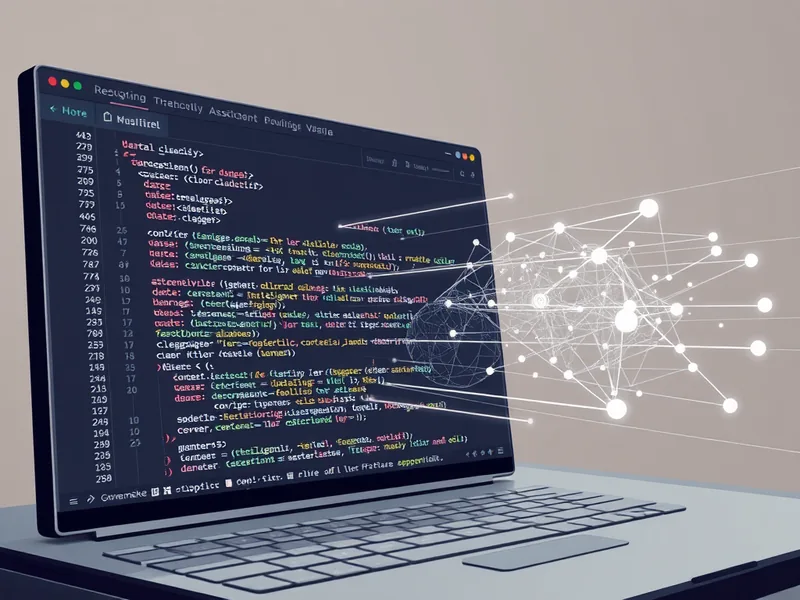
Today, the landscape has changed fundamentally. AI extensions like Copilot, Cursor, Claude, and others are taking on more than just code generation-they’re making architectural decisions. This shift doesn’t just reduce your cognitive load; it inverts it.
Instead of grinding through implementation details, you now focus on steering this intelligence toward solutions that might be difficult to articulate fully. It’s the difference between manually shifting gears and thinking about racing lines. Here are some key points:
To understand this shift better, consider the difference between driving a regular car and a Formula 1 car. When you drive a regular car, you think about mechanics-clutch, gas, brake, turn. Each action is processed sequentially by your brain. It’s linear and human-scale.
In contrast, when you drive a Formula 1 car, the speed makes it impossible to think about individual actions. The car handles many of these tasks automatically, allowing you to focus on higher-level decisions like racing lines. Similarly, in modern software development, AI extensions handle the low-level details, freeing your mind to focus on more complex and strategic aspects of the project.
This cognitive handoff isn’t just a convenience; it’s a paradigm shift that could redefine how we approach software development. As these tools become more sophisticated, they will continue to augment our abilities, making us more efficient and effective developers.
Tags
Original Sources
About the author
Kai built ML infrastructure at a Bay Area startup before developing an obsession with transformer architectures and inference optimisation that eventually pulled him out of product work entirely. A stint at a compute research lab sharpened his instinct for what actually matters in a model release versus what is marketing. He writes from the inside — from the perspective of someone who has debugged the systems he is describing at three in the morning. He is allergic to hype and instinctively drawn to the unglamorous plumbing questions that everyone else skips over.
More from The Engineer →This Week's Edition
19 August 2025
24 articles
Related Articles

Microsoft Unveils Maia 300, Its Next AI Inference Chip, With Multi-Gigawatt Rollout Planned for 2027
Tools & Engineering · 5 min
3D Chip Stacking Moves From Lab Curiosity to Production Necessity
Tools & Engineering · 6 min

Why AI Pilots Stall: Enterprises Are Missing a Decision Layer, Not a Better Model
Tools & Engineering · 5 min
Related Articles
Microsoft Unveils Maia 300, Its Next AI Inference Chip, With Multi-Gigawatt Rollout Planned for 2027
Tools & Engineering · 5 min
3D Chip Stacking Moves From Lab Curiosity to Production Necessity
Tools & Engineering · 6 min
Why AI Pilots Stall: Enterprises Are Missing a Decision Layer, Not a Better Model
Tools & Engineering · 5 min
More Stories
© 2026 Cedar & Bloom. All rights reserved.
