The Drum · Weekly AI news, freeSubscribe →

Share
A federal brief argues that letting copyright law restrict how AI models learn from books and articles would slow American innovation, adding political weight to a legal question courts are still struggling to answer.
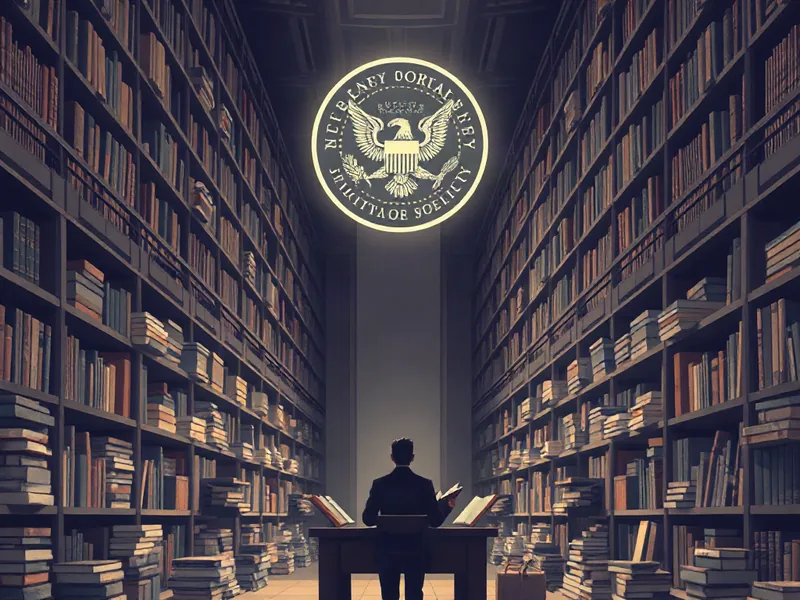
Imagine a library that lets you read every book ever written, but no author gets a say in whether you're allowed inside. That's roughly the tension at the heart of a legal fight now playing out in a Manhattan courtroom, and this week, the U.S. government decided to weigh in on the library's side.
The Trump administration filed a 20-page brief in the lawsuit The New York Times brought against OpenAI, defending the company's practice of training its large language models on copyrighted material without asking permission or paying licensing fees. The filing doesn't come from a judge. It comes from the executive branch, and it carries the unmistakable message that the federal government wants AI companies to keep doing what they're doing.
"The United States has a strong interest in continuing to develop a robust and competitive artificial intelligence industry that sets the standard for the practice and procedure of AI use globally," the brief states. It goes on to describe this as "critical" to helping the country "retain global leadership in artificial intelligence," language pulled almost directly from an executive order President Trump signed last year aimed at removing regulatory barriers to AI development.
To understand why this case matters, it helps to know how large language models actually get built. Systems like ChatGPT, Claude, and Gemini don't spring fully formed from nothing. They're trained on staggering quantities of text: books, news articles, essays, forum posts, whatever a company can gather. Much of that material is copyrighted, and much of it gets fed into training pipelines without the creators' consent.
Publishers, including the Times in this case, argue that's simply illegal. You can't take someone's work, they say, and use it to build a commercial product without paying for the privilege. It's not a fringe complaint. Writers, journalists, and artists have watched their work get absorbed into systems that can now generate competing content in seconds, often without credit or compensation.
The legal fight hinges on a doctrine called fair use, a set of exceptions built into copyright law that allow limited use of protected material without permission under certain conditions. Courts typically look at whether the new use is "transformative," meaning it does something meaningfully different with the original work rather than simply reproducing or replacing it. Whether feeding a book into an AI training pipeline counts as transformative is exactly what judges across the country are now being asked to decide, and reasonable people, including reasonable judges, disagree.
The Trump administration's brief comes down firmly on one side of that debate. "Constraining LLM development under a misunderstanding of fair use doctrine would thwart such creative and scientific progress while hindering American prosperity and economic mobility," it argues. That's a policy argument dressed in legal language: innovation and economic growth should outweigh the individual claims of writers whose work ended up in a training set without their say.
So far, the courts have mostly agreed with that framing, though not entirely. Last year, Judge William Alsup approved a $1.5 billion settlement requiring Anthropic to pay a group of writers whose books were used to train its AI models. But that penalty wasn't for training on copyrighted material itself. It was for how Anthropic obtained the books, through illegal shadow libraries that pirate copyrighted works rather than purchasing or licensing them legitimately.
Judge Alsup's own reasoning revealed just how much the "transformative" question comes down to analogy and intuition rather than clean legal formula. "Like any reader aspiring to be a writer, Anthropic's LLMs trained upon works not to race ahead and replicate or supplant them, but to turn a hard corner and create something different," he wrote, comparing a machine reading millions of texts to a human absorbing influences before writing something new. It's a generous comparison, and not everyone finds it convincing. A human writer reads a handful of books over a lifetime. An LLM ingests libraries' worth of text in a single training run, at a scale no person could replicate. Whether that difference in scale changes the moral or legal calculus is precisely what's unresolved.
The New York Times case adds another layer of friction. Earlier this year, the paper accused OpenAI of hiding evidence during the litigation, a claim that, if borne out, could shape how much sympathy the court has for the company regardless of how the fair use question ultimately gets resolved.
It's worth being clear about what this brief does and doesn't do. The filing was submitted to the U.S. District Court for the Southern District of New York, but the government lawyers who wrote it don't have jurisdiction over the case. They can't rule. They can't dictate an outcome. What they can do is signal, loudly and publicly, where the executive branch stands, and that kind of signal tends to matter more than its formal legal weight might suggest.
For everyday writers, journalists, and artists, this brief lands as a discouraging sign. It suggests that when the interests of individual creators collide with the ambitions of a fast-growing AI industry, the federal government is inclined to side with scale and speed. That's not a small thing. Copyright law exists, in part, to protect people who don't have the resources of a multibillion-dollar tech company, and a legal environment shaped by "American prosperity" arguments risks treating those protections as an afterthought.
At the same time, there's a real policy tension worth taking seriously. If U.S. courts and regulators impose strict licensing requirements on AI training while other countries don't, American companies could find themselves at a competitive disadvantage globally, exactly the outcome the Trump administration's executive order was designed to prevent. Neither side of that argument is baseless. What's missing so far is a framework that protects creators' livelihoods without simply handing AI companies a blank check to use anyone's work as free training fuel. Until courts, Congress, or some combination of the two settle that question, cases like this one will keep testing where the line actually falls.
Tags
Original Sources
US government sides with OpenAI on issue of training LLMs on copyrighted material | TechCrunch
↗ https://techcrunch.com/2026/09/02/u-s-government-sides-with-openai-on-issue-of-training-llms-on-copyrighted-material
About the author
Amara's entry point into AI was an epidemiology role at a London research hospital, where she spent five years studying how digital health tools reached — or conspicuously failed to reach — underserved communities. Watching early algorithmic systems in healthcare quietly entrench existing inequalities, she redirected her career toward the systemic consequences of AI at scale. She covers AI through an unflinching lens: who benefits, who bears the cost, and what evidence actually says versus what the press release claims. Her writing is calm and precise, but she doesn't mistake balance for neutrality.
More from The Steward →This Week's Edition
5 September 2026
24 articles
Related Articles

German Bishops Back Child-Friendly AI Standards, Citing Papal Call on Human Dignity
Policy & Regulation · 5 min

Meta Walks Back Terms That Seemed to Permit AI Scraping of Business Websites
Policy & Regulation · 5 min
AI Is Reshaping Climate Risk and Opportunity, But the UN's Main Climate Treaty Hasn't Caught Up Yet
Policy & Regulation · 5 min
Related Articles
German Bishops Back Child-Friendly AI Standards, Citing Papal Call on Human Dignity
Policy & Regulation · 5 min
Meta Walks Back Terms That Seemed to Permit AI Scraping of Business Websites
Policy & Regulation · 5 min
AI Is Reshaping Climate Risk and Opportunity, But the UN's Main Climate Treaty Hasn't Caught Up Yet
Policy & Regulation · 5 min
More Stories
© 2026 Cedar & Bloom. All rights reserved.
