The Drum · Weekly AI news, freeSubscribe →

Share
A medical informatics professor warns that rushed, commercialized AI training is stripping clinicians of the theoretical grounding they need, and argues regulators must mandate tiered education before patient trust collapses further.
Imagine handing a surgeon a scalpel after a weekend seminar and calling them trained. That is roughly what is happening right now with artificial intelligence in medicine, according to Prof. Dr. Gheorghe Ioan Mihalas, a longtime medical informatics educator at Vasile Goldiș Western University of Arad in Romania. In a recent essay, he argues that healthcare has been caught flat-footed by AI's rapid arrival, and the response so far has been speed over substance.
The problem isn't that clinicians are unwilling to learn. It's what they're being taught, and how fast they're being rushed through it. Mihalas points to a booming market of courses promising to turn any clinician into an "AI expert" in two weeks or four weekends. These programs teach people how to type a prompt or generate a polished slide deck. What they skip, he writes, is everything underneath: the logic, the data structures, the limits of the algorithms doing the actual work.
Think of it like teaching someone to drive by showing them which pedal makes the car go, without ever mentioning brakes, traffic laws, or what happens in black ice. They might get somewhere. They might also crash, and not understand why.
Mihalas leans on a warning from Stephen Hawking: "The greatest enemy of knowledge is not ignorance, but the illusion of knowledge." In most fields, that illusion is a minor embarrassment. In medicine, he argues, it's a direct threat to patient safety.
Here's the mechanism. AI systems used in clinical settings often rely on probabilistic models, meaning they generate answers based on statistical likelihood rather than fixed rules. That's a very different thing from a calculator spitting out a guaranteed correct sum. A probabilistic model can "hallucinate," producing a confident, plausible-sounding answer that is simply wrong. If a clinician never learns why these models work the way they do, Mihalas argues, they have no real way to catch a dangerous error when the system produces one.
What worries him most is how normalized this gap has become. Healthcare workers now shrug and repeat phrases like "well, that's just AI, it hallucinates sometimes." That's not acceptance of a known risk. It's acceptance of ignorance dressed up as technical literacy. Mihalas puts it bluntly: institutions have normalized the error before bothering to teach the mechanism behind it.
This gap isn't just theoretical. It's already playing out in exam rooms. Mihalas describes patients arriving at appointments holding AI-generated printouts, demanding specific prescriptions because a chatbot told them so, armed with total confidence in the screen's authority. If the treating physician knows no more about how that chatbot actually works than the patient does, something fundamental breaks down. Clinical authority depends on clinicians actually understanding more than their patients about the tools shaping a diagnosis. When that knowledge gap closes from the wrong direction, through clinician ignorance rather than patient education, the doctor-patient relationship itself starts to erode.
Mihalas frames the vacuum left by slow, cautious institutional reform as an opening that's already been filled, just not by anyone qualified. Software vendors, self-styled digital gurus, and "learn by discovery" advocates have rushed in to meet demand that medical schools and hospitals failed to address with any urgency. The result is a workforce trained by people with a commercial stake in making AI look simple, not by people with a professional stake in making sure it's used safely.
His proposed fix avoids a single blanket solution. He calls for three distinct tiers of mandatory AI education, each built for a different audience with different stakes. Medical students need grounding in formal logic, medical ontologies, and the distinction between deterministic and probabilistic models, not shortcuts for finishing homework faster. Practicing clinicians need training focused on validation, liability, and safety: spotting model drift, auditing algorithmic bias, and resisting automation bias, the tendency to defer to a machine's output simply because it came from a machine. Hospital leaders and policymakers need governance training covering malpractice frameworks, data privacy, and systemic risk, rather than another vendor sales pitch dressed up as a briefing.
What ties these tiers together is a rejection of the idea that AI literacy is a single skill anyone can pick up in a weekend. A medical student, a practicing oncologist, and a hospital CEO face entirely different risks and responsibilities when AI enters the room. Treating their education needs as identical, Mihalas argues, is part of how the field got into this mess in the first place.
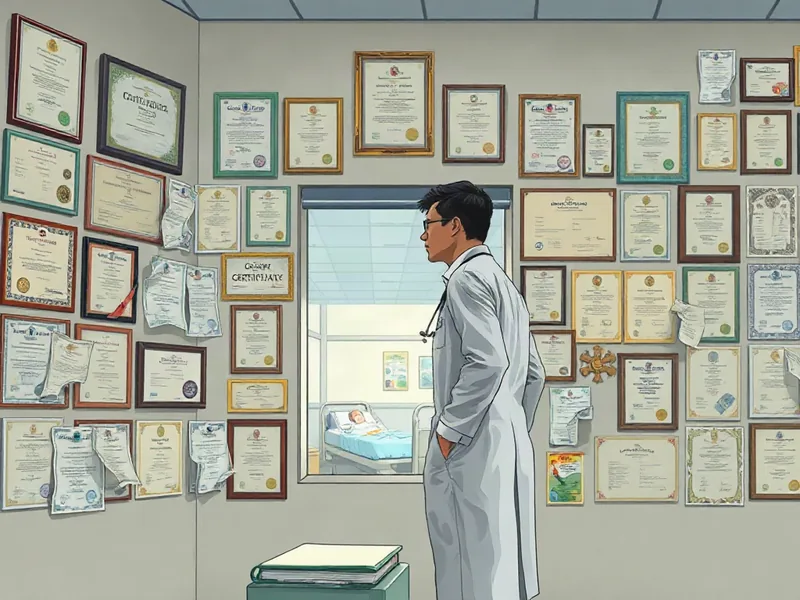
The stakes here aren't abstract. Mihalas warns that if a clinician, relying on an AI tool they don't fully understand, makes a fatal diagnostic error, the blame won't land on the algorithm. It will land on the institutions that decided teaching the fundamentals was too slow, too costly, or too theoretical to bother with. That's a sobering frame for hospital administrators currently weighing a cheap two-week certification program against a longer, more rigorous curriculum.
This isn't an argument against AI in medicine. It's an argument about sequencing and seriousness. AI in healthcare, as Mihalas frames it, is an ecosystem, not a single tool you bolt onto existing workflows. Ecosystems need sustained investment across every component, and education is one component that has been treated as optional for too long. Medical schools, licensing bodies, and hospital systems now face a choice between two paths: keep issuing quick certificates that look good on a resume but teach little, or commit to standards that take longer, cost more, and actually prepare clinicians for what they're using. The second path is harder. It's also the only one that treats patient safety as more than a talking point.
Tags
Original Sources
The Dangerous Illusion of the "Two-Week AI Expert": A Call to Action Against Superficial Medical Education - MedCity News
↗ https://medcitynews.com/2026/11/the-dangerous-illusion-of-the-two-week-ai-expert-a-call-to-action-against-superficial-medical-education
About the author
Amara's entry point into AI was an epidemiology role at a London research hospital, where she spent five years studying how digital health tools reached — or conspicuously failed to reach — underserved communities. Watching early algorithmic systems in healthcare quietly entrench existing inequalities, she redirected her career toward the systemic consequences of AI at scale. She covers AI through an unflinching lens: who benefits, who bears the cost, and what evidence actually says versus what the press release claims. Her writing is calm and precise, but she doesn't mistake balance for neutrality.
More from The Steward →This Week's Edition
6 November 2026
28 articles
Related Articles

A Bipartisan Permitting Bill Could Reshape US Energy Emissions, For Better or Worse
Policy & Regulation · 5 min

A Democratic Wave Puts AI Companies on Notice
Policy & Regulation · 5 min

Big Tech Pours $720 Billion Into AI Data Centers With No Profit in Sight, and No One's Stopping Them
Policy & Regulation · 6 min
Related Articles
A Bipartisan Permitting Bill Could Reshape US Energy Emissions, For Better or Worse
Policy & Regulation · 5 min
A Democratic Wave Puts AI Companies on Notice
Policy & Regulation · 5 min
Big Tech Pours $720 Billion Into AI Data Centers With No Profit in Sight, and No One's Stopping Them
Policy & Regulation · 6 min
More Stories
© 2026 Cedar & Bloom. All rights reserved.
