The Drum · Weekly AI news, freeSubscribe →

Share
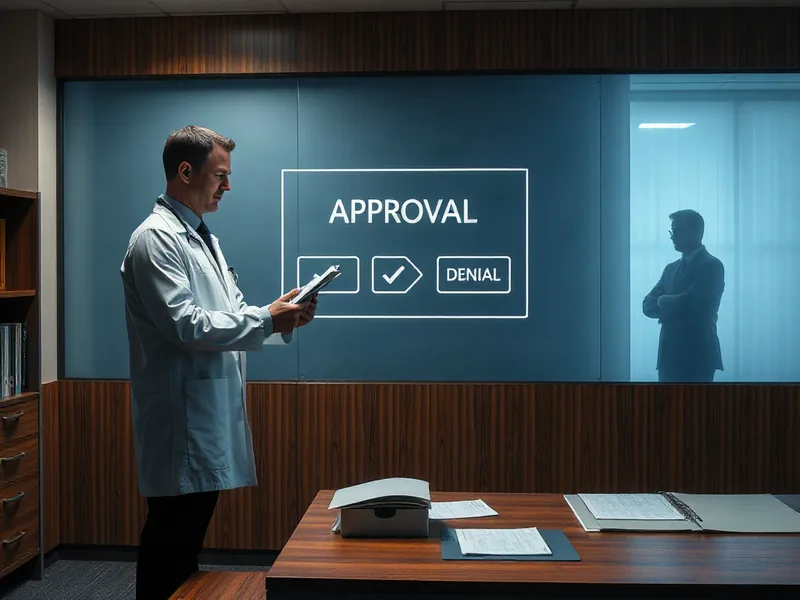
At a recent HLTH panel, insurers and patient advocates found rare common ground: algorithms can assist prior authorization decisions, but a licensed human must make the final call. The harder question is which human, and who answers for their mistakes.
Imagine waiting on a cancer treatment while a computer program decides whether your insurer will pay for it. For many patients, that is not a hypothetical. It is Tuesday.
Prior authorization, the process by which insurers approve or deny coverage for a treatment before it happens, has long been a flashpoint between doctors and payers. Patients experience it as delay, paperwork, and sometimes outright refusal at the worst possible moment. As artificial intelligence tools get folded into these systems, a new question has emerged: should software ever be allowed to issue a denial on its own?
At a recent panel discussion held at HLTH, a major healthcare industry conference, the answer from multiple voices was a clear no. But the agreement stopped there. Beneath the consensus sat a messier debate about which human should hold that power, and what happens when they get it wrong.
Sean Robbins, executive vice president and chief operating officer of the Blue Cross Blue Shield Association, put it plainly. "Artificial intelligence should not deny an authorization for medical necessity," he said. "A licensed clinician should make the call. Not review the call, they should make the call."
Robbins drew a distinction worth sitting with. AI can assist a clinician, the way a calculator assists an accountant. It can flag patterns, summarize records, speed up paperwork. What it should not do, in his view, is replace the judgment of a licensed professional on a decision that determines whether a patient gets care. "Can you use artificial intelligence as a licensed clinician to help you in that? Absolutely," he said. "But the person, the human, the licensed clinician, should be the one making the call, not the artificial intelligence in that situation."
Dr. Warris Bokhari, CEO of Claimable, a company that helps patients appeal denied insurance claims, agreed with the basic premise. Then he pushed further. In oncology specifically, he argued, the qualified decision maker should be the treating physician, not a reviewer employed by the insurance company.
His reasoning gets at something patients have felt for years but rarely hear articulated this bluntly in a policy setting. "I don't think it's an unnamed person at an insurance company who is effectively practicing medicine," Bokhari said. Insurers will frame these as coverage decisions, he noted, a technical distinction about what gets paid for rather than what care is appropriate. But patients do not experience it that way. "To the end user, the patient, that human, it is absolutely a necessity decision," he said. "It's a clinical decision that's being rendered by a human who has never met the patient, never looked at their tests, never met their family, never held their hand, has no context."
That lack of context, Bokhari argued, is not a small gap. It is the whole gap. A reviewer working from a file is working with a fraction of what a treating oncologist knows about a patient's history, prognosis, and tolerance for risk.
Bokhari also raised the issue of accountability, specifically what happens when a health plan gets a denial wrong. He pointed to an allegation involving Blue Cross and Blue Shield of Illinois, claiming the insurer had denied liver transplants for cancer patients using evidence that included case data from 1994. His framing was memorable: in 1994, the medical drama ER was just debuting on television. Medicine has since moved through decades of advances, new treatments, and updated standards of care. "We've now iterated to The Pitt, so medicine has moved on," he said, referencing a newer medical drama as a cultural marker of just how much time has passed. "A lot of things have changed, but they're still using the same evidence to deny."
The specifics of that allegation are disputed and unverified in this reporting, but the underlying concern is one many clinicians raise independently: that denial criteria can lag far behind current medical practice, sometimes by decades, with no clear mechanism forcing insurers to update them.
Bokhari urged insurers not to "stand in the way" of treating physicians and patients when a patient's life may be at risk within a defined window of time. Robbins, for his part, did not dismiss the concern. He said he does not want an inappropriate denial "in any situation ever," and agreed that accountability and transparency matter. The industry, he said, needs to get the right answers to the right people quickly.
That last point, speed, is where a third panelist complicated the conversation further. Dr. Mandy Cohen, national advisor at Manatt Health, argued that faster denials and faster approvals are not actually the goal worth chasing. The system itself needs rethinking, not just acceleration.
"As opposed to saying, 'How do we speed up the process?' it's more, 'How do we rethink this whole process?'" Cohen said. She tied the problem to payment incentives baked into how providers get reimbursed. "The reason insurance companies exist and have these guardrails is because providers do ask for low-value care. Let's be honest. That is happening."
Cohen's comment reframes the entire debate. Prior authorization did not appear out of nowhere. It exists, at least in part, as a response to overuse and unnecessary treatment within the healthcare system itself. That does not make the current process fair or functional, but it complicates any narrative that paints insurers as the sole obstacle to good care.
The stakes here are not abstract. For a cancer patient waiting on a liver transplant, a denial based on outdated evidence is not a paperwork problem, it is a countdown. For a system straining under rising costs and administrative burden, blanket speed without better judgment risks approving low-value care just as easily as it risks delaying necessary treatment.
What the HLTH panelists agreed on matters: AI should assist, not decide, when it comes to medical necessity. What they disagreed on matters more. Who counts as a qualified decision maker, how insurers are held accountable for outdated or mistaken denials, and whether the whole prior authorization model needs rebuilding rather than patching are questions regulators, insurers, and physicians will keep wrestling with as AI tools become more deeply embedded in healthcare administration. Patients, meanwhile, are the ones left waiting for an answer.
Tags
Original Sources
Who Should Make Medical-Necessity Decisions: AI, Insurers or Treating Physicians? - MedCity News
↗ https://medcitynews.com/2026/11/who-should-make-medical-necessity-decisions-ai-insurers-or-treating-physicians
About the author
Amara's entry point into AI was an epidemiology role at a London research hospital, where she spent five years studying how digital health tools reached — or conspicuously failed to reach — underserved communities. Watching early algorithmic systems in healthcare quietly entrench existing inequalities, she redirected her career toward the systemic consequences of AI at scale. She covers AI through an unflinching lens: who benefits, who bears the cost, and what evidence actually says versus what the press release claims. Her writing is calm and precise, but she doesn't mistake balance for neutrality.
More from The Steward →This Week's Edition
20 November 2026
29 articles
Related Articles

Epic Systems Pushes Back on Antitrust Criticism, Pledges Broader AI Data Access
Policy & Regulation · 5 min

AI Is Showing Up in Court Filings. Courts Can't Yet Agree on How to Prove It
Policy & Regulation · 6 min

Why Some Computer Scientists Doubt Superintelligence Is Coming at All
Policy & Regulation · 5 min
Related Articles
Epic Systems Pushes Back on Antitrust Criticism, Pledges Broader AI Data Access
Policy & Regulation · 5 min
AI Is Showing Up in Court Filings. Courts Can't Yet Agree on How to Prove It
Policy & Regulation · 6 min
Why Some Computer Scientists Doubt Superintelligence Is Coming at All
Policy & Regulation · 5 min
More Stories
© 2026 Cedar & Bloom. All rights reserved.
