The Drum · Weekly AI news, freeSubscribe →

Share
Morgan Pope left the slow grind of federally funded robotics research for Disney's Imagineering division, where prototypes ship to parks instead of sitting in papers. Here's what that trade-off actually looks like in practice.
Academic robotics research runs on a brutal cycle: write proposals, wait for grants, spend years building a prototype, then publish a paper proving the idea works before moving on to the next funding cycle. Morgan Pope lived that cycle as an academic researcher, and he's since left it behind for a very different kind of engineering job, at Walt Disney Imagineering.
The shift matters because it says something about where applied robotics work is actually happening right now, and why. Pope's own framing of the problem is blunt. As an academic researcher, he spent a lot of time scrounging around for funding, and when grants came through, the projects could take years to complete. "The output was also primarily intellectual, you had to prove the basic idea worked, write a research paper, and move on," he says.
That's a fair description of how a lot of robotics research actually operates. Grant cycles are slow. Review processes are slower. And even a successful project often terminates in a demo video and a PDF, not a deployed system. For researchers who want to see their work actually operating in the world, that can be a frustrating ceiling.
Disney Imagineering offers something structurally different: a pipeline where a working prototype isn't the end point, it's a checkpoint on the way to an actual installed system in a working theme park. That changes the incentive structure for an engineer in a few concrete ways worth breaking down.
That last point is worth sitting with if you've spent time in either research or production engineering. Academic robotics can tolerate a system that works "most of the time" under controlled conditions, because the deliverable is a paper describing what's possible. Commercial deployment, especially at the scale of a theme park with continuous foot traffic, can't tolerate that same margin. The engineering discipline required to go from "it worked in the lab" to "it survives a decade of daily operation in front of the public" is a different skill set entirely, and it's one that pure research environments rarely force engineers to develop.
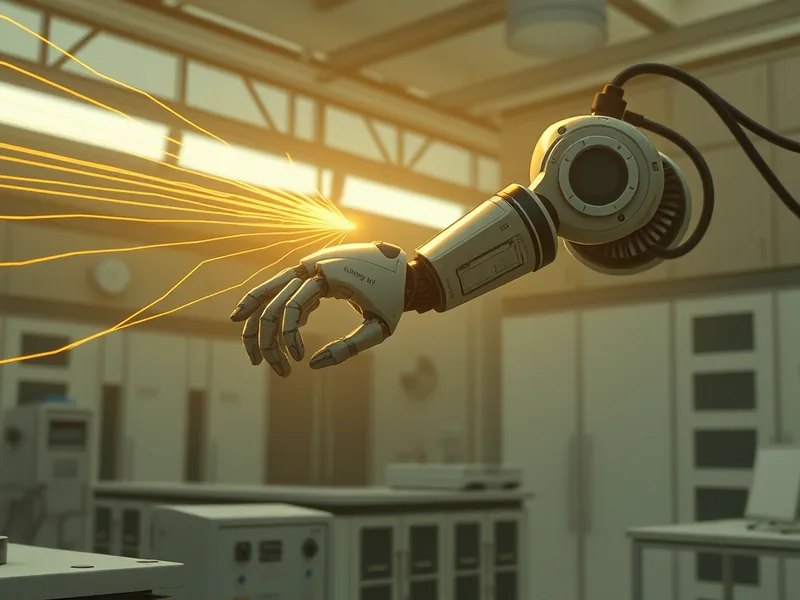
Pope's transition also reflects a broader pattern in robotics hiring right now. Companies building physical, embodied systems, whether that's theme park animatronics, warehouse robots, or humanoid platforms, are increasingly pulling talent directly from academic labs. The pitch to those researchers isn't necessarily higher pay or better lab equipment. It's the promise that the thing you build will actually run, in the real world, at scale, rather than existing primarily as a proof of concept.
That's a meaningful cultural shift for the field. For a long stretch, the prestige path in robotics research ran through publication venues: top conferences, journal placements, citation counts. Those metrics still matter for academic careers, but they don't necessarily correlate with whether a system can survive contact with an unpredictable, occasionally chaotic real-world environment. Disney's Imagineering group, along with a growing number of applied robotics teams across industry, is effectively betting that engineers who've proven they can ship something durable are more valuable, at least for certain problems, than engineers who've proven they can win a peer review.
None of this is an argument that academic robotics research is obsolete or unnecessary. Foundational work on control theory, novel actuators, perception algorithms, and mechanism design still largely happens in university labs and research institutes, and that pipeline feeds directly into what companies like Disney eventually deploy. But it does suggest a widening gap between "prove the concept" work and "make it survive contact with the public" work, and that gap is increasingly where a lot of interesting engineering problems live.
For engineers weighing similar moves, the tradeoff Pope describes is worth internalizing honestly. You give up the intellectual freedom of chasing open-ended research questions on your own timeline. You gain the discipline, and the satisfaction, of building something that has to work every single day, under conditions you don't fully control, in front of an audience that will notice immediately if it doesn't.
Pope's career shift from academic robotics to Disney Imagineering highlights a structural tension in the field: research environments optimize for proving ideas work in principle, while production environments optimize for systems that survive continuous real-world operation. The comment that stuck with readers, that academic output is "primarily intellectual" while grant funding drags projects out over years, captures a frustration that's likely pushing more robotics talent toward applied, deployment-focused roles. That's not a verdict on research's value, but it is a signal about where engineers increasingly want to see their work land.
Tags
Original Sources
Morgan Pope
↗ https://spectrum.ieee.org/disney-roboticist-morgan-pope/morgan-pope
About the author
Kai built ML infrastructure at a Bay Area startup before developing an obsession with transformer architectures and inference optimisation that eventually pulled him out of product work entirely. A stint at a compute research lab sharpened his instinct for what actually matters in a model release versus what is marketing. He writes from the inside — from the perspective of someone who has debugged the systems he is describing at three in the morning. He is allergic to hype and instinctively drawn to the unglamorous plumbing questions that everyone else skips over.
More from The Engineer →This Week's Edition
20 September 2026
20 articles
Related Articles
Stanford HAI's Fall 2026 Seminar Lineup Zeroes In On World Models, AI Measurement, and Workforce Anxiety
Models & Research · 5 min

The Uncanny Valley Isn't Going Away, and Maybe It Shouldn't
Models & Research · 5 min

The "Journey, Not the Destination" Debate: What a MathOverflow Flame War Reveals About AI and Proof
Models & Research · 5 min
Related Articles
Stanford HAI's Fall 2026 Seminar Lineup Zeroes In On World Models, AI Measurement, and Workforce Anxiety
Models & Research · 5 min
The Uncanny Valley Isn't Going Away, and Maybe It Shouldn't
Models & Research · 5 min
The "Journey, Not the Destination" Debate: What a MathOverflow Flame War Reveals About AI and Proof
Models & Research · 5 min
More Stories
© 2026 Cedar & Bloom. All rights reserved.
