The Drum · Weekly AI news, freeSubscribe →

Share
As wildfires and other crises become more frequent, a new type of AI called world models could revolutionize emergency response. But with great power comes the need for robust regulation.
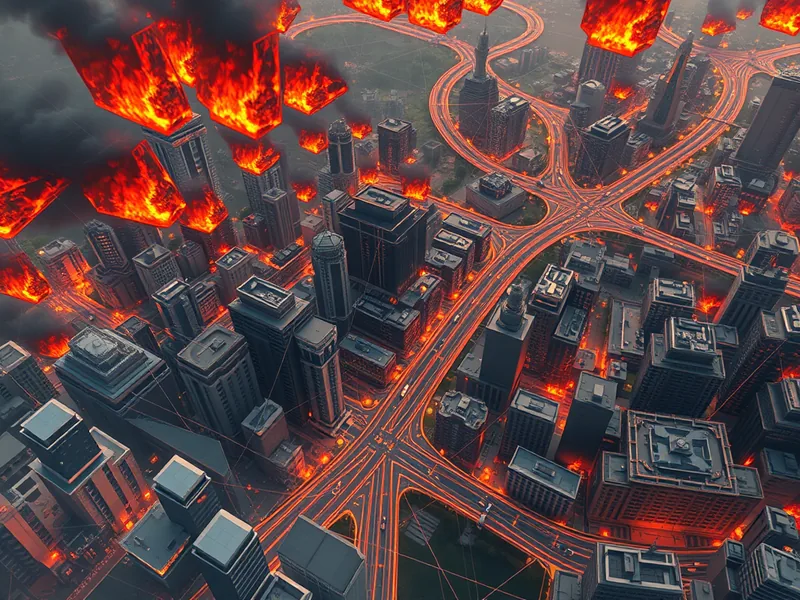
It's 2 a.m., and a wildfire is rapidly closing in on a densely populated suburb. An incident commander faces critical decisions: which evacuation routes are still passable, which hospitals can be reached, and where the power grid will fail next. Current systems provide real-time forecasts, but these projections are siloed and conditions change faster than analysts can track.
Enter world models-AI systems that build and maintain a dynamic representation of an environment to predict how it will evolve in response to action. In this scenario, a world model could integrate forecasts about roads, the power grid, and hospital capacity into one continuously updated picture. The commander would use this integrated data to reroute crews, redirect resources, and test evacuation plans before issuing orders.
World models are AI systems that build a working representation of an environment to predict how it changes in response to action. They have the potential to lower the cost of high-quality simulation, benefiting infrastructure planning, crisis response, experimentation, and embodied AI training. For instance, in disaster management, world models can help emergency responders make informed decisions by providing real-time, integrated data on multiple critical factors.
No existing benchmark gives policymakers an adequate basis to evaluate a world model for safety-critical deployment. This gap is particularly concerning because the risks associated with world models are distinct from those of traditional AI systems. While current regulations address AI-generated content and autonomous decision-making, they do not fully encompass the unique risk profile of world models.
The key question is whether a simulated environment matches physical reality closely enough to train or test another system or guide real-world decisions. For example, if a world model is used to simulate traffic patterns for urban planning, it must accurately reflect real-world conditions to be effective. This requires rigorous validation and verification processes that are not yet standardized.
The scarcest input for training world models is action-labeled interaction data-robot trajectories and fleet logs that cannot be scraped from the web. The risk of concentrated control over these datasets is significant, as they could become proprietary assets held by a few powerful entities. To mitigate this, public datasets should be an explicit target of federally funded research.
World models are dual-use technologies with national security implications. By lowering the cost of capable autonomous systems, they could democratize military advantage, making early leadership in world-model research, development, and governance an urgent national security priority. This dual-use nature complicates regulatory efforts, as policymakers must balance innovation with safety and ethical considerations.
The emergence of world models signals a broader shift in AI. While current systems primarily operate through language, multimodal systems are expanding this capability to include images, audio, and video. However, most still cannot track a coherent environment over time. World models aim to maintain a continuous representation of an environment and predict how it will change in response to action. This capacity-spatial intelligence-is crucial for understanding physical environments and using that information to guide real-world actions.
In crisis management, world models could revolutionize emergency response by providing integrated, real-time data on multiple critical factors. In infrastructure planning, they could help optimize resource allocation and reduce costs. In scientific research, they could enable more accurate simulations and experiments. However, these benefits come with significant risks that must be addressed through robust regulatory frameworks.
The development of world models is a rapidly evolving field, and policymakers must act quickly to ensure that these technologies are used responsibly and ethically. Public investment in measurement science, the creation of public datasets, and the establishment of clear regulatory guidelines are essential steps toward achieving this goal. As we navigate the complexities of AI governance, it is crucial to prioritize the safety and well-being of all individuals and communities.
Tags
Original Sources
The World Model and Spatial Intelligence Era: Governing AI Beyond Language
↗ https://hai.stanford.edu/assets/files/hai-issue-brief-the-world-model-and-spatial-intelligence-era.pdf
About the author
Amara's entry point into AI was an epidemiology role at a London research hospital, where she spent five years studying how digital health tools reached — or conspicuously failed to reach — underserved communities. Watching early algorithmic systems in healthcare quietly entrench existing inequalities, she redirected her career toward the systemic consequences of AI at scale. She covers AI through an unflinching lens: who benefits, who bears the cost, and what evidence actually says versus what the press release claims. Her writing is calm and precise, but she doesn't mistake balance for neutrality.
More from The Steward →This Week's Edition
6 August 2026
25 articles
Related Articles
Related Articles
More Stories
© 2026 Cedar & Bloom. All rights reserved.