The Drum · Weekly AI news, freeSubscribe →

Share
A small, perception-first model is beating general-purpose giants on spatial grounding benchmarks. Here's what XPeng's academic collaboration tells us about where embodied AI's bottleneck really is.
Here's a question that's been nagging at robotics researchers for a while: do we actually need bigger general-purpose models to make robots better at physical tasks, or do we need better eyes first? A new open-source model called GroundingPI, built by researchers affiliated with XPeng, Peking University, The University of Hong Kong, and other academic partners, makes a pretty compelling case for the latter.
GroundingPI is a visual perception foundation model, meaning it's not trying to reason, plan, or chat. Its entire job is to look at a scene and tell you exactly where things are. At roughly 4 billion parameters, it's small by current frontier-model standards, but in the team's own evaluation it posted an average score of 73.68 across 34 perception benchmarks spanning 11 capability categories, edging out GPT-6 Astra's 71.54. That's a general-purpose flagship model losing to a specialized, dramatically smaller one on its home turf.
Worth flagging upfront: this comparison is scoped to perception benchmarks. It's not a claim that GroundingPI is "smarter" than GPT-6 Astra or that parameter count doesn't matter broadly. It's a claim that for the specific job of visual grounding, specialization beats scale.
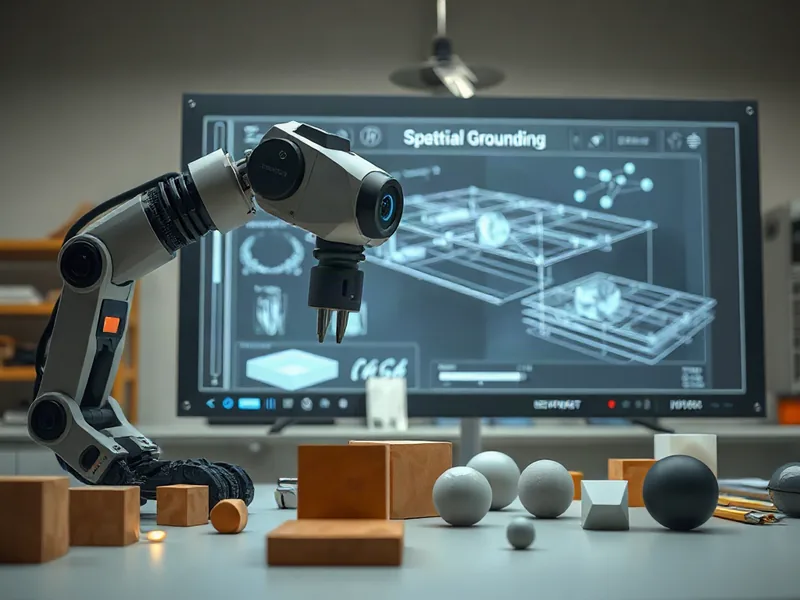
The pitch behind GroundingPI is straightforward once you sit with it. Language models have gotten very good at reasoning and planning. But robots and autonomous vehicles don't operate on language, they operate on coordinates. Tell a robot to grab "the handle of the cup on the right" and it's not enough to recognize there's a cup and a handle somewhere in frame. The system needs to localize that handle down to specific spatial coordinates, points and bounding boxes, precise enough to actually drive a gripper there.
This is where a lot of general-purpose vision-language models quietly fall short. They're trained to describe and reason about images, not to pin down exact pixel-level or 3D positions with robotic precision. GroundingPI's training deliberately skips over robot action labels (the usual approach for most embodied AI models, where you train directly on demonstration data paired with motor commands) and instead builds up foundational visual grounding skills that downstream systems can build on later.
The model is trained across 11 perceptual capability categories:
That's a broad spread for a 4B model, and it's clearly intentional. The idea is a general-purpose perceptual backbone that other, task-specific systems can plug into, rather than a monolithic model trying to do everything end to end.
The research team describes this through what they call "Visual Primitives," the idea being that complex scene understanding decomposes into the smallest identifiable building blocks of an image. Get those primitives right and reliable, and higher-level tasks, grasping, navigation, manipulation, inherit that reliability.
The benchmark numbers are interesting, but the downstream simulation results are where this gets practically relevant for anyone building embodied AI systems.
Data efficiency is the big one. Robotic learning famously needs mountains of human demonstration data, and collecting it is slow and expensive. In RoboCasa-GR1 simulation experiments, robotic learning systems using GroundingPI as their visual backbone hit higher task success rates using only 50% of available demonstration data than comparison models needed 75% to match. If that holds up outside simulation, it's a meaningful efficiency gain, fewer human demos needed per task, which is exactly the kind of bottleneck that's been slowing robotics training pipelines industry-wide.
Generalization is the other half of the story. A model that nails a task in training conditions but falls apart when the lighting changes or an object gets swapped out isn't actually useful. In RoboTwin 2.0 simulation evaluations, GroundingPI outperformed mainstream visual backbones across four out-of-distribution settings, meaning it held up better when test conditions diverged from training conditions. That's the kind of robustness that separates a lab demo from something deployable.
The team also ran GroundingPI through autonomous driving perception tests on the nuScenes dataset (a widely used benchmark for self-driving research), where it achieved an average open-loop trajectory prediction error of 0.296 metres as a visual backbone. That's a modest but notable data point suggesting the perception-first approach generalizes beyond robotic arms into vehicle perception stacks too.
It's worth being clear-eyed here: all of these downstream results are simulation and offline evaluations. There's no real-world deployment data in this release, and the research team is explicit that this doesn't establish readiness for commercial use. Simulation-to-real transfer is notoriously tricky in robotics, so treat the efficiency and generalization numbers as promising signals, not settled conclusions.
GroundingPI's paper, model weights, and source code are all publicly available, subject to the relevant open-source and third-party licensing terms. For researchers building embodied AI systems, that's the practically useful part, you can actually go test this backbone against your own pipelines rather than taking the benchmark table at face value.
GroundingPI is a research contribution, not a product announcement. XPeng is explicit that this doesn't represent integration into its commercial vehicle or robotics lineup, nor a commitment to future deployment. But as a research direction, it's a useful counterpoint to the "just scale the general model" trend dominating a lot of foundation model work right now.
The bigger implication here is architectural: embodied AI systems may end up looking less like one giant model doing everything, and more like a stack where a lean, specialized perception model handles grounding while separate systems handle reasoning, planning, and action. If a 4B-parameter perception specialist can out-ground a frontier general-purpose model on spatial tasks, that's a strong argument for building embodied AI as a pipeline of specialists rather than a single do-everything brain. Worth keeping an eye on whether other labs pick up this perception-first framing in their own robotics stacks over the next few release cycles.
Tags
Original Sources
XPENG Researchers and Academic Partners Introduce GroundingPI, An Open-Source Visual Perception Model For Physical AI - CleanTechnica
↗ https://cleantechnica.com/2026/11/05/xpeng-researchers-and-academic-partners-introduce-groundingpi-an-open-source-visual-perception-model-for-physical-ai
About the author
Kai built ML infrastructure at a Bay Area startup before developing an obsession with transformer architectures and inference optimisation that eventually pulled him out of product work entirely. A stint at a compute research lab sharpened his instinct for what actually matters in a model release versus what is marketing. He writes from the inside — from the perspective of someone who has debugged the systems he is describing at three in the morning. He is allergic to hype and instinctively drawn to the unglamorous plumbing questions that everyone else skips over.
More from The Engineer →This Week's Edition
6 November 2026
28 articles
Related Articles

METR Study Finds Anthropic's Models Are Improving Nearly Twice as Fast, With AI Now Helping Build AI
Models & Research · 5 min

Pennsylvania Researchers Turn Hickory Nuts Into a Climate-Friendly Cooking Oil Substitute
Models & Research · 5 min

Wearables Are Turning Daily Health Data Into a Tool for Patients and Doctors Alike
Health & Science · 6 min
Related Articles
METR Study Finds Anthropic's Models Are Improving Nearly Twice as Fast, With AI Now Helping Build AI
Models & Research · 5 min
Pennsylvania Researchers Turn Hickory Nuts Into a Climate-Friendly Cooking Oil Substitute
Models & Research · 5 min
Wearables Are Turning Daily Health Data Into a Tool for Patients and Doctors Alike
Health & Science · 6 min
More Stories
© 2026 Cedar & Bloom. All rights reserved.
