The Drum · Weekly AI news, freeSubscribe →

Environment
In Turkish forests, AI-powered wildfire prediction maps are empowering communities to protect their homes and natural habitats.
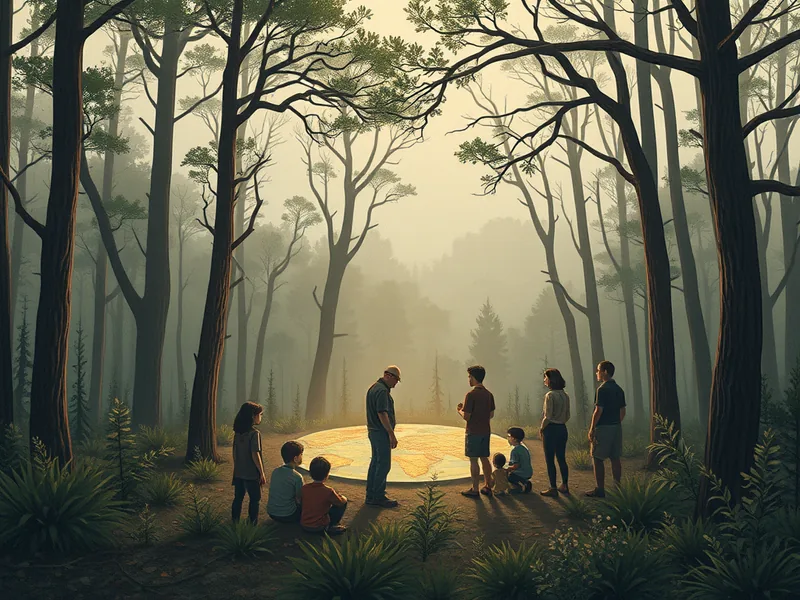
In the heart of a dense Turkish forest, a community gathers around a map. This isn’t just any map; it’s an interactive, AI-powered tool that could change their lives forever. The map, part of the FireAId initiative, is a beacon of hope in a world where wildfires are becoming increasingly frequent and devastating.
Wildfires are a global crisis, costing over $50 billion annually and leaving behind trails of destruction. In Türkiye, this issue has hit particularly hard, prompting a coalition of international organizations to take action. The World Economic Forum’s Centre for the Fourth Industrial Revolution, Koç Holding, the Turkish Ministry for Agriculture and Forestry, and Deloitte joined forces in January 2022 to launch FireAId, an initiative aimed at enhancing wildfire prediction and prevention through the power of Artificial Intelligence (AI).
Since its inception, FireAId has grown into a global community driven by action and knowledge exchange. Partners like Microsoft, Google, Hewlett Packard Enterprise, Scale AI, Conservation International, the Inter-American Development Bank, NASA, Lockheed Martin, Sempra Energy, Qcentroid, the Patrick J. McGovern Foundation, Planet Labs, and Miami University have joined forces to make a difference. Portugal and South Africa have also joined Türkiye in this initiative, expanding its reach and impact.
At the core of FireAId is an interactive wildfire risk map, a tool that leverages AI and machine learning algorithms to predict and prevent wildfires with unprecedented accuracy. This map draws on data from satellite imagery, weather forecasts, historical fire patterns, and ground sensors, all processed by advanced algorithms developed by a global community of experts.
For the communities in Türkiye, this map is more than just a technological marvel; it’s a lifeline. The first pilot program in the country has already achieved an 80% accuracy rate in predicting wildfires, a statistic that translates into real lives saved and ecosystems preserved. Local firefighters can now receive early warnings, allowing them to respond quickly and effectively. Forest rangers have access to detailed risk assessments, enabling them to allocate resources more efficiently and prevent fires before they start.
The impact of this initiative is far-reaching. In a world where climate change exacerbates the frequency and intensity of wildfires, FireAId offers a glimmer of hope. It’s not just about technology; it’s about people-firefighters, rangers, community members, and researchers-all working together to protect what they hold dear.
The success in Türkiye has sparked interest from other regions facing similar challenges. The global community is now looking at how this model can be adapted and scaled to other parts of the world. From the dense forests of Portugal to the vast savannas of South Africa, the potential for AI to transform wildfire management is immense.
While there are still challenges to overcome-such as ensuring data accuracy and building robust infrastructure in remote areas-the progress made by FireAId is undeniable. It’s a testament to what can be achieved when technology is harnessed with a human-centered approach.
As we look to the future, the possibilities are vast. Imagine a world where wildfires are no longer an inevitable disaster but a manageable challenge. Thanks to initiatives like FireAId, this vision is closer than ever before. For the communities that stand to benefit, it means more than just safety; it means hope for a brighter, greener future.
Tags
Original Sources
About the author
Lena spent a decade working in international development before AI tools began showing up in the field programmes she was running — first as curiosity, then as something that genuinely changed outcomes. She writes about the moments where AI stops being a headline and starts being a lifeline: the early cancer detection in a rural clinic, the flood model that gave a village three extra days to evacuate, the translation tool that let a child speak to a doctor for the first time. She is not naive about the risks, but she believes the stories of AI doing real good deserve the same rigour and airtime as the cautionary ones.
More from The Optimist →The essence
The problem
Wildfires are a growing global threat, causing billions in damage annually and devastating ecosystems. In Türkiye, the impact has been particularly severe.
Who is helped
Local communities and forest ecosystems in high-risk areas benefit from early warnings and better preparedness, reducing both economic losses and environmental damage.
Evidence of impact
Since its launch, FireAId's AI-powered maps have accurately predicted wildfire risks, leading to timely evacuations and more effective firefighting. The initiative has also fostered international collaboration, enhancing global disaster response capabilities.
Limitations
Despite its success, the system's accuracy can be limited by data availability and infrastructure in remote areas. Scaling up requires significant investment in technology and training.
What remains unresolved
There is still a need to improve real-time data collection methods and ensure that all communities, regardless of their location or resources, can access and benefit from these advanced tools.
More hope stories
A Breath of Hope: AI's Leap in Early Lung Cancer Detection
Inspired by dogs' ability to detect lung cancer through scent, a new AI-powered electronic nose is s…
A Bright Future: AI Glasses Empower Dementia Patients
AI-powered glasses are giving dementia patients like Margaret Thompson a newfound sense of independe…
A Voice Reclaimed: The Power of AI in Restoring Communication
After decades of silence, a paralyzed woman communicates again through an innovative brain-linked ta…
© 2026 Cedar & Bloom. All rights reserved.
