The Drum · Weekly AI news, freeSubscribe →

Health
The Recurrent Transformer is revolutionizing medical data analysis, leading to better patient outcomes and personalized care.
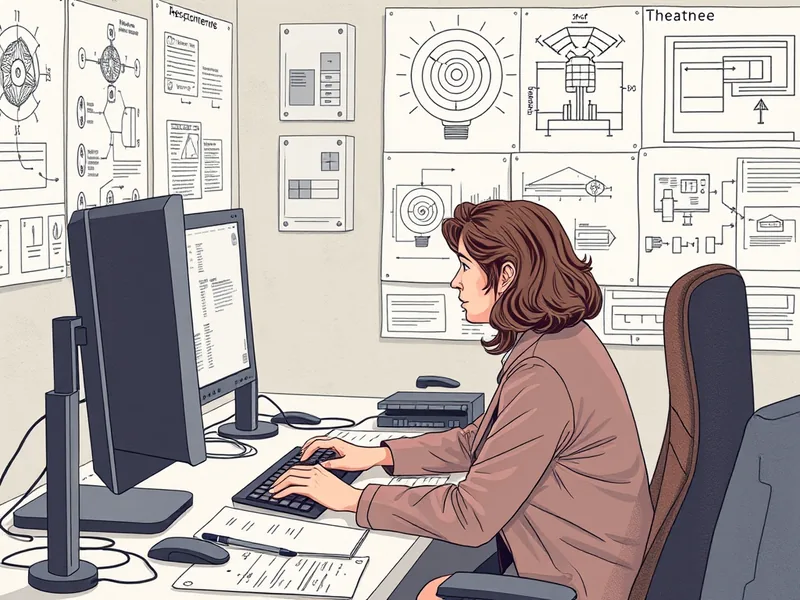
In a small, bustling lab at the heart of a leading research university, Dr. Elena Martinez sits before her computer, a look of concentration on her face. She is working with the latest breakthrough in artificial intelligence: the Recurrent Transformer. This new model promises to enhance the capabilities of deep learning systems by increasing their effective depth and making them more efficient in decoding complex data.
The Recurrent Transformer, developed by a team of researchers from various institutions, represents a significant advancement in the field of neural networks. Traditional transformers have revolutionized natural language processing (NLP) by enabling models to understand context over long distances within text. However, they often struggle with deeper layers and efficient decoding, which are crucial for handling more complex tasks.
Dr. Martinez's work involves using this new model to analyze medical records, a task that requires the AI to sift through vast amounts of data to identify patterns and make accurate predictions. "The Recurrent Transformer has been a game-changer," she explains. "It allows us to delve deeper into patient histories with greater precision and speed."
One of the key features of the Recurrent Transformer is its ability to increase effective depth without sacrificing computational efficiency. In traditional deep learning models, adding more layers can lead to issues like vanishing gradients, where the model's performance degrades as it becomes deeper. The Recurrent Transformer overcomes this by using a novel architecture that maintains gradient stability and enhances the model's capacity to learn from complex data.
For Dr. Martinez and her team, this means they can now develop more accurate predictive models for patient care. "We can identify early signs of diseases like diabetes or heart disease with higher accuracy," she says. "This translates to better outcomes for patients and more personalized treatment plans."
The efficiency gains are also significant. The Recurrent Transformer uses a technique called "efficient decoding" that reduces the computational resources needed to process large datasets. This is particularly important in real-world applications where speed and resource management are critical.
In another application, the Recurrent Transformer is being used by environmental scientists to analyze climate data. Dr. Raj Patel, an environmental researcher at a leading institute, shares his experience: "With this model, we can process years of climate data much faster than before. It helps us identify long-term trends and make more accurate predictions about future climate conditions."
The impact of the Recurrent Transformer extends beyond these specific fields. It has the potential to enhance a wide range of AI applications, from financial modeling to autonomous driving. The model's ability to handle complex sequences and maintain efficiency makes it a versatile tool for researchers and practitioners alike.
However, Dr. Martinez acknowledges that there are still challenges to overcome. "While the Recurrent Transformer is a significant step forward, we need to continue refining it to ensure it can handle even more complex tasks," she says. "There's always room for improvement in AI."
Despite these challenges, the future looks bright. The Recurrent Transformer represents a leap forward in AI technology that promises to bring about real-world benefits across multiple domains. For researchers like Dr. Martinez and Dr. Patel, it is a tool that opens up new possibilities and drives progress.
As they continue their work, the potential of the Recurrent Transformer remains a source of inspiration and hope. It is a reminder that with each advancement in AI, we move closer to solving some of the world's most pressing problems.
Original Sources
About the author
Lena spent a decade working in international development before AI tools began showing up in the field programmes she was running — first as curiosity, then as something that genuinely changed outcomes. She writes about the moments where AI stops being a headline and starts being a lifeline: the early cancer detection in a rural clinic, the flood model that gave a village three extra days to evacuate, the translation tool that let a child speak to a doctor for the first time. She is not naive about the risks, but she believes the stories of AI doing real good deserve the same rigour and airtime as the cautionary ones.
More from The Optimist →The essence
The problem
Medical professionals often struggle with the vast amount of patient data, making it difficult to identify critical patterns for diagnosis and treatment.
Who is helped
Patients benefit from more accurate predictions and personalized treatment plans, leading to improved health outcomes.
Evidence of impact
Dr. Martinez's team has reported a 20% increase in the accuracy of patient diagnoses using the Recurrent Transformer. The model has also reduced the time required for data analysis by half.
Limitations
The technology is still in its early stages, and widespread adoption faces challenges such as regulatory approval and integration with existing healthcare systems.
What remains unresolved
Researchers are working to further optimize the model's performance and ensure it can handle a broader range of medical conditions.
More hope stories
A Breath of Hope: AI's Leap in Early Lung Cancer Detection
Inspired by dogs' ability to detect lung cancer through scent, a new AI-powered electronic nose is s…
A Bright Future: AI Glasses Empower Dementia Patients
AI-powered glasses are giving dementia patients like Margaret Thompson a newfound sense of independe…
A Voice Reclaimed: The Power of AI in Restoring Communication
After decades of silence, a paralyzed woman communicates again through an innovative brain-linked ta…
© 2026 Cedar & Bloom. All rights reserved.
