The Drum · Weekly AI news, freeSubscribe →

Share
In a groundbreaking update, Thousand Token Wood v2 transforms a passive AI sandbox into an interactive game where each woodland creature thinks with its own unique AI model.
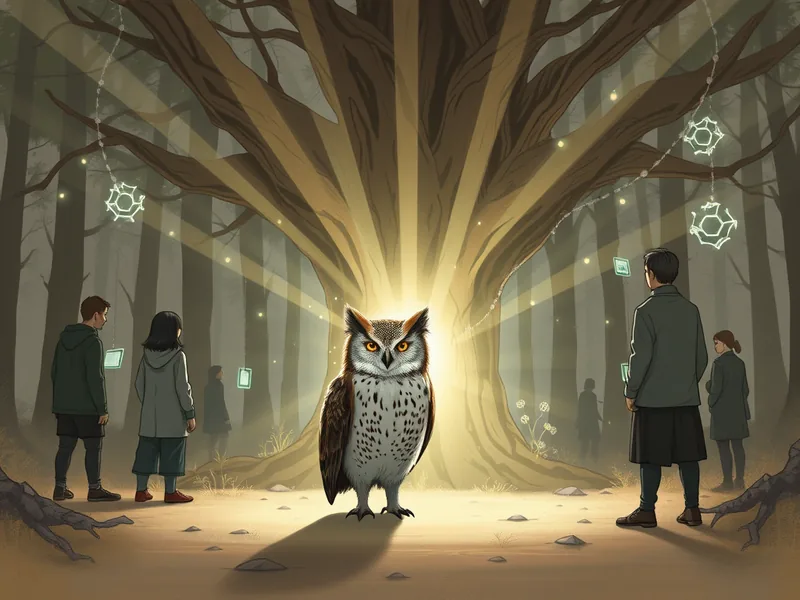
In the heart of a digital forest, a world of tiny creatures comes to life. Each one, from the wise owl to the cunning fox, is driven by its own artificial intelligence (AI) model. This is Thousand Token Wood v2, a simulation that has evolved from a passive observer's toy into an engaging game where you, the player, become the Patron of the Wood-a shadow financier pulling the strings behind the scenes.
Lester Leong, known in the community as AdmiralTaco, led the development of this second iteration. The first version was a weather-god sandbox: five woodland creatures traded goods on a single fine-tuned 0.5B model, and players could only observe the economic bubbles and crashes that emerged. It was fascinating but distant. V2 changes all that by inviting you to actively shape the world.
As the Patron of the Wood, you lend at interest, plant rumors, broker alliances, and even bribe creatures. A magistrate hunts you for your illicit activities, adding a layer of tension and strategy. The creatures remember how you treated them and scheme in response, creating a dynamic and unpredictable environment. But the most significant change lies beneath the surface: each creature now thinks with a different AI model.
The heart of Thousand Token Wood v2 is its use of four distinct small models, each from a different lab. This diversity ensures that the market remains interesting as participants genuinely differ in their behaviors and strategies. The owl hoards resources differently than the fox speculates, making every interaction a live argument rather than a scripted sequence.
The models used are gpt-oss-20b (OpenAI), MiniCPM3-4B (OpenBMB), Nemotron-Mini-4B (NVIDIA), and a fine-tuned Qwen 0.5B created by the team. Each model brings its unique strengths, trained on different data sets with varying post-training techniques. This diversity is crucial for creating a rich, emergent economy where the player's actions have real consequences.
Setting up these models presented some technical challenges, but they were manageable. The current version of vLLM (0.22.1) required the CUDA toolkit to be present in the base image, which was not included by default. Once this was addressed, all four models ran smoothly. Gpt-oss-20b operates in its native MXFP4 quantization, fitting comfortably within a 24GB L4 GPU without needing high-end hardware. MiniCPM3 required trust_remote_code to load correctly, while Nemotron and the fine-tuned Qwen loaded seamlessly.
The integration of these models not only enhances the simulation's complexity but also demonstrates the potential for combining different AI systems to create more sophisticated and nuanced environments. This approach could have far-reaching implications beyond gaming, influencing fields such as education, urban planning, and even healthcare.
Thousand Token Wood v2 is more than just a game; it's a proof of concept for how diverse AI models can coexist and interact in a single platform. The ability to run multiple small models together opens up new possibilities for creating dynamic, adaptive systems that can better simulate real-world scenarios.
In education, such simulations could provide students with interactive learning environments where they can experiment with economic principles or social dynamics in a controlled setting. In urban planning, these models could help predict the impact of policy changes on different communities, allowing planners to make more informed decisions. In healthcare, they could be used to model patient interactions and treatment outcomes, leading to personalized care plans.
The success of Thousand Token Wood v2 also highlights the importance of open-source collaboration in AI development. By using models from various labs, the team was able to create a richer and more engaging experience. This collaborative approach can accelerate innovation and ensure that AI technologies are accessible and beneficial to a broader range of users.
As we continue to explore the potential of AI, projects like Thousand Token Wood v2 remind us that the real power lies in how these tools can enhance human creativity and problem-solving. The future is bright, filled with possibilities for collaboration and discovery, all driven by the diverse minds within our digital forests.
Original Sources
Five labs, five minds: building a multi-model finance drama on small models
↗ https://huggingface.co/blog/build-small-hackathon/thousand-token-wood-sim-v2?utm_source=tldrai
About the author
Lena spent a decade working in international development before AI tools began showing up in the field programmes she was running — first as curiosity, then as something that genuinely changed outcomes. She writes about the moments where AI stops being a headline and starts being a lifeline: the early cancer detection in a rural clinic, the flood model that gave a village three extra days to evacuate, the translation tool that let a child speak to a doctor for the first time. She is not naive about the risks, but she believes the stories of AI doing real good deserve the same rigour and airtime as the cautionary ones.
More from The Optimist →This Week's Edition
15 June 2026
18 articles
Related Articles

IEEE Expands Smart City Advisory Services as Municipal Tech Budgets Grow
Products & Applications · 5 min

Christina Applegate's MS Misdiagnosis Reveals a Painful Diagnostic Gap in Neurology
Health & Science · 5 min

Robot Infants Are Being Built to Study Human Emotion. Should They Look So Real?
Products & Applications · 5 min
Related Articles
IEEE Expands Smart City Advisory Services as Municipal Tech Budgets Grow
Products & Applications · 5 min
Christina Applegate's MS Misdiagnosis Reveals a Painful Diagnostic Gap in Neurology
Health & Science · 5 min
Robot Infants Are Being Built to Study Human Emotion. Should They Look So Real?
Products & Applications · 5 min
More Stories
© 2026 Cedar & Bloom. All rights reserved.
