The Drum · Weekly AI news, freeSubscribe →
Share
New James Webb Space Telescope observations show the rings of Chariklo, a small icy body beyond Saturn, have shifted dramatically in a decade, raising fresh questions about how ring systems form, persist, and evolve across the solar system.
Rings used to feel like a Saturn thing, a signature so tied to gas giants that finding them anywhere else seemed almost implausible. Then in 2013, a small, dark chunk of rock and ice orbiting between Saturn and Uranus passed in front of a distant star and blinked twice before the main event. That double-flicker turned out to be starlight dimming as it passed through two narrow rings circling a body barely 250 kilometers across, smaller than many city-sized asteroids.
"It was a surprise," says Pablo Santos-Sanz, an astronomer at the Instituto de Astrofísica de Andalucía in Granada, Spain. The object, now named Chariklo, became the first known minor body with rings of its own. Ever since, scientists have wondered what those rings are made of, and whether they're stable or slowly falling apart.
Santos-Sanz and his colleagues just got a striking answer. Using the James Webb Space Telescope to watch Chariklo cross in front of a background star again, they found that one of its two rings had grown noticeably denser over the past decade. The other had nearly disappeared. Nobody knows exactly why.
The method astronomers use here is elegant in concept, even if it's brutal in practice. "We predict when a Solar System object passes in front of a star," Santos-Sanz explained. As the object crosses the star's light, the dimming pattern reveals details about its size, shape, and anything orbiting it. Think of it like reading a person's silhouette as they walk past a lit doorway: you can't see them directly, but the shape of the shadow tells you plenty.
The trouble is scale. Chariklo's silhouette against the sky is minuscule, and predicting exactly when it will cross paths with a particular star demands extremely precise positioning data for both objects. In 2013, ground-based telescopes managed to spot Chariklo's two rings, later named C1R and C2R. They sit 390 and 405 kilometers from the body's center, each only a few kilometers wide, separated by about 7 kilometers.
Doing this from space multiplies the difficulty. JWST orbits near a gravitational balance point called L2, roughly a million miles from Earth, and controllers have to nudge its position every few weeks just to keep it stable. That constant drift makes aiming at a specific patch of sky months in advance a moving target, literally. "It's a kind of tricky task," Santos-Sanz said.
His team spotted a possible Chariklo occultation in August 2022 and recalculated the prediction weekly as new data came in. Between the earliest estimate and one of the final ones, the projected sightline shifted by about 110 kilometers, more than enough to miss the target entirely. JWST needs observation plans locked in at least 14 days ahead, so there was no room to wait for last-minute certainty.
"We did this maybe a bit blindly, because we didn't know exactly where the line of sight was," Santos-Sanz admitted. "I'm going to move one of the biggest, best telescopes in space, and we don't know if finally we will catch this or not." The gamble paid off.
On October 18, 2022, the occultation happened. JWST's line of sight to the background star passed just 7.4 kilometers above Chariklo's surface, missing the body itself but slicing directly through its rings. The telescope recorded the event in two infrared wavelengths at once, 1.5 and 3.2 micrometers, marking the first time anyone has observed a minor body's rings beyond three micrometers, a range Earth's atmosphere normally blocks from ground observatories entirely.
The results were startling. The inner ring, C1R, showed up with sharp, unmistakable edges, but far darker than expected. Averaged across roughly ten previous ground-based observations, its typical opacity, meaning the fraction of starlight it blocks, measured 0.303. JWST recorded 0.431 instead, a substantial jump. "We didn't believe it at the beginning, so we fought a lot with the data," Santos-Sanz said.
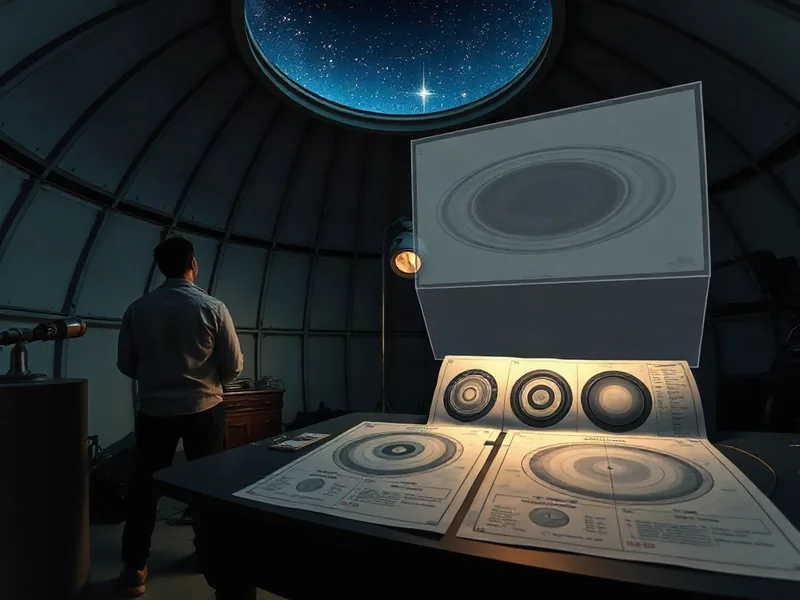
His team initially suspected a simpler explanation: rings aren't perfectly uniform, and the telescope might have simply crossed a denser clump by chance. To test that, they built a model of a lumpy, irregular ring and ran ten million simulated occultations. The odds of randomly hitting a clump dense enough to match JWST's reading came out to roughly 1 in 1,000 at the shorter wavelength and 4 in 100,000 at the longer one, for a single pass. JWST caught the ring twice, entering and exiting, which shrinks those odds even further.
Meanwhile, the outer ring told the opposite story. C2R barely registered at 1.5 micrometers and vanished completely at 3.2, even though the telescope recorded both wavelengths simultaneously across the same stretch of ring. "At the beginning we didn't even see the outer ring in the light curve," Santos-Sanz said. "We had to use models. It was really barely visible, so we said, 'What is happening here?'"
Two explanations are on the table. One is that JWST, observing wavelengths almost never used to study ring occultations before, is simply picking up how tiny ice and dust grains scatter infrared light differently than visible light. The other is that the rings have genuinely changed. Santos-Sanz leans toward real change. Older visible-light data fit a mix of ice and silicate particles reasonably well, but once JWST's numbers are folded in, no combination of grain sizes or materials explains the full picture.
"We are witnessing a real evolution of the rings with time," he said. "Of course it is not a certainty, but for me it is the preferred explanation." Interestingly, the math doesn't support simple migration, where the vanishing outer ring's material just drifted inward to bulk up the inner one. Measured by equivalent width, the inner ring gained roughly ten times more material than the outer ring lost.
So where did the extra material come from? "We don't know where the extra material is coming from, but there are some hypotheses," Santos-Sanz said. The leading candidate is an undetected shepherd moon, a small satellite that could gravitationally corral the outer ring, explain its sharp edges, and shed debris that slowly feeds the inner ring. "This satellite has not been detected yet, if it exists," he added.
A preliminary model built from the JWST data offers a hint about composition, too. "Our feeling after this model is that the inner ring should be composed of bigger particles than the outer ring. The outer ring we think is more dusty," Santos-Sanz said, though he's careful to call this a work in progress rather than a settled result.
The team's next step is catching another Chariklo occultation, this time in visible light, which would help separate genuine physical change from a wavelength illusion. "We are searching for new occultations," Santos-Sanz said.
The stakes go beyond one small, icy body. Rings have now turned up around the centaur Chiron, the dwarf planet Haumea, and the trans-Neptunian object Quaoar, suggesting these delicate structures are far more common among small bodies than anyone expected a decade ago. Giant planets already show similar restlessness: Saturn's D ring has measurably shrunk over the years, and Neptune's Adams ring arcs constantly rearrange themselves. Small, distant worlds, it now seems, play by the same dynamic rules.
"I think this work is just a piece of the puzzle," Santos-Sanz said, "but it could be an important clue for broader studies about the rings around minor bodies and around giant planets." Understanding how these fragile rings form, evolve, and sometimes fade away could reshape how astronomers think about planetary formation across the solar system, from its biggest worlds down to its smallest.
Tags
Original Sources
Rings around a tiny body have changed over the past decade
↗ https://arstechnica.com/science/2026/09/rings-around-a-tiny-body-have-changed-over-the-past-decade
About the author
Amara's entry point into AI was an epidemiology role at a London research hospital, where she spent five years studying how digital health tools reached — or conspicuously failed to reach — underserved communities. Watching early algorithmic systems in healthcare quietly entrench existing inequalities, she redirected her career toward the systemic consequences of AI at scale. She covers AI through an unflinching lens: who benefits, who bears the cost, and what evidence actually says versus what the press release claims. Her writing is calm and precise, but she doesn't mistake balance for neutrality.
More from The Steward →This Week's Edition
20 September 2026
20 articles
Related Articles
AI Tools Are Learning to Read Kidney Transplant Biopsies, and Pathologists Are Taking Notice
Health & Science · 6 min
AI Moves From Novelty to Necessity in Cancer Care
Health & Science · 6 min
Stanford HAI's Fall 2026 Seminar Lineup Zeroes In On World Models, AI Measurement, and Workforce Anxiety
Models & Research · 5 min
Related Articles
AI Tools Are Learning to Read Kidney Transplant Biopsies, and Pathologists Are Taking Notice
Health & Science · 6 min
AI Moves From Novelty to Necessity in Cancer Care
Health & Science · 6 min
Stanford HAI's Fall 2026 Seminar Lineup Zeroes In On World Models, AI Measurement, and Workforce Anxiety
Models & Research · 5 min
More Stories
© 2026 Cedar & Bloom. All rights reserved.
