The Drum · Weekly AI news, freeSubscribe →

Share
Aeneas, built by DeepMind, uses advanced contextual reasoning to analyze ancient inscriptions, offering historians unprecedented insights and speeding up the restoration process by identifying subtle connections in fragmented texts.
Aeneas, a groundbreaking AI model from DeepMind, is transforming how historians interpret, attribute, and restore ancient inscriptions. This new tool, introduced in a recent paper published in Nature, accelerates the complex process of identifying parallels among fragmentary texts, providing historians with a powerful resource to connect the past.
Aeneas builds upon DeepMind's earlier work with Ithaca, an AI model that focused on restoring, dating, and placing ancient Greek inscriptions. However, Aeneas takes this a step further by:
Historians traditionally rely on their expertise and specialized resources to identify "parallels", texts that share similarities in wording, syntax, standardized formulas, or provenance. This process is often time-consuming and requires extensive knowledge. Aeneas significantly speeds up this work by:
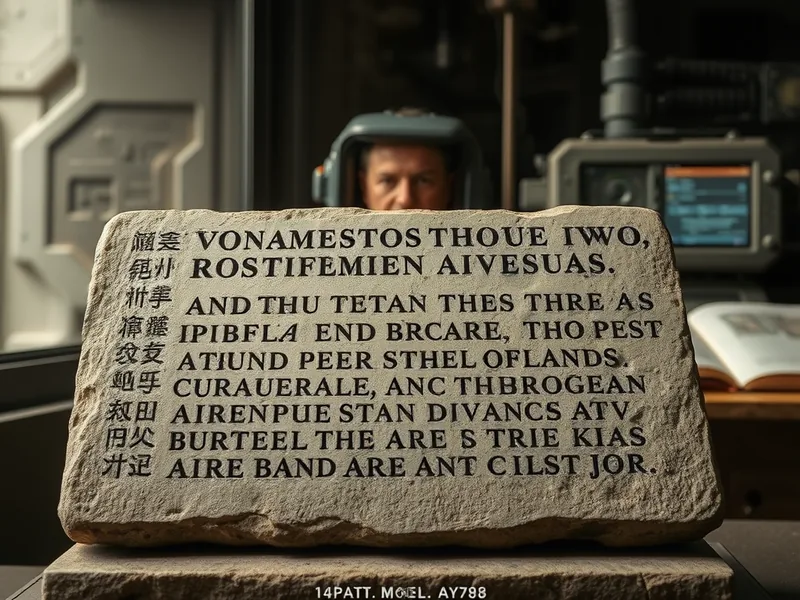
Aeneas is built on advanced deep learning techniques and leverages a vast corpus of Latin inscriptions. Here are some key technical points:
To ensure this research benefits as many people as possible, DeepMind has made an interactive version of Aeneas freely available at predictingthepast.com. This tool is accessible to researchers, students, educators, and museum professionals. Additionally, the code and dataset are open-sourced on GitHub, encouraging further research and development in this field.
Aeneas represents a significant step forward in using AI for historical analysis. The model's adaptability to other ancient languages and media opens up new possibilities for connecting diverse historical evidence. DeepMind is committed to continuing this research and exploring how generative AI can further enhance the work of historians.
Tags
Original Sources
About the author
Kai built ML infrastructure at a Bay Area startup before developing an obsession with transformer architectures and inference optimisation that eventually pulled him out of product work entirely. A stint at a compute research lab sharpened his instinct for what actually matters in a model release versus what is marketing. He writes from the inside — from the perspective of someone who has debugged the systems he is describing at three in the morning. He is allergic to hype and instinctively drawn to the unglamorous plumbing questions that everyone else skips over.
More from The Engineer →This Week's Edition
24 July 2025
29 articles
Related Articles

Wharton's Fourth Annual AI Survey: Most Companies See Returns, Few See Big Ones
Models & Research · 6 min
Tensormesh Launches Enterprise KV Cache Platform to Cut Redundant LLM Compute
Models & Research · 6 min

Iambic Therapeutics Raises $150 Million in IPO to Fund AI-Designed Cancer Drugs
Finance & Markets · 5 min
Related Articles
Wharton's Fourth Annual AI Survey: Most Companies See Returns, Few See Big Ones
Models & Research · 6 min
Tensormesh Launches Enterprise KV Cache Platform to Cut Redundant LLM Compute
Models & Research · 6 min
Iambic Therapeutics Raises $150 Million in IPO to Fund AI-Designed Cancer Drugs
Finance & Markets · 5 min
More Stories
© 2026 Cedar & Bloom. All rights reserved.
