The Drum · Weekly AI news, freeSubscribe →

Share
Radiologists are moving from AI that flags abnormalities to AI that writes the report itself. At this year's RSNA meeting, the conversation shifted from "can it work" to "should we trust it," with patient safety hanging in the balance.
Imagine going in for a chest CT after a bad cough that won't quit. A radiologist reviews your scan, writes up findings, and that report becomes the basis for whatever your doctor tells you next. Now imagine an AI system writes the first draft of that report, before a human ever looks at your images. That is not a hypothetical anymore. It is happening in radiology departments right now, and the people who build and use these tools are still working out what it means for patient safety.
Radiology has used artificial intelligence for more than twenty years. Nearly every radiologist today relies on some kind of AI, whether it's sorting incoming scans by urgency, transcribing spoken notes, or flagging a suspicious shadow on an X-ray. These tools have mostly played a supporting role. They point things out. They don't decide what the findings mean.
That started to change. At last year's meeting of the Radiological Society of North America, the field's largest annual gathering, something new took center stage. Companies debuted vision-language models, AI systems trained to connect images with written language, capable of doing a task long considered uniquely human: looking at a scan and drafting the actual clinical report describing what it shows.
"Last year's RSNA was mainly focused on whether it's actually possible that an AI model will write a draft for radiologists that would look like an actual radiology report, and that would be accurate enough to be even considered by a radiologist," said Michael Braginsky, chief technology officer of Aidoc, a company building these tools.
That question, in other words, was about basic feasibility. Could a machine produce something that even resembled the real thing? The industry's attention has since moved past that first hurdle. Business deals and heated professional debates have followed, centered on whether AI-drafted reports can interpret something as sensitive as a chest X-ray without a radiologist checking every line first.
Think of the older generation of radiology AI like a smoke detector. It doesn't tell you what's burning or how bad the fire is. It just makes noise so a human comes running. A vision-language model that drafts a full report is a different kind of tool entirely. It's more like a junior colleague handing you a completed write-up for your signature, one you still need to check carefully, but one that's already done most of the drafting work.
That distinction matters enormously for patient safety. A flagging tool can miss something, and a radiologist might still catch it during their own independent read. A drafting tool changes the workflow itself. If a radiologist starts from an AI's draft instead of a blank page, their attention shifts from active search to passive review. Psychologists who study human error call this automation bias: the tendency to trust a machine's output simply because it's already there, polished and confident-looking, even when it's wrong.
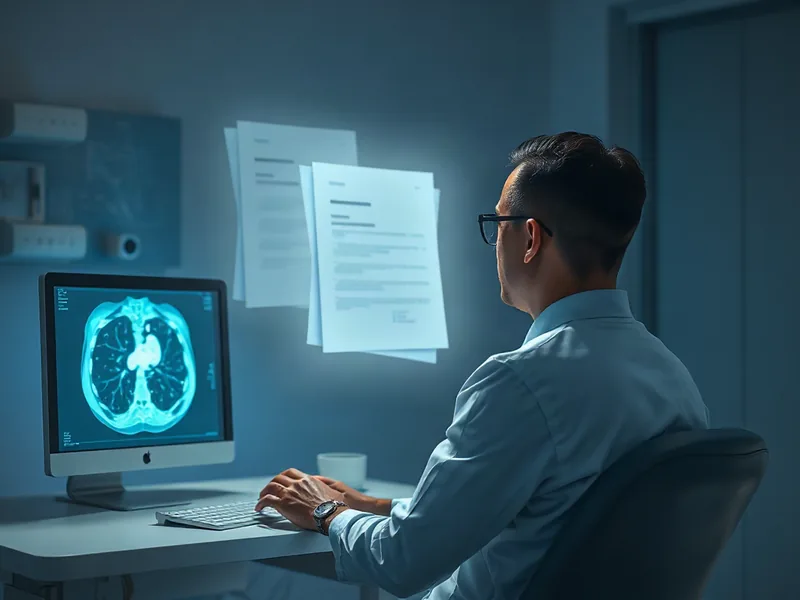
That risk is exactly why the radiology community has moved from asking whether AI can write a convincing report to asking harder questions about accuracy, oversight, and accountability. Acquisitions in the imaging AI space have accelerated as companies race to build and buy this technology. At the same time, practicing radiologists have pushed back hard on the idea that any AI system, no matter how advanced, should interpret something like a chest X-ray without a trained physician checking the work.
The stakes of getting this wrong are not abstract. A missed nodule on a CT scan can mean a cancer diagnosis delayed by months. A misread fracture can send a patient home without the cast or surgery they needed. Radiology reports are the backbone of countless downstream decisions, from whether a patient gets rushed into surgery to whether they're reassured and sent home. If AI drafts start introducing subtle errors at scale, across thousands of hospitals processing millions of scans, the cumulative harm could be significant even if each individual mistake seems small.
There's a flip side worth taking seriously too. Radiologists are stretched thin. Many read dozens of complex studies a day, often under significant time pressure, in a field already grappling with workforce shortages in many regions. A well-built drafting tool that handles the routine, time-consuming parts of a report, like measurements and standard phrasing, could free up a radiologist's limited mental energy for the genuinely difficult diagnostic calls that need a trained human eye. Used thoughtfully, this technology could reduce fatigue-driven errors rather than introduce new ones.
The difference between those two outcomes, better care or new risks, likely comes down to implementation. Who checks the AI's work, and how carefully? What happens when a radiologist is reviewing their fortieth AI-drafted report of the day and starts to rubber-stamp rather than truly re-examine each one? These are workflow and culture questions as much as technical ones, and they don't have easy answers yet.
For patients, none of this debate is academic. The radiology report is often the single document that determines what happens next in your care, whether that's immediate treatment, more testing, or reassurance that nothing is wrong. As AI takes on a larger role in producing that document, the margin for undetected error becomes a direct patient safety issue, not just a technical curiosity debated at industry conferences.
What's encouraging is that the field seems to recognize this. The shift in conversation at RSNA, from "can AI write a report" to "can we trust an AI-written report without full human oversight," reflects a maturing awareness that capability and safety are not the same thing. A tool can be technically impressive and still be dangerous if it's deployed without the right safeguards, training, and accountability built around it.
The coming years will likely bring clearer answers, as hospitals test these tools in real clinical settings and track outcomes over time. For now, the most responsible path forward is one where AI handles the routine so radiologists can focus their expertise where it matters most, with every draft still subject to a careful, skeptical human eye before it shapes a patient's care.
Tags
Original Sources
AI can analyze X-rays and CT scans to draft radiology reports. Will it make care better, safer?
↗ https://www.statnews.com/2026/11/24/does-radiology-ai-draft-reports-make-care-better-safer-rsna
About the author
Amara's entry point into AI was an epidemiology role at a London research hospital, where she spent five years studying how digital health tools reached — or conspicuously failed to reach — underserved communities. Watching early algorithmic systems in healthcare quietly entrench existing inequalities, she redirected her career toward the systemic consequences of AI at scale. She covers AI through an unflinching lens: who benefits, who bears the cost, and what evidence actually says versus what the press release claims. Her writing is calm and precise, but she doesn't mistake balance for neutrality.
More from The Steward →This Week's Edition
25 November 2026
20 articles
Related Articles

South Korea Builds National AI Network to Close Healthcare Gap Between Seoul and the Regions
Health & Science · 6 min

In Alaska's Vast Interior, AI Is Racing to Save Minutes in Stroke Care
Health & Science · 6 min

ACA Marketplace Choices Shrink for 2027, With Over 200 Counties Down to One Insurer
Policy & Regulation · 5 min
Related Articles
South Korea Builds National AI Network to Close Healthcare Gap Between Seoul and the Regions
Health & Science · 6 min
In Alaska's Vast Interior, AI Is Racing to Save Minutes in Stroke Care
Health & Science · 6 min
ACA Marketplace Choices Shrink for 2027, With Over 200 Counties Down to One Insurer
Policy & Regulation · 5 min
More Stories
© 2026 Cedar & Bloom. All rights reserved.