The Drum · Weekly AI news, freeSubscribe →
Share
With most of Alaska unreachable by road and only five clot-extracting specialists statewide, hospitals are turning to artificial intelligence to shrink the diagnostic delays that cost stroke patients their brain cells, and sometimes their lives.
It was just after lunchtime when a neurointerventionalist's phone in Anchorage began buzzing. Three hundred miles away, deep in Alaska's interior, a clot was choking off blood flow to a patient's brain. He would need the clot removed, and the nearest person who could do it was in Anchorage.
For a stroke patient, time is not just precious. It is brain tissue. Every minute blood flow is cut off, roughly 2 million brain cells die. That math is brutal enough in a city hospital. In Alaska, a state more than twice the size of Texas with most of its land inaccessible by road, it becomes something closer to a cruel logistics puzzle.
Consider what it actually takes to get a stroke patient the care they need there. A plane has to be arranged. The patient has to be airlifted to Ted Stevens airport in Anchorage. Then an ambulance has to carry them to one of just five neurointerventionalists in the entire state, the specialists trained to physically extract a clot from a blocked artery. That chain of events can eat up hours. Hours that, cell by cell, a stroke patient cannot spare.
The man at the center of this particular case was in his mid-60s. He'd fallen that morning and woken up weak on his left side, a classic warning sign of stroke. Like most patients with these symptoms, he was given a head CT scan, a standard tool doctors use to figure out what kind of stroke they're dealing with: whether it's caused by a clot or a brain bleed, and whether that clot might respond to clot-busting drugs or needs to be physically pulled out.
The scan itself is fast. What happens next usually isn't. Under the old system, once that CT was finished, it could take 45 minutes just to transmit the thousands of two-dimensional brain images to a specialist in Anchorage for review. Forty-five minutes translates to roughly 90 million brain cells lost before a doctor even sees the scan, let alone accepts the transfer and starts the journey to get the patient into surgery.
This is the problem a growing number of Alaskan hospitals are trying to solve with artificial intelligence. The idea is straightforward even if the engineering behind it isn't: software that can scan a CT image almost instantly, flag signs of a blocked artery, and alert a specialist before a human radiologist has even finished reviewing the file.
Think of it like a smoke detector versus waiting for someone to smell smoke and call the fire department. The AI doesn't replace the neurointerventionalist's judgment. It replaces the delay in getting that judgment the information it needs. In a place like Alaska, where the "fire department" might be a plane ride away, shaving even 20 or 30 minutes off that alert time can be the difference between a patient walking out of the hospital and one who doesn't regain full use of a limb.
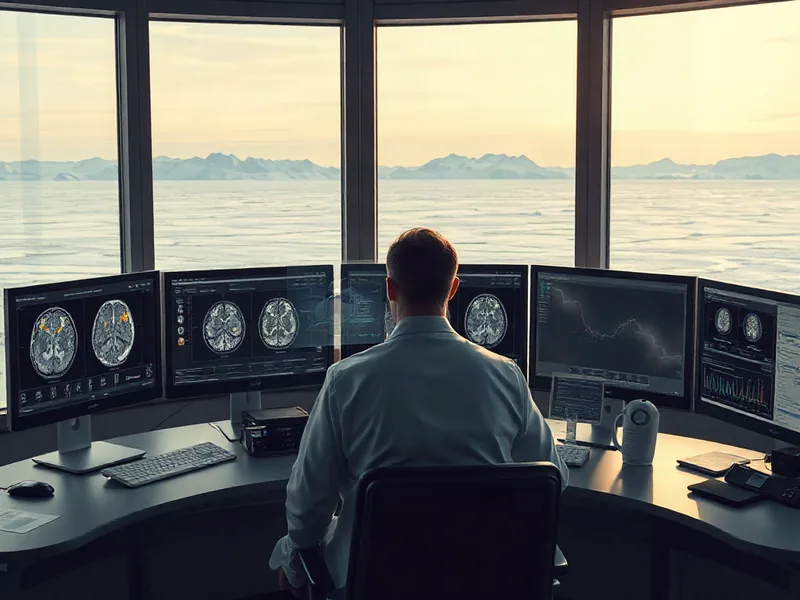
Rural health systems across the country have struggled with this same bottleneck for years, just rarely at Alaska's scale. Stroke care depends on something doctors call "door-to-needle" or "door-to-puncture" time, the interval between a patient arriving at a hospital and receiving treatment. National guidelines push hospitals to hit that mark in under an hour whenever possible. In Alaska's interior, where the nearest big-city hospital might be a flight away rather than a drive, that target has historically felt almost unreachable.
AI tools built to detect large vessel occlusions, the kind of major artery blockages that require physical clot removal, have already started showing up in emergency departments in the lower 48. What makes the Alaska effort notable isn't the technology itself so much as the environment it's being deployed into. This is a stress test in one of the hardest possible settings: vast distances, limited specialist coverage, and weather that can ground a medevac flight without warning.
That doesn't mean the technology is a cure-all. AI models trained to spot clots on CT scans are only as good as the data they were trained on, and false positives or missed detections remain real risks that clinicians have to weigh. A flagged scan still needs a human specialist to confirm the diagnosis and make the call on treatment. The software is meant to compress the waiting period, not replace the expertise waiting on the other end of the phone.
There's also the question of access and equity woven through all of this. Alaska's Indigenous communities, many of them in the most remote parts of the state, already face some of the starkest health care disparities in the country. A tool that shaves critical minutes off stroke response could meaningfully narrow that gap, but only if hospitals in those communities actually have the scanners, the bandwidth, and the staff training to use it. Technology deployed unevenly can just as easily widen a disparity as close one.
Stroke remains one of the leading causes of long-term disability in the United States, and the speed of treatment is one of the few variables doctors can actually control. In a state where geography works against nearly every other part of the equation, from distance to doctor density to weather, tools that buy back even small amounts of time carry outsized weight.
What happened to the patient on that summer Wednesday captures both the promise and the stakes. His case moved through a system built on human relay, phone calls, scans, flights, and ambulances, each step layered with the risk of delay. Faster image analysis won't fix the distances involved. It won't put more neurointerventionalists in rural Alaska. But it can shrink the one part of the process that technology is actually capable of shrinking: the time between a scan being taken and a specialist knowing what it shows.
For a stroke patient losing 2 million brain cells a minute, that shrinking window is not an abstraction. It's the difference, quite literally, measured in brain tissue that gets to survive.
Tags
Original Sources
How artificial intelligence is offering new hope for stroke patients in the Last Frontier
↗ https://www.statnews.com/2026/11/24/alaskan-hospitals-artificial-intelligence-bet-improve-stroke-care
Alaskan hospitals use AI to improve stroke care, peptides ...
↗ https://www.statnews.com/2026/11/24/alaskan-hospitals-using-ai-rsna-2026-peptides-health-tech
About the author
Amara's entry point into AI was an epidemiology role at a London research hospital, where she spent five years studying how digital health tools reached — or conspicuously failed to reach — underserved communities. Watching early algorithmic systems in healthcare quietly entrench existing inequalities, she redirected her career toward the systemic consequences of AI at scale. She covers AI through an unflinching lens: who benefits, who bears the cost, and what evidence actually says versus what the press release claims. Her writing is calm and precise, but she doesn't mistake balance for neutrality.
More from The Steward →This Week's Edition
25 November 2026
20 articles
Related Articles
AI Can Now Draft Your Radiology Report. The Question Is Whether That Makes You Safer
Health & Science · 6 min
South Korea Builds National AI Network to Close Healthcare Gap Between Seoul and the Regions
Health & Science · 6 min
ACA Marketplace Choices Shrink for 2027, With Over 200 Counties Down to One Insurer
Policy & Regulation · 5 min
Related Articles
AI Can Now Draft Your Radiology Report. The Question Is Whether That Makes You Safer
Health & Science · 6 min
South Korea Builds National AI Network to Close Healthcare Gap Between Seoul and the Regions
Health & Science · 6 min
ACA Marketplace Choices Shrink for 2027, With Over 200 Counties Down to One Insurer
Policy & Regulation · 5 min
More Stories
© 2026 Cedar & Bloom. All rights reserved.