The Drum · Weekly AI news, freeSubscribe →

Share
Families that once argued only over Trump or abortion are now splitting over chatbots. A psychologist says the fights aren't really about AI at all, they're about who feels left behind.
Sophie, a 27-year-old social work student in North Carolina, hasn't touched ChatGPT or Claude. She types "minus AI" after every Google search and switched off Microsoft Copilot entirely. Her reasons stack up: worries about eroding critical thinking, AI leaders cozying up to the Trump administration, and data centers straining water supplies in nonwhite communities. "My anti-AI stance is very deeply ingrained in my anti-capitalist beliefs," she says.
Her extended family doesn't share that stance, and the gap has gotten personal. She worries one aunt is "bordering on AI psychosis." A cousin built her twins' entire feeding and sleeping schedule using ChatGPT and now runs an AI app for pediatric assessments. When Sophie once shared her résumé for feedback, that same cousin fed it straight into ChatGPT without asking. "She didn't ask for my consent to use my intellectual property to train large language models," Sophie says. It sparked what she calls a huge conflict, one that still echoes every time the family gathers. "I'm constantly anticipating frustration and being judged, being told that I am naive," she says.
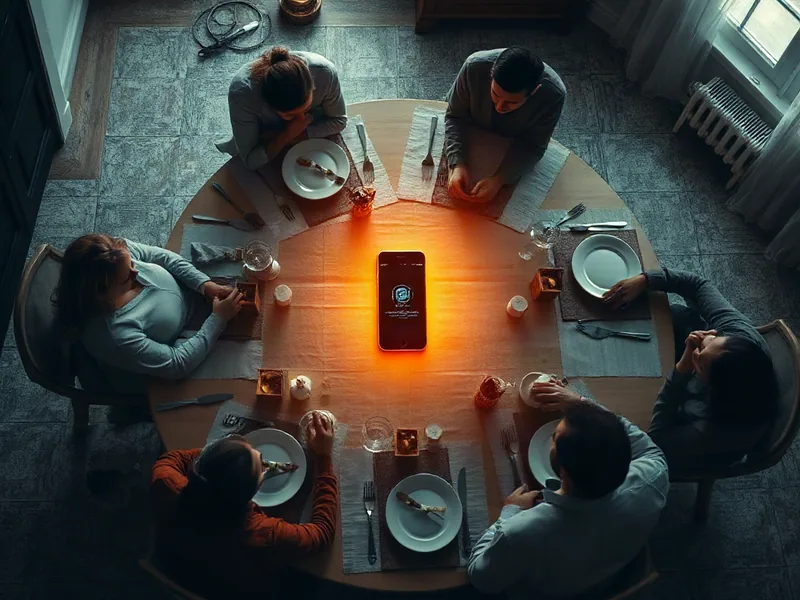
This is what Thanksgiving tables look like now in a lot of American households. For years the list of topics to steer clear of included Trump, immigration, Israel and Palestine, abortion, LGBTQ rights. Add AI to the pile. Think of it less like a new argument and more like an old fault line that's found a new crack to run through.
"It's the latest generational beef," says Matt Lundquist, a psychologist and founder of Tribeca Therapy in New York City. He's seen AI arguments rise sharply within families, cutting even through relationships that used to agree on everything.
Take Lindsay, a 40-year-old romance novelist in Pennsylvania whose family is, by her own description, "very politically aligned." They'd never needed a rule about avoiding politics or Israel at the table, until her uncle started gushing about ChatGPT at Passover dinner. Lindsay had recently discovered that one of her own books had been used to train an AI model without her permission. "Do you understand that ChatGPT is not a magical device?" she remembers telling him. "It is being created by pirating work from actual writers." Her uncle, she says, grew "befuddled," then "giggly and nervous," clearly hearing for the first time that the tool he loved ran on uncredited, uncompensated creative labor. "I can tell that he thinks this is a benevolent, harmless thing," Lindsay says.
That disconnect shows up again and again among people in creative fields. John, a 20-year-old cinematography student in Chicago whose girlfriend works in animation, worries about both his career and the future of art itself. His father, a civil and chemical engineer, uses AI to manage plant data across multiple sites and sees it as an unambiguous time-saver. "I'll say, 'Oh, this is potentially taking away my job,'" John says. "And his response will be like, 'Well, I don't think that it'll get to that point.' But then I'll say, 'Oh, it's already doing that.'" Neither side budges. "Our positions are so ingrained," he says.
Lundquist has noticed a pattern: it's mostly people under 30, especially those still finding their footing in the job market, who are pushing back hardest against their elders. Pew Research backs this up. A survey published in August found that most American adults under 30 describe themselves as more worried than excited about AI, and 73 percent in that age group believe it will shrink the number of jobs available to them. That's not an abstract fear for people just entering the workforce. It's the difference between landing that first job or watching it disappear into an algorithm.
But young people's relationship with AI is more tangled than pure rejection. An Axios poll from August found that 61 percent of 18-to-34-year-olds had used ChatGPT in the past month, with 48 percent trying Gemini and 20 percent trying Claude. People can distrust a technology and still rely on it. That contradiction, as much as anything, fuels the family arguments: it's hard to hold a hard line when you're quietly using the thing you're condemning.
Luke, a 23-year-old in Toronto who just finished a sports media degree and is struggling to find entry-level work, says AI has become "the most debated topic in the household by far." His father, a longtime computer science and web developer, views AI as "the next big step for every single person in the world." Last Canadian Thanksgiving, a casual conversation about Luke's career plans spiraled into a full AI debate. Luke assumes his dad's intensity comes from a protective place, a fear that an anti-AI stance might hurt his son's livelihood. "He wants what's best for me," Luke says.
Kaleigh, a 26-year-old in Vermont working toward a master's in social work, sees the same split with her parents, who dismiss her and her younger brother's concerns as "a young-person-exclusive take." When her mother mentioned that ChatGPT helped redesign the family's backyard, Kaleigh bristled, in part because a close friend is studying landscape architecture. "It feels so out of touch or annoying to me to have somebody that has actual money not want to pay somebody to do something creative just because it's easier to access with this data thing," she says.
Lundquist thinks a lot of older relatives are simply insulated from what feels, to younger people, like an existential threat. "If you own your second or third home with a 2.8 percent interest rate and you've already sent your kids to college, you're not worried about this stuff," he says. "And so the fact that an AI bot can order your groceries for you is just kind of cool."
Lundquist's advice for the holiday table is simple: tread carefully, or don't go there at all. "If it's done in the genuine spirit of connection, learning, and exchanging ideas, that's great," he says. "If it's done in the spirit of 'This is going to be the 2026 Thanksgiving throwdown,' that's probably not very fruitful." For those who can't resist, he suggests looking underneath the argument. The fight over AI, he says, is often standing in for something else entirely: economic anxiety, a sense of being unheard, grief over a future that looks nothing like what was promised. "The real beef is, 'I'm mad about the pittance you and your generation have left for me,'" he says. When Dad casually asks Claude for a sweet potato recipe, it can land less like convenience and more like dismissal. Understanding that distinction won't fix the dinner table divide, but it might make the leftovers easier to swallow.
Tags
Original Sources
Don’t Bring Up AI if You Want to Enjoy Your Thanksgiving
↗ https://www.wired.com/story/dont-bring-up-ai-if-you-want-to-enjoy-your-thanksgiving
About the author
Amara's entry point into AI was an epidemiology role at a London research hospital, where she spent five years studying how digital health tools reached — or conspicuously failed to reach — underserved communities. Watching early algorithmic systems in healthcare quietly entrench existing inequalities, she redirected her career toward the systemic consequences of AI at scale. She covers AI through an unflinching lens: who benefits, who bears the cost, and what evidence actually says versus what the press release claims. Her writing is calm and precise, but she doesn't mistake balance for neutrality.
More from The Steward →This Week's Edition
25 November 2026
20 articles
Related Articles

New Benchmark Finds AI Assistants Still Fumble the Basics of Daily Life
Job Market & Society · 5 min

AI Can Now Draft Your Radiology Report. The Question Is Whether That Makes You Safer
Health & Science · 6 min

South Korea Builds National AI Network to Close Healthcare Gap Between Seoul and the Regions
Health & Science · 6 min
Related Articles
New Benchmark Finds AI Assistants Still Fumble the Basics of Daily Life
Job Market & Society · 5 min
AI Can Now Draft Your Radiology Report. The Question Is Whether That Makes You Safer
Health & Science · 6 min
South Korea Builds National AI Network to Close Healthcare Gap Between Seoul and the Regions
Health & Science · 6 min
More Stories
© 2026 Cedar & Bloom. All rights reserved.