The Drum · Weekly AI news, freeSubscribe →

Share
Scientists at Cambridge have created an AI system that autonomously builds structures mirroring complex organism brains, potentially revolutionizing cognitive modeling and problem-solving efficiency in artificial intelligence.
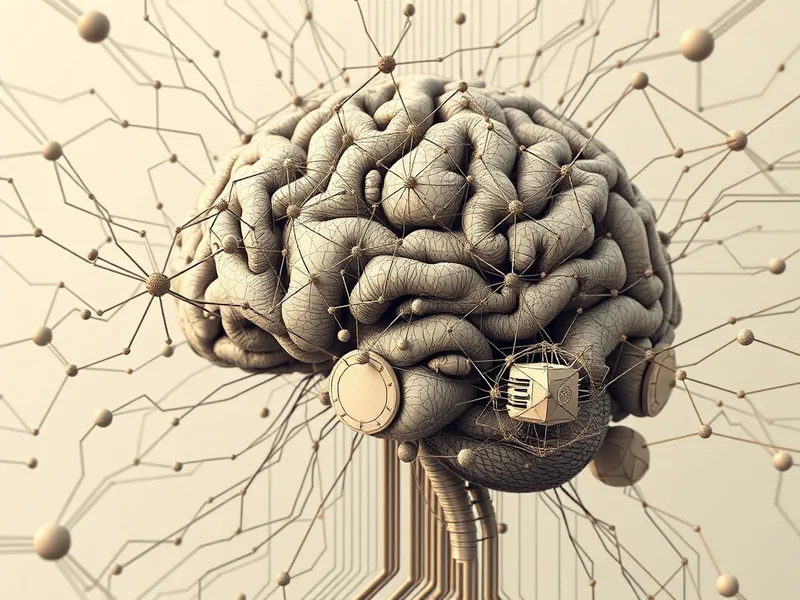
Researchers at the University of Cambridge have developed an AI system that self-organizes to develop features similar to those found in the brains of complex organisms. This breakthrough could lead to more efficient problem-solving and better cognitive models, offering new insights into how AI can be designed to mimic biological intelligence.
The key innovation is a novel constraint-based approach that guides the AI system to self-organize its architecture. Unlike traditional deep learning models that rely on pre-defined architectures and extensive training data, this system uses constraints inspired by biological processes to evolve its structure dynamically.
For AI researchers and practitioners, this development opens up new possibilities for creating more efficient and adaptive systems. Here are a few key points:
The researchers used a combination of neural network architecture and evolutionary algorithms to achieve this self-organization. Here are the key technical details:
The AI system was tested on a variety of tasks, including pattern recognition and decision-making. Here are some notable results:
The researchers also noted that the system's ability to self-organize reduced the need for extensive hyperparameter tuning, making it easier to deploy and scale.
This research from the University of Cambridge represents a significant step forward in creating AI systems that can mimic the complexity and efficiency of biological brains. By using constraint-based self-organization, the AI not only performs better on complex tasks but also offers new insights into how cognitive processes can be modeled computationally.
Tags
Original Sources
About the author
Kai built ML infrastructure at a Bay Area startup before developing an obsession with transformer architectures and inference optimisation that eventually pulled him out of product work entirely. A stint at a compute research lab sharpened his instinct for what actually matters in a model release versus what is marketing. He writes from the inside — from the perspective of someone who has debugged the systems he is describing at three in the morning. He is allergic to hype and instinctively drawn to the unglamorous plumbing questions that everyone else skips over.
More from The Engineer →This Week's Edition
1 December 2023
29 articles
Related Articles

Wharton's Fourth Annual AI Survey: Most Companies See Returns, Few See Big Ones
Models & Research · 6 min

Tensormesh Launches Enterprise KV Cache Platform to Cut Redundant LLM Compute
Models & Research · 6 min

Iambic Therapeutics Raises $150 Million in IPO to Fund AI-Designed Cancer Drugs
Finance & Markets · 5 min
Related Articles
Wharton's Fourth Annual AI Survey: Most Companies See Returns, Few See Big Ones
Models & Research · 6 min
Tensormesh Launches Enterprise KV Cache Platform to Cut Redundant LLM Compute
Models & Research · 6 min
Iambic Therapeutics Raises $150 Million in IPO to Fund AI-Designed Cancer Drugs
Finance & Markets · 5 min
More Stories
© 2026 Cedar & Bloom. All rights reserved.
