The Drum · Weekly AI news, freeSubscribe →

Share
As tech giants pour trillions into AI, health systems must adapt to a future where human-machine collaboration redefines hospital work and efficiency.
The healthcare industry has been slowly integrating artificial intelligence (AI) into its operations, primarily through automation tools like AI scribes and revenue cycle management systems. However, the real transformation is just beginning. According to Eric Langshur, co-founder of Abundant Venture Partners, the most significant impact will be the reinvention of hospital work and human-machine collaboration.
The massive investments in AI by tech giants are a clear signal of this shift. Data compiled by eco3min shows that the four largest U.S. Technology companies are committed to spending approximately $1.12 trillion on capital expenditures over 2025 and 2026, with the majority dedicated to AI infrastructure. This figure, in 2025 dollars, exceeds the combined inflation-adjusted costs of the Apollo Program ($189 billion), the Marshall Plan ($137 billion), and the Manhattan Project ($36 billion).
With such substantial investments, it's no surprise that AI will drive significant labor market shifts. In healthcare, where labor accounts for 56% of hospital costs, according to data from the American Hospital Association, these changes will have profound implications. Health systems need to find ways to deploy AI that enhance staff efficiency without compromising trust or care quality.
One key area is the reinvention of hospital work. Langshur emphasizes that AI's role in healthcare will not just be about replacing human tasks but about augmenting them. For example, AI can assist doctors in diagnosing diseases by analyzing medical images more accurately and quickly than humans alone. This collaboration can lead to faster and more accurate diagnoses, ultimately improving patient outcomes.
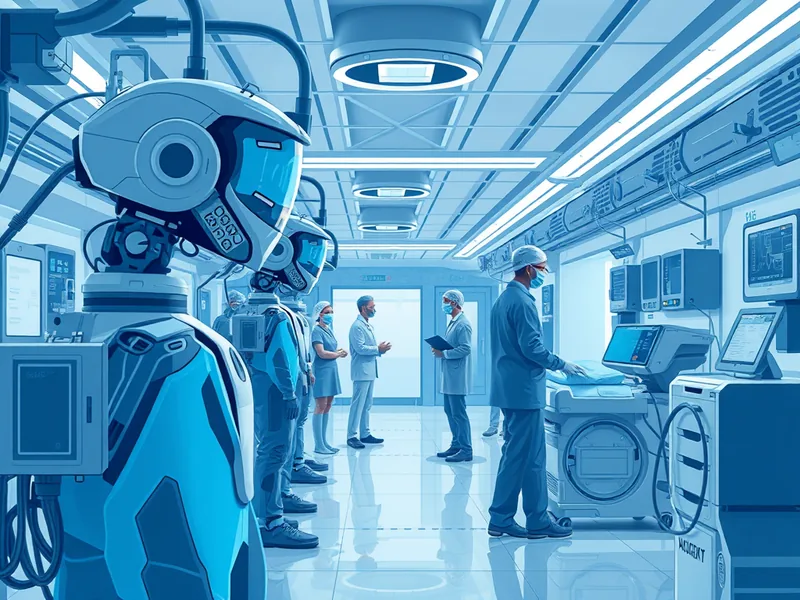
These applications are not just theoretical. Yale New Haven, Keck Medicine of USC, and Hartford HealthCare have joined Aegis Ventures' digital consortium, a group focused on leveraging AI and other advanced technologies to improve healthcare delivery.
As health systems prepare for this AI-driven transformation, several key considerations will be crucial:
Seth Hain, who led AI efforts at Epic, recently left the EHR giant as part of a broader executive exodus. This move highlights the dynamic nature of the AI landscape in healthcare and underscores the importance of staying ahead of technological trends.
The seismic shift brought about by AI in healthcare is inevitable. Health systems that proactively prepare for this transformation will be better positioned to leverage AI's potential to improve patient care, enhance efficiency, and drive innovation.
Tags
Original Sources
Health systems need to prepare for an AI-driven reinvention of work, Abundant Alliance's Eric Langshur says
↗ https://www.fiercehealthcare.com/ai-and-machine-learning/health-systems-need-prepare-ai-driven-reinvention-work-abundant-alliances
About the author
Kai built ML infrastructure at a Bay Area startup before developing an obsession with transformer architectures and inference optimisation that eventually pulled him out of product work entirely. A stint at a compute research lab sharpened his instinct for what actually matters in a model release versus what is marketing. He writes from the inside — from the perspective of someone who has debugged the systems he is describing at three in the morning. He is allergic to hype and instinctively drawn to the unglamorous plumbing questions that everyone else skips over.
More from The Engineer →This Week's Edition
27 July 2026
23 articles
Related Articles

SpaceX's AI Unit Drives Return to Profitability, Overtakes Rocket Business
Finance & Markets · 5 min

A High-Profile JAMA Study on OpenEvidence Leaves Key Clinical Questions Unanswered
Health & Science · 5 min

Stanford HAI Convenes Researchers to Rethink Empirical Methods for the AI Era
Models & Research · 5 min
Related Articles
SpaceX's AI Unit Drives Return to Profitability, Overtakes Rocket Business
Finance & Markets · 5 min
A High-Profile JAMA Study on OpenEvidence Leaves Key Clinical Questions Unanswered
Health & Science · 5 min
Stanford HAI Convenes Researchers to Rethink Empirical Methods for the AI Era
Models & Research · 5 min
More Stories
© 2026 Cedar & Bloom. All rights reserved.
