The Drum · Weekly AI news, freeSubscribe →

Share
Hours before 4,000 nurses were set to walk out in what would have been the state's largest nurse strike, Brigham and Women's Hospital and its union struck a tentative deal over staffing, wages and benefits.
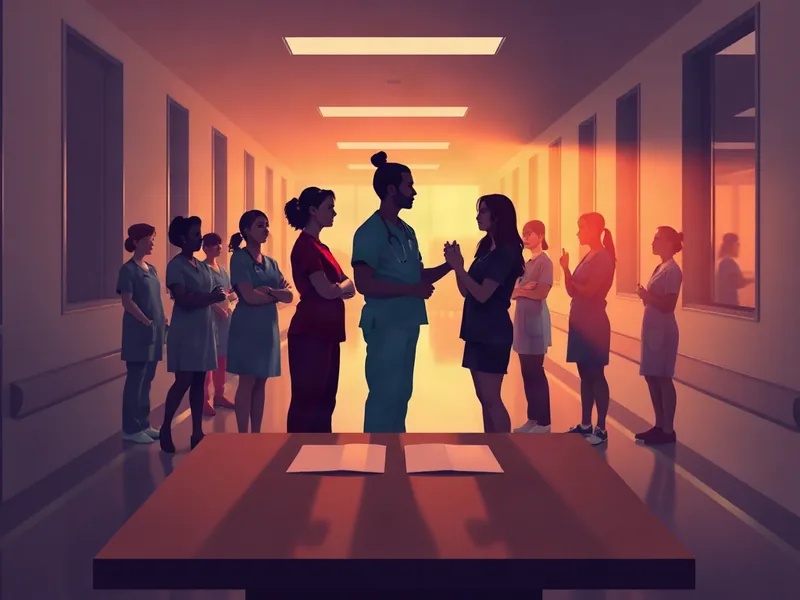
For a few tense days in November, Boston came close to watching its largest nurse strike unfold in real time. Four thousand nurses at Brigham and Women's Hospital were set to walk off the job Thursday morning, an open-ended action that would have left one of the region's flagship hospitals leaning on temporary staff during a period of deep financial strain across its parent system. Late Wednesday night, with hours to spare, the Massachusetts Nurses Association and Mass General Brigham announced they had reached a tentative agreement instead.
For the nurses and patients caught in the middle, this was not an abstract labor dispute. It was about whether someone recovering from surgery would see a familiar face at the bedside, or a rotating cast of temporary workers unfamiliar with the unit. Think of a hospital floor like a well-rehearsed ensemble: when experienced nurses are swapped out for short-term fill-ins, the rhythm breaks down, and patients are the ones who feel it.
Kelly Morgan, a labor and delivery nurse who chairs the union's bargaining committee at the Brigham, framed the outcome as a collective win. "I'm incredibly proud of the Brigham nurses who stood strong to protect the world-class patient care we provide," she said, crediting "countless community members, patients, unions and elected officials" who backed the union through months of standoff. "By standing together, we protected patients and the future of union nursing care at the Brigham."
The bargaining committee said it will recommend members ratify the agreement. According to the union, it addresses the hospital's reliance on staffing contingencies like temporary nurses and floating between units, preserves what the union calls "affordable" health insurance, and adds new pay steps at the top of the wage scale for the most experienced nurses. Brigham and Women's Hospital, for its part, said the deal falls "within the financial limits" of the offer it floated last month, calling it recognition of nurses' "important contributions" while supporting "the long-term sustainability of our hospital."
The path to this agreement stretched back to last November, when the prior contract began heading toward its March 31 expiration. By July, nurses and roughly 450 home care clinicians staged a one-day awareness strike, itself a record for the state and the first of its kind at the Brigham. Talks stalled by mid-August. In late September, members voted 93% in favor of authorizing an open-ended strike, a number that speaks less to anger than to conviction: nearly every nurse in the room was willing to walk.
What they wanted was never complicated, even if the negotiations dragged on for months. The union sought limits on temporary nurse staffing to protect continuity of care, a float differential to compensate nurses pulled between unfamiliar units, insurance options that preserve access to care, and a wage scale competitive enough to retain both new hires and veterans. Hospital leadership countered that its offer already kept Brigham nursing pay "among the highest in the market" and reflected the system's need to balance investment in staff against its broader financial picture.
That financial backdrop mattered. Mass General Brigham is the largest private employer in Massachusetts, with roughly 85,000 workers and $22.8 billion in annual revenue, ranking it among the country's largest nonprofit health systems. Nine months into its current fiscal year, the system reported $15 million in operating income, a notable swing from a $44 million operating loss the year before, though its total bottom line including investment gains reached $1.9 billion. The union pointed to that figure, along with the system's $35.8 billion in total assets and CEO Anne Klibanski's nearly $9.2 million compensation, as evidence the hospital could afford to meet nurses' demands.
The negotiations also unfolded against a backdrop of layoffs. Early last year, MGB cut about 1,500 workers in the largest layoffs in its history. More recently, the system announced a new round of job cuts tied to a $300 million budget shortfall, affecting both clinical and operational programs including its hospital-at-home initiative. For nurses watching executives discuss investor priorities at an MGB-hosted AI forum in September, the contrast was hard to ignore, and bargaining committee members rallied outside the event to make that point directly.
The path to Wednesday's deal was not a straight line. In October, the union initially postponed a scheduled Oct. 14 strike to let members vote on what the hospital called its "last, best and final offer," which would have retained the existing wage progression of annual 5% step increases up to 20 years of tenure, plus two additional 2.5% increases at the top. Members rejected it. The union then filed formal strike notice for Nov. 12, prompting the hospital to begin onboarding at least 800 agency nurses as a contingency, with some ambulatory sites adjusting hours to prepare for a prolonged walkout.
By the hospital's own account, the final sticking points in this week's marathon sessions were not about patient or workplace safety. They came down to wages and benefits, the kind of dollars-and-cents disagreements that can feel abstract on a spreadsheet but translate directly into whether a nurse can afford to stay in the profession long-term.
Strikes at this scale are rare, and their near-misses tell their own story about the pressures facing hospital staff nationwide. Nurses are not simply negotiating paychecks. They are pushing back against staffing models that lean on temporary labor and constant floating, arrangements that save hospitals money in the short term but can erode the continuity of care that keeps patients safe. When a system posts billions in assets while nurses fight for basic protections against burnout and turnover, it raises a fair question about priorities, one that extends well beyond Boston.
This agreement, if ratified, offers a measure of relief for Brigham nurses and the patients who depend on them. But it arrives alongside fresh layoffs and a shaky financial picture at the parent system, a reminder that labor peace in healthcare is rarely permanent. The same tensions that nearly triggered a historic strike this month are unlikely to disappear simply because one contract gets signed.
Tags
Original Sources
Brigham and Women's avoids 4,000-nurse strike with 11th hour deal
↗ https://www.fiercehealthcare.com/providers/brigham-and-womens-nurses-authorize-open-ended-strike
About the author
Amara's entry point into AI was an epidemiology role at a London research hospital, where she spent five years studying how digital health tools reached — or conspicuously failed to reach — underserved communities. Watching early algorithmic systems in healthcare quietly entrench existing inequalities, she redirected her career toward the systemic consequences of AI at scale. She covers AI through an unflinching lens: who benefits, who bears the cost, and what evidence actually says versus what the press release claims. Her writing is calm and precise, but she doesn't mistake balance for neutrality.
More from The Steward →This Week's Edition
13 November 2026
14 articles
Related Articles

Companies Are Buying AI Tools by the Billions. Few Know What To Do Next.
Job Market & Society · 6 min

Tether Evo's New Research Tackles BCI's Calibration Problem with Cross-Subject Models
Models & Research · 5 min

Why Some Engineers Think the Ocean Floor Is the Future of Data Centers
Environment & Climate · 5 min
Related Articles
Companies Are Buying AI Tools by the Billions. Few Know What To Do Next.
Job Market & Society · 6 min
Tether Evo's New Research Tackles BCI's Calibration Problem with Cross-Subject Models
Models & Research · 5 min
Why Some Engineers Think the Ocean Floor Is the Future of Data Centers
Environment & Climate · 5 min
More Stories
© 2026 Cedar & Bloom. All rights reserved.
