The Drum · Weekly AI news, freeSubscribe →

Share
The Cleveland Clinic and AI startup Luminai are teaming up to revolutionize hospital referrals, aiming to streamline administrative tasks and free up staff to focus on patient care.
As artificial intelligence (AI) technologies continue to evolve, healthcare systems are increasingly moving beyond specialized tools for individual tasks and toward comprehensive platforms that can manage end-to-end operational workflows. One of the leading institutions in this shift is the Cleveland Clinic, which has partnered with startup Luminai to automate complex administrative processes, starting with referral management.
Cleveland Clinic, one of the world’s largest academic medical centers, reported nearly 16 million patient encounters in 2025 across its network of 23 hospitals and 300 outpatient facilities. Referrals are a critical entry point for many of these care journeys, but managing them has traditionally been a labor-intensive process. The current workflow relies heavily on manual review of faxes and the interpretation of unstructured information.
Kesava Kirupa Dinakaran, founder and CEO of Luminai, highlights the challenges in automating healthcare administrative functions: "Healthcare’s administrative functions operate as a massive, manual coordination layer. Encoding that work into software has historically been difficult because workflows span systems and point solutions, depend on unstructured inputs, and require embedded business and clinical context at every step."
Recent advances in AI have made it possible to handle this complexity directly, not just automate isolated tasks but execute full workflows reliably. Luminai’s technology is designed to streamline the referral process by automating several key steps:
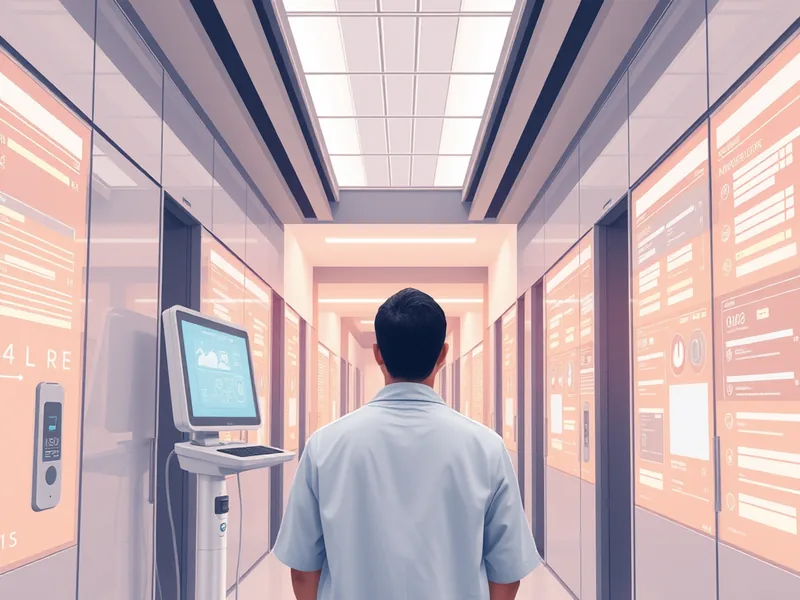
Rohit Chandra, Cleveland Clinic’s executive vice president and chief digital officer, explained why they chose referrals as their first focus: "We started with referrals because they’re one of those workflows that touch a lot of systems and involve a lot of coordination behind the scenes. There’s intake, validation, follow-up. Before this, a lot of that process depended on caregivers manually reviewing information and coordinating across different systems."
The Cleveland Clinic processes millions of faxes annually, each containing handwritten notes and operational data that must be extracted and imported into electronic medical records (EMRs). In pilot tests with Luminai’s technology, the clinic saw significant improvements in efficiency and accuracy.
"All of these referrals were being processed through raw fax operations. They were getting millions of faxes where the job of the operations organization was to look at every fax and the handwritten notes within them, and then read and extract both the operational and clinical data from those faxes, and then import it into the EMR," Chandra noted.
The partnership between Cleveland Clinic and Luminai represents a significant step forward in leveraging AI to improve hospital operations. By addressing the inefficiencies in referral management, they are setting a precedent for how AI can be integrated into healthcare systems to enhance patient care and operational efficiency.
Tags
Original Sources
Cleveland Clinic taps startup Luminai to test how AI can run hospital operations
↗ https://www.fiercehealthcare.com/ai-and-machine-learning/how-cleveland-clinic-working-startup-luminai-test-how-ai-can-run-hospital
About the author
Kai built ML infrastructure at a Bay Area startup before developing an obsession with transformer architectures and inference optimisation that eventually pulled him out of product work entirely. A stint at a compute research lab sharpened his instinct for what actually matters in a model release versus what is marketing. He writes from the inside — from the perspective of someone who has debugged the systems he is describing at three in the morning. He is allergic to hype and instinctively drawn to the unglamorous plumbing questions that everyone else skips over.
More from The Engineer →This Week's Edition
7 May 2026
29 articles
Related Articles

Rosarium Health Partners With Anthem Medi-Cal to Fund Home Modifications for Older Californians
Products & Applications · 5 min

Meta's new open-weight model runs on Macs, if you have 1TB of RAM to spare
Products & Applications · 5 min

Persona AI Bets on Calm Execution in a Noisy Humanoid Robotics Market
Products & Applications · 5 min
Related Articles
Rosarium Health Partners With Anthem Medi-Cal to Fund Home Modifications for Older Californians
Products & Applications · 5 min
Meta's new open-weight model runs on Macs, if you have 1TB of RAM to spare
Products & Applications · 5 min
Persona AI Bets on Calm Execution in a Noisy Humanoid Robotics Market
Products & Applications · 5 min
More Stories
© 2026 Cedar & Bloom. All rights reserved.
