The Drum · Weekly AI news, freeSubscribe →
Share
A 27-year drought has drained the reservoirs behind two of the Southwest's biggest dams, cutting hydropower output 28 percent and raising a question few are asking: what replaces it when the water runs too low?
Picture a bathtub that millions of people depend on for light, refrigeration, and air conditioning. Now imagine the water inside it dropping so low that the drain barely works anymore. That is roughly what's happening at Lake Powell and Lake Mead, the two reservoirs that anchor hydropower generation for a region spanning Arizona, New Mexico, and parts of Nevada and California.
New data from the US Energy Information Administration shows that hydropower generation across the Southwest fell 28% between April and August, compared with the 10-year average for that stretch. That is not a small dip. It reflects a decades-long drought in the Colorado River Basin that has pushed water levels dangerously close to the thresholds dams need to keep producing power.
Here's how the system is supposed to work. Snow piles up in the Rocky Mountains each winter, then melts in spring and flows south through the Colorado River. That snowmelt supplies about 85% of the river's annual flow. Dams along the way hold the water back in reservoirs, releasing it gradually through turbines to generate electricity on demand, almost like a faucet that doubles as a power plant. When the snowpack shrinks or the rain doesn't come, the whole system runs dry from the top down.
That is exactly what's been happening. At the end of September, Lake Powell sat at 3,518 feet, less than 1% above the minimum level required to run water through the turbines at the Glen Canyon power plant. Lake Mead was in slightly better shape, 9% above the 950-foot minimum needed for the Hoover Dam plant. But "slightly better" is a relative term after 27 years of drought.
Together, Glen Canyon and Hoover produced nearly seven terawatt-hours of electricity in 2025, enough to serve more than 2 million people. That's not a backup power source. For many Southwestern communities, it's part of the everyday baseline, the kind of generation utilities count on precisely because it's dispatchable: unlike wind or solar, operators can release water through the turbines whenever demand spikes, not just when conditions allow.
Losing that flexibility matters more than losing an equivalent amount of intermittent power would. It strips grid operators of one of the tools they use to balance supply and demand during heat waves, exactly the moments when air conditioning demand soars and the stakes for keeping the lights on are highest.
The drought's effects aren't uniform or simple to project, even within the climate science community. A 2022 review study found that rising temperatures bring more frequent droughts, warmer winters mean less snow and ice available to recharge reservoirs, and greater swings between floods and droughts make hydropower less predictable as a resource. Some regions globally may actually see more rain and snow as weather patterns shift. The Southwest, unfortunately, looks to be on the losing end of that redistribution.
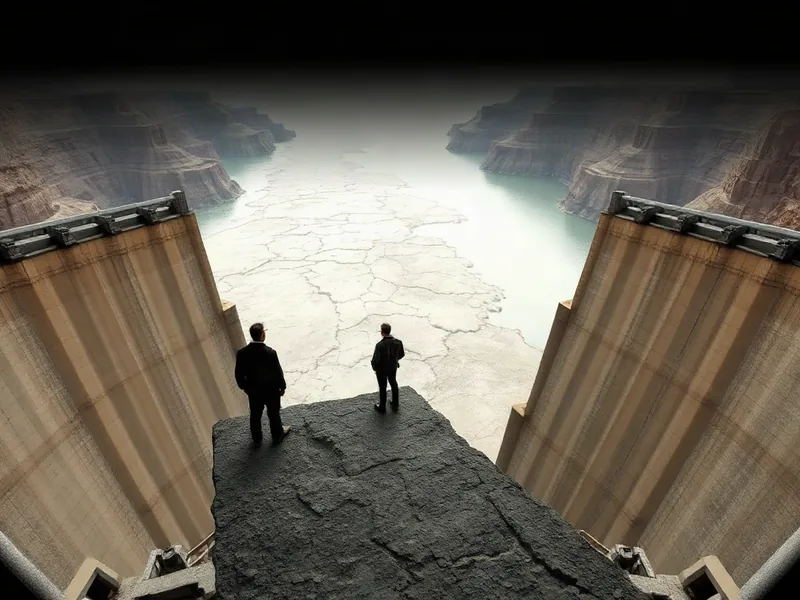
EIA projections suggest 2026 will mark the lowest hydropower output in the region in over a decade, with 2027 dipping even lower. That's a sobering trajectory for a renewable resource that utilities and climate planners have long treated as a stable pillar of decarbonization efforts.
There's been a flicker of good news. El Niño, a weather pattern that can bring cooler, wetter conditions to the southern US, delivered heavy rains and flooding across the region in October and early November. Lake Powell's water level rose more than 20 feet from its mid-September low. That's genuinely meaningful in the short term, but it's a bucket of water thrown at a problem that took decades to create. Reservoirs this depleted need sustained wet years, not a single storm cycle, to meaningfully recover.
The hydropower shortfall isn't just a regional inconvenience. It has global climate implications, because when hydropower falls short, something else usually fills the gap, and that something is often fossil fuel generation. In 2023, global energy-related greenhouse-gas emissions rose 1.1%. According to a report from the International Energy Agency, a worldwide shortfall in hydropower generation accounted for roughly 40% of that increase.
That statistic deserves a moment of reflection. Hydropower has long been treated as one of the most reliable renewable resources we have, a kind of climate solution that doesn't depend on whether the sun is shining or the wind is blowing. But it turns out hydropower has its own dependency: a stable, predictable water cycle. Climate change is actively destabilizing that cycle in parts of the world, including one of the most important river systems in the American West.
For residents, farmers, and utility planners across the Southwest, this is a dual crisis playing out on the same timeline. The same drought threatening drinking water and agricultural irrigation is also undermining a major source of clean electricity. These aren't separate problems to be solved independently. They are two symptoms of the same underlying shift in precipitation patterns, and addressing one without considering the other risks leaving communities more vulnerable, not less.
What happens next will depend heavily on factors largely outside human control, like whether future winters bring enough snowpack to meaningfully refill Lake Powell and Lake Mead. But it will also depend on choices within our control: how aggressively grid operators invest in battery storage and other flexible resources to replace what hydropower used to provide, and how honestly climate and energy planners reckon with the fact that even renewable infrastructure built for a different climate may not perform the way it once did.
Tags
Original Sources
Hydropower hit record lows in the US Southwest this summer
↗ https://www.technologyreview.com/2026/11/17/1148742/hydropower-drought-colorado-river
About the author
Amara's entry point into AI was an epidemiology role at a London research hospital, where she spent five years studying how digital health tools reached — or conspicuously failed to reach — underserved communities. Watching early algorithmic systems in healthcare quietly entrench existing inequalities, she redirected her career toward the systemic consequences of AI at scale. She covers AI through an unflinching lens: who benefits, who bears the cost, and what evidence actually says versus what the press release claims. Her writing is calm and precise, but she doesn't mistake balance for neutrality.
More from The Steward →This Week's Edition
18 November 2026
29 articles
Related Articles

As COP31 Pushes Fossil-Fuel Transition Plans, Data Centres Threaten to Undo the Gains
Environment & Climate · 6 min

Venezuela Bets on AI to Clean Up Oil Production Without Slowing It Down
Environment & Climate · 5 min

National Academies Report Calls for Faster, Tougher Retraction Standards
Models & Research · 5 min
Related Articles
As COP31 Pushes Fossil-Fuel Transition Plans, Data Centres Threaten to Undo the Gains
Environment & Climate · 6 min
Venezuela Bets on AI to Clean Up Oil Production Without Slowing It Down
Environment & Climate · 5 min
National Academies Report Calls for Faster, Tougher Retraction Standards
Models & Research · 5 min
More Stories
© 2026 Cedar & Bloom. All rights reserved.
