The Drum · Weekly AI news, freeSubscribe →

Share
Satellites in geosynchronous orbit were never meant to be fixed once launched. DARPA's Robotic Servicing of Geosynchronous Satellites program wants to change that with a robotic arm built to repair, refuel, and reposition spacecraft 36,000 kilometers up.
Geosynchronous orbit is a rough neighborhood for anything that breaks. Sitting roughly 36,000 kilometers above Earth, satellites up there provide the backbone for weather monitoring, communications, and national security missions. But once something fails, whether it's a stuck solar panel or a dead thruster, there's historically been no fix. You write it off and launch a replacement, at a cost that can run into the hundreds of millions of dollars.
DARPA wants to break that cycle. The agency's Robotic Servicing of Geosynchronous Satellites (RSGS) program is developing a robotic spacecraft designed to dock with satellites already in orbit and perform maintenance tasks that until now required either a full redesign-and-relaunch or simply giving up on the asset entirely. Think of it as roadside assistance, except the "road" is tens of thousands of kilometers from the nearest highway and the vehicle is moving at orbital velocity.
The core of the system is a robotic arm, precise enough to grapple with hardware that was never designed to be serviced. That's the tricky part. Most satellites currently in GEO were built assuming nobody would ever touch them again after launch. There are no standardized grapple fixtures, no universal docking ports, nothing like the common interfaces you'd find on, say, the International Space Station's robotic arm systems. Engineers on the RSGS team have had to design for compatibility with hardware never meant to be serviced, which means building a level of adaptability into the gripping and docking mechanisms that goes well beyond what you'd need for a purpose-built servicing target.
Operating a robot in GEO comes with constraints that don't show up in a typical robotics lab.
That last point is probably the biggest departure from how most robotic servicing demos have worked in the past, including NASA's Restore-L mission concept and the Robotic Refueling Mission experiments flown on the ISS. Those efforts tended to assume at least some cooperative hardware on the target. RSGS is explicitly trying to prove out servicing on satellites that offer none of that.
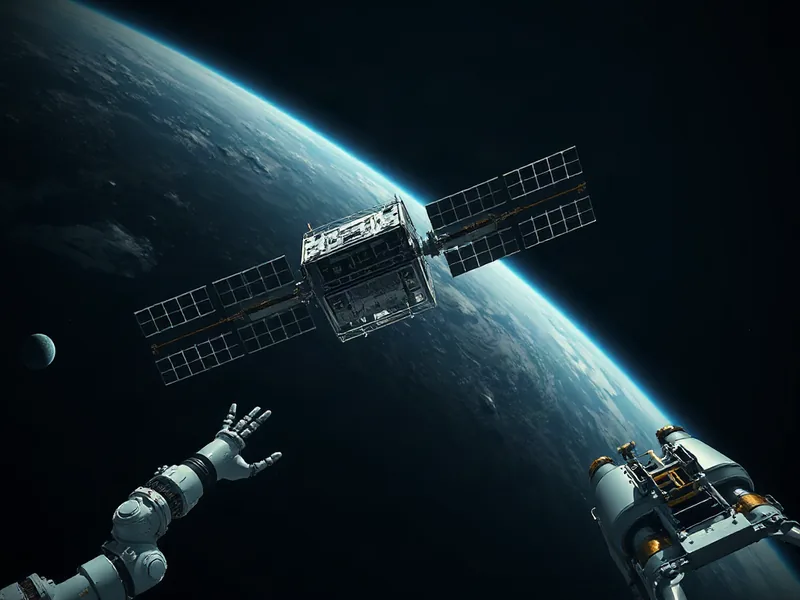
The payoff, if it works, is a genuine shift in how the space industry thinks about asset lifecycle. Right now, a GEO satellite's design life is essentially fixed at launch. Fuel runs out, a component degrades, and that's the end, regardless of how much of the rest of the spacecraft is still functional. A working on-orbit repair and refueling capability changes that math entirely. Instead of writing off a satellite because of one failed subsystem or an empty fuel tank, operators could extend its operational life by years, potentially saving enormous sums compared to building and launching a full replacement.
There's a broader industry angle here too. Commercial players like Northrop Grumman's SpaceLogistics have already flown Mission Extension Vehicles that dock with aging satellites to extend their service life by providing propulsion, though those are docking-and-boosting missions rather than full repair jobs. RSGS pushes further into actual hands-on maintenance: swapping or fixing components, not just providing a ride. That's a meaningfully harder robotics and autonomy problem, and it's why DARPA, rather than a commercial outfit working alone, has been steering the research.
Funding and timeline details for RSGS have shifted over the program's life, as is common with DARPA efforts that depend on partnering with commercial or government launch providers. But the underlying technical goals have stayed consistent: demonstrate that a robotic arm can autonomously grapple, inspect, and service a satellite in GEO that wasn't built for servicing, using a combination of machine vision, precision manipulation, and onboard autonomy to handle a job that's too far away and too slow-communicating for direct remote control.
The RSGS program is a bet that on-orbit robotic servicing can become routine infrastructure rather than a one-off demonstration. If DARPA's approach proves out, it opens a path for commercial servicing providers to extend the life of GEO assets across the industry, not just government or military satellites built with cooperative hardware in mind.
The harder technical problem, grappling non-cooperative targets with autonomy that doesn't depend on constant ground control, is also the part most likely to generalize. Solve that, and you've built a toolkit that applies well beyond any single satellite bus or orbit. For an industry that's spent decades treating satellites as disposable once something breaks, that's a genuinely different way of doing business.
Tags
Original Sources
Inside DARPA’s Mission to Send a Repair Robot to Geosynchronous Orbit
↗ https://spectrum.ieee.org/inside-darpas-mission-to-send-a-repair-robot-to-geosynchronous-orbit/particle-7
About the author
Kai built ML infrastructure at a Bay Area startup before developing an obsession with transformer architectures and inference optimisation that eventually pulled him out of product work entirely. A stint at a compute research lab sharpened his instinct for what actually matters in a model release versus what is marketing. He writes from the inside — from the perspective of someone who has debugged the systems he is describing at three in the morning. He is allergic to hype and instinctively drawn to the unglamorous plumbing questions that everyone else skips over.
More from The Engineer →This Week's Edition
4 October 2026
25 articles
Related Articles
Text-Message AI Agents Multiply as Instinct's $10B Valuation Draws a Crowded Field
Products & Applications · 5 min

In a New York Times Songwriting Contest, AI Lost. The Details Explain Why
Products & Applications · 5 min
STEM Toys Worth Your Money in 2026: What Actually Holds Kids' Attention
Products & Applications · 5 min
Related Articles
Text-Message AI Agents Multiply as Instinct's $10B Valuation Draws a Crowded Field
Products & Applications · 5 min
In a New York Times Songwriting Contest, AI Lost. The Details Explain Why
Products & Applications · 5 min
STEM Toys Worth Your Money in 2026: What Actually Holds Kids' Attention
Products & Applications · 5 min
More Stories
© 2026 Cedar & Bloom. All rights reserved.
