The Drum · Weekly AI news, freeSubscribe →

Share
Innovative drone technology is transforming how scientists monitor ice spines in the Arctic, providing critical data to understand climate change impacts.
The Arctic, one of the most remote and rapidly changing regions on Earth, has long posed significant challenges for environmental research. Scientists have relied on satellite imagery and occasional manned expeditions to study glaciers, but these methods often fall short in capturing detailed, real-time data. Now, a groundbreaking solution is emerging: drones equipped with claws that can perch on ice spines.
These robotic scouts are not just flying cameras; they are sophisticated tools designed to gather precise information about the health and behavior of Arctic ice. By perching on ice spines-narrow, vertical formations that jut out from glaciers-these drones can collect data over extended periods, providing continuous monitoring that was previously impossible.
The technology behind these drones is a testament to interdisciplinary collaboration between robotics engineers and environmental scientists. The drones are equipped with advanced sensors, including high-resolution cameras, thermal imagers, and LIDAR (Light Detection and Ranging) systems. These tools allow researchers to measure ice thickness, detect melting patterns, and track the movement of glaciers with unprecedented accuracy.
One of the key challenges in Arctic research is the harsh environment. Extreme cold, strong winds, and unpredictable weather conditions can damage or destroy traditional monitoring equipment. The drones' ability to perch on ice spines offers a significant advantage. By securing themselves to these natural formations, the drones can withstand severe weather while continuing to collect data.
The development of these perching drones represents a major step forward in environmental research. Traditional methods, such as satellite imagery and ground-based sensors, have limitations. Satellites provide broad overviews but lack the detail needed for precise measurements. Ground-based sensors are more accurate but are limited by their fixed locations and the difficulty of maintaining them in remote areas.
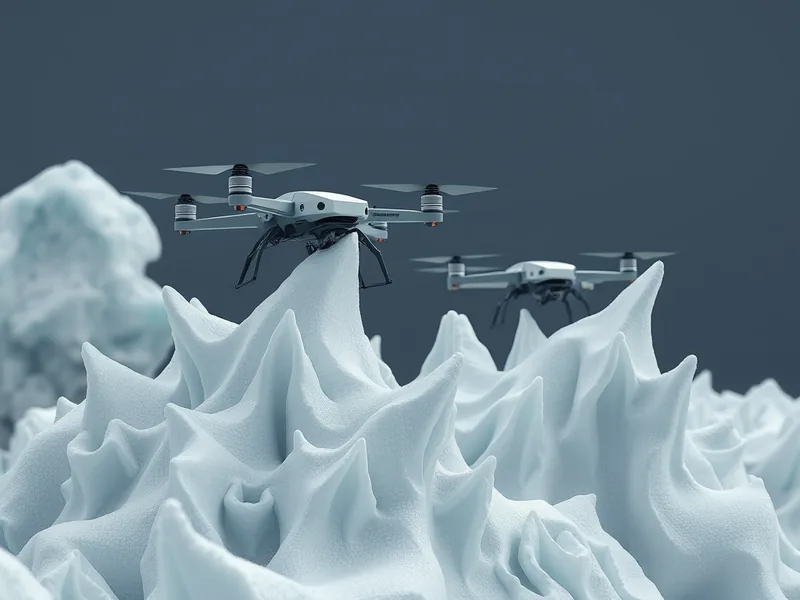
Perching drones bridge this gap by combining the mobility of aerial platforms with the stability of ground-based instruments. They can fly to specific locations, perch on ice spines, and gather data continuously. This capability is crucial for understanding the dynamic processes that govern glacier behavior, such as calving (the breaking off of ice chunks) and basal melting (melting at the base of the glacier).
The drones' sensors are calibrated to detect subtle changes in ice structure and temperature. For example, LIDAR can create detailed 3D maps of the glacier surface, revealing patterns of erosion and deposition. Thermal imagers can identify areas of rapid melting, which may indicate underlying issues such as increased heat flow from the Earth's interior.
The deployment of perching drones in the Arctic is just the beginning. As this technology matures, it has the potential to revolutionize our understanding of climate change and its impacts on polar regions. Researchers are already exploring ways to integrate machine learning algorithms into the data analysis process, which could further enhance the accuracy and efficiency of monitoring.
The success of these drones in the Arctic may inspire similar applications in other challenging environments, such as mountain glaciers and ice sheets in Antarctica. The ability to gather continuous, high-quality data will be invaluable for developing predictive models and informing policy decisions aimed at mitigating climate change.
The collaboration between robotics engineers and environmental scientists is a powerful example of how technology can address some of the world's most pressing issues. By providing real-time insights into the health of Arctic glaciers, these drones are helping to build a more comprehensive picture of our changing planet. As we continue to refine and expand this technology, the future of environmental research looks brighter than ever.
Tags
Original Sources
Spider-Like Drone Grips Steep Glaciers With Tiny Ice Spines
↗ https://spectrum.ieee.org/arctic-iceberg-drones
About the author
Amara's entry point into AI was an epidemiology role at a London research hospital, where she spent five years studying how digital health tools reached — or conspicuously failed to reach — underserved communities. Watching early algorithmic systems in healthcare quietly entrench existing inequalities, she redirected her career toward the systemic consequences of AI at scale. She covers AI through an unflinching lens: who benefits, who bears the cost, and what evidence actually says versus what the press release claims. Her writing is calm and precise, but she doesn't mistake balance for neutrality.
More from The Steward →This Week's Edition
24 August 2026
25 articles
Related Articles

Amazon Drops NDAs in Data Center Deals, But Trust Gap With Communities Remains Wide
Environment & Climate · 6 min

DARPA's RSGS Program Aims to Put a Repair Robot in Geosynchronous Orbit
Products & Applications · 5 min

Stanford Convenes Researchers to Rethink Empirical Methods for the AI Era
Models & Research · 5 min
Related Articles
Amazon Drops NDAs in Data Center Deals, But Trust Gap With Communities Remains Wide
Environment & Climate · 6 min
DARPA's RSGS Program Aims to Put a Repair Robot in Geosynchronous Orbit
Products & Applications · 5 min
Stanford Convenes Researchers to Rethink Empirical Methods for the AI Era
Models & Research · 5 min
More Stories
© 2026 Cedar & Bloom. All rights reserved.
