The Drum · Weekly AI news, freeSubscribe →

Share
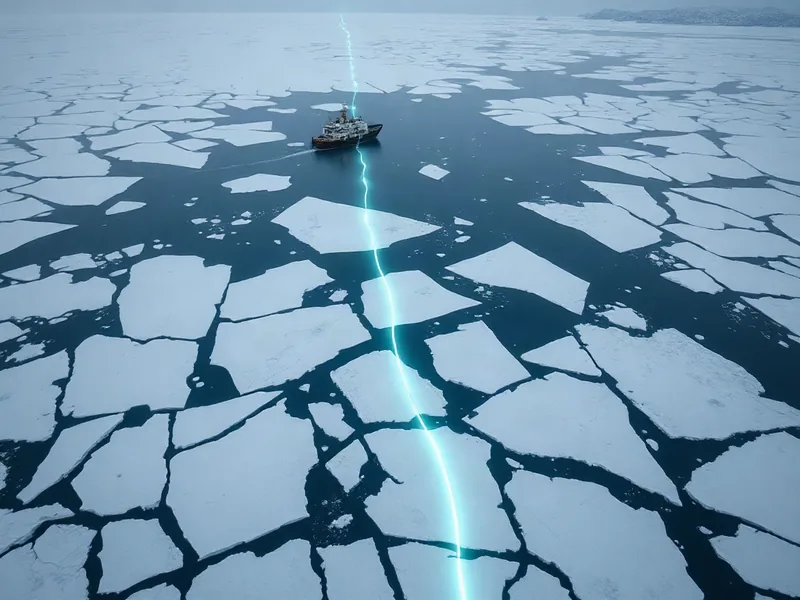
As melting sea ice opens new shipping lanes, the European Commission is studying whether to run fiber optic cables through the Arctic, a project that could reshape global data routes while exposing fragile infrastructure to new threats.
Imagine a highway that connects two cities but currently forces every truck to drive three times farther than necessary. That is roughly the situation with internet traffic moving between Europe and Asia today. Nearly all of it travels through cables routed around existing landmasses or through chokepoints like the Red Sea, where damage from anchors, earthquakes, or sabotage has repeatedly disrupted service for millions of people. An Arctic route could shorten that journey dramatically, but building it means confronting ice, cost, and a geopolitical landscape that grows more tense by the year.
The European Commission is now examining what it would actually take to lay fiber optic cable across the top of the world. This is not a simple infrastructure question. It touches on climate change, international law, economic competition, and the physical security of systems that carry everything from bank transactions to emergency communications. For people who rarely think about the cables running along ocean floors, it is worth pausing on just how much depends on them. Roughly 99 percent of international data traffic moves through undersea cables, not satellites. When one breaks, the consequences are immediate and real: outages, slowed commerce, and disrupted communication for entire regions.
The Arctic has become newly relevant because it is changing fast. Sea ice that once made the region impassable for much of the year is retreating, opening shipping lanes and construction windows that did not exist a generation ago. That shift is alarming from a climate standpoint, since a warming Arctic accelerates global sea level rise and disrupts weather patterns far beyond the polar region. But it also creates a narrow, strategic opportunity: a northern cable route could cut the distance between European and Asian data hubs significantly compared to southern paths, reducing latency and offering an alternative when other routes are compromised.
Laying cable in the Arctic is nothing like laying it in temperate waters. Ice scour, the gouging action of drifting ice against the seabed, can damage cables buried too close to the surface. Engineers have to bury lines deeper or route them through specific corridors to avoid the worst of it, all while working in a region with limited ports, sparse repair infrastructure, and weather windows that can close without warning. Maintenance ships capable of operating in Arctic conditions are scarce, and if a cable breaks in winter, repair crews may simply not be able to reach it for months.
Then there is the security dimension, which has become harder to ignore. Undersea cables have proven to be an easy, asymmetric target, a point raised by engineers and policy observers alike when discussing this project. A single vessel dragging an anchor, intentionally or not, can sever a cable that serves millions of users. In recent years, incidents involving cables in the Baltic Sea have raised suspicions of deliberate interference, and those suspicions have made governments more cautious about where and how they build new infrastructure. An Arctic route, patrolled by few nations and claimed in overlapping ways by several, presents its own version of that risk.
This creates a genuine tension for planners. Building and maintaining a cable system of this scale requires cooperation between multiple countries and companies, sharing technical details, construction schedules, and monitoring data. But every piece of information shared with a partner is also a piece of information potentially available to an adversary. Striking the right balance between transparency and security is not a technical problem with a clean solution. It is closer to the challenge of designing a shared water system between neighbors who do not fully trust one another: everyone benefits from cooperation, but everyone also has reason to hold something back.
Monitoring technology is where engineers may be able to help close that gap. Systems that can detect tampering or damage early, without requiring constant human oversight in hard-to-reach locations, would lower the cost of both maintenance and security. That kind of innovation matters because the Arctic's remoteness cuts both ways: it offers a measure of natural protection from casual interference, but it also means that if something does go wrong, the people who need to fix it are far away and the weather may not cooperate.
The European Commission's interest reflects a broader pattern of governments treating undersea cables as critical infrastructure deserving the same level of planning attention as power grids or water systems. That shift makes sense. A disrupted cable does not just slow down streaming video. It can interfere with financial transactions, emergency coordination, and the daily functioning of hospitals and public services that increasingly depend on constant connectivity. Treating these cables as an afterthought, something laid once and forgotten, no longer matches how central they have become to everyday life.
The Arctic cable question is ultimately about resilience and reach: whether the world's digital infrastructure can adapt to a region we never planned to build in and still protect the people who rely on it daily. A successful route could reduce dependence on crowded, vulnerable chokepoints and give Europe and Asia a faster, more diversified path for essential communication. But rushing the project without addressing ice risk, maintenance gaps, and the asymmetric threat of sabotage would simply create a new point of failure in a system that already has too many. Getting this right will take patient engineering, honest diplomacy among nations with competing Arctic claims, and a clear-eyed acknowledgment that the region opening up to new infrastructure is only accessible because of a warming planet nobody asked for.
Tags
Original Sources
Inside Europe’s Risky Plan for an Arctic Internet Lifeline
↗ https://spectrum.ieee.org/undersea-cables-arctic-european-commission
About the author
Amara's entry point into AI was an epidemiology role at a London research hospital, where she spent five years studying how digital health tools reached — or conspicuously failed to reach — underserved communities. Watching early algorithmic systems in healthcare quietly entrench existing inequalities, she redirected her career toward the systemic consequences of AI at scale. She covers AI through an unflinching lens: who benefits, who bears the cost, and what evidence actually says versus what the press release claims. Her writing is calm and precise, but she doesn't mistake balance for neutrality.
More from The Steward →This Week's Edition
13 November 2026
14 articles
Related Articles

Europe's Digital ID Push Tests a New Privacy Tool: Zero-Knowledge Proofs
Policy & Regulation · 5 min
Why the Woman Who Fired Sam Altman Still Doesn't Trust AI's Boardrooms
Policy & Regulation · 5 min

Pakistan to Send Climate Minister to India for First High-Level Visit in Three Years
Policy & Regulation · 5 min
Related Articles
Europe's Digital ID Push Tests a New Privacy Tool: Zero-Knowledge Proofs
Policy & Regulation · 5 min
Why the Woman Who Fired Sam Altman Still Doesn't Trust AI's Boardrooms
Policy & Regulation · 5 min
Pakistan to Send Climate Minister to India for First High-Level Visit in Three Years
Policy & Regulation · 5 min
More Stories
© 2026 Cedar & Bloom. All rights reserved.
