The Drum · Weekly AI news, freeSubscribe →
Share
Bob McGrew spent years shaping OpenAI's reasoning models before quietly pivoting to factory floors. Now backed by Altimeter, Accel and Khosla, his startup Arda is betting AI can shrink manufacturing's slowest bottleneck: retooling.
Bob McGrew left OpenAI in 2024 with a reputation for shipping reasoning breakthroughs. He has now spent more than a year building something far removed from chatbots: software that helps manufacturing engineers redesign assembly lines in days instead of months.
The startup, called Arda, has raised $230 million at a $1.5 billion valuation, the company confirmed to CNBC in an exclusive interview this week. Altimeter Capital, Accel and Khosla Ventures led the round. Until now, McGrew had said nothing publicly about the company.
The pitch is narrow and specific. Arda builds an AI assistant for manufacturing engineers, the kind of tool McGrew compares to what Claude or Cursor already do for software developers. "It's a user interface and an agent that does for manufacturing engineers what Claude or Cursor does for programmers," he told CNBC.
That comparison matters because it frames Arda not as a robotics company but as a software layer sitting on top of human expertise. The company's models are already deployed with Anduril, the defense technology firm known for drones and autonomous systems. That early customer relationship lends Arda a credibility that pure AI hype often lacks: a paying client in a sector where failure has real consequences.
Manufacturing has a stubborn inefficiency at its core. When a product design changes, human workers adapt quickly. Machines do not.
"When a design changes, you can retrain a human in a day, but it takes three to six months in order to change the automation to reflect the new design," McGrew said. That gap is the entire thesis behind Arda. Close it, and manufacturers no longer face a binary choice between flexible human labor overseas and rigid automation at home.
McGrew frames this as a geography problem as much as a technology one. "If your design changes very frequently, the only place you can really build your product is in East Asia, because you need an army of human workers who can be retrained quickly, and you can't wait for automation to catch up," he said. Arda's software is meant to remove that constraint, letting manufacturers automate production lines that adapt as fast as a design changes.
The team's background suggests this is not a hobbyist bet on AI's next frontier. McGrew spent over a decade at Palantir as product and engineering lead before joining OpenAI in 2017, where he worked on reasoning capabilities ahead of ChatGPT's launch. He stayed through the chaotic November 2023 weekend when Sam Altman was fired and reinstated, reportedly because he wanted to finish shipping what he called the "last key breakthrough left before AGI."
Co-founder Augustus Odena previously helped start Adept and worked at Google and Meta. Two other co-founders, Alex Mark and Jakob Frick, are former Palantir engineers. It is a team steeped in both frontier AI research and the kind of enterprise software discipline that defense and industrial clients demand.
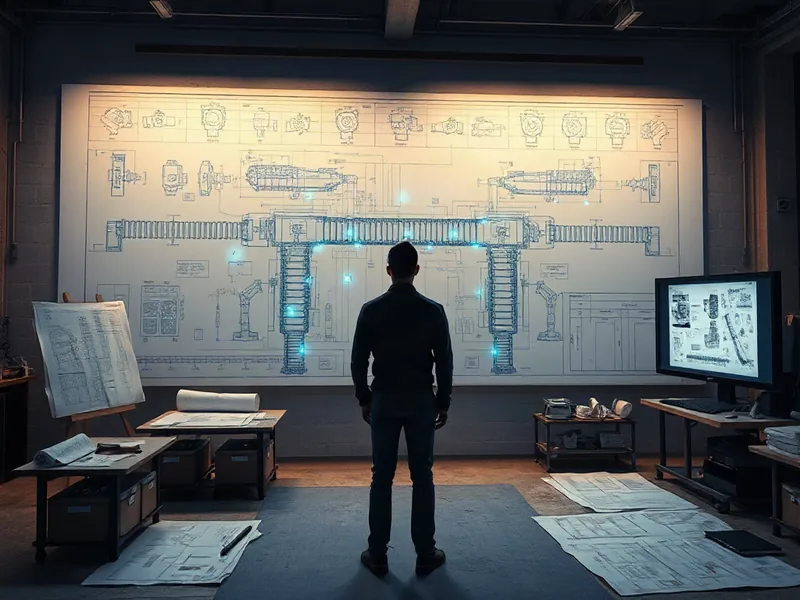
Arda runs on a mix of proprietary models, open-source systems and frontier models from outside labs, according to McGrew. That hybrid approach is pragmatic rather than ideological: use whatever model performs best for a given task, rather than betting the company on a single architecture.
Why it matters goes beyond one startup's valuation. Apoorv Agrawal of Altimeter Capital, who led the round and knew McGrew from their Palantir days, frames the opportunity in blunt dollar terms. "Manufacturing globally is a $16 trillion industry. In the U.S. alone, it's $3 trillion," Agrawal said. "We think that Arda, and the vision that they've outlined, will continue to capture a significant portion of that."
Agrawal does not pretend the valuation is cheap. "Yes, the price is steep today, but the long-term opportunity is very high," he said. That candor is worth noting. A $1.5 billion valuation for a company that has not publicly disclosed revenue figures demands scrutiny, and even its lead investor is framing this as a long-duration bet rather than a near-term arbitrage.
The timing aligns with a broader political and economic push. The Trump administration has made onshoring manufacturing a policy priority, and McGrew is explicit about positioning Arda within that narrative. "No one has ever successfully built a smartphone in the U.S.," he said. "Never successfully assembled one, and so if you can build a smartphone in the U.S. that is not taking away American jobs. That is bringing American jobs."
That is an ambitious claim for a company still early in its commercial life. Smartphone assembly has resisted U.S. reshoring for decades, not purely because of labor costs but because of supply chain density, skilled labor pools and component ecosystems concentrated in Asia. Software alone may not solve all of that. McGrew's bet is that the retooling bottleneck is the biggest lever, and that robotics, which he says is next on Arda's product roadmap, will eventually close the remaining gap.
Arda sits at an intersection that has attracted serious capital this year: AI applied to physical industry rather than purely digital products. The defense tie-in with Anduril gives it a credible early customer and a sector with government tailwinds. The Altimeter, Accel and Khosla backing signals institutional confidence from investors with track records in both enterprise software and deep tech.
Risks remain substantial. The $1.5 billion valuation rests heavily on narrative and a founding team's pedigree rather than disclosed revenue or margin data. Manufacturing is a capital-intensive, slow-moving industry, and software adoption cycles in defense and industrial settings tend to be long even when the technology works. Competitors building similar AI-for-manufacturing tools, along with incumbents like Siemens and Rockwell Automation expanding their own AI offerings, could compress Arda's window.
For investors watching the AI-to-industrial pipeline, Arda is a name worth tracking rather than a company to value on hype alone. Its success will hinge on whether retooling speed, not labor cost or automation hardware, really is the binding constraint on U.S. manufacturing's return. If McGrew is right, the market opportunity Agrawal cites is real. If he is wrong, a steep valuation built on a research pedigree and one high-profile client may prove a cautionary tale rather than a blueprint.
Tags
Original Sources
Former OpenAI exec has quietly built $1.5 billion startup, betting AI can revive U.S. manufacturing
↗ https://www.cnbc.com/2026/10/20/ex-openai-executive-builds-1point5-billion-ai-manufacturing-startup-arda.html
About the author
Marcus began tracking AI's market implications in 2016, noticing AI-related patent filings accelerating ahead of earnings upgrades before most of the sell-side had caught on. A former fixed-income quantitative analyst, he spent two decades building models that priced risk across emerging markets before pivoting to cover the economic impact of AI full-time. His writing translates opaque technical developments into clear risk/reward terms — and he's rarely diplomatic about the gap between AI valuations and underlying fundamentals. He believes most market participants still underestimate AI's long-run deflationary effect on knowledge work.
More from The Analyst →This Week's Edition
21 October 2026
23 articles
Related Articles

SpaceX's AI Unit Drives Return to Profitability, Overtakes Rocket Business
Finance & Markets · 5 min

Readily Raises $11M Series A to Automate Healthcare Compliance as Federal Fines Surge
Finance & Markets · 5 min

HSBC's Elhedery: AI Is Transformational, Data Center Deals Are Not All Equal
Finance & Markets · 5 min
Related Articles
SpaceX's AI Unit Drives Return to Profitability, Overtakes Rocket Business
Finance & Markets · 5 min
Readily Raises $11M Series A to Automate Healthcare Compliance as Federal Fines Surge
Finance & Markets · 5 min
HSBC's Elhedery: AI Is Transformational, Data Center Deals Are Not All Equal
Finance & Markets · 5 min
More Stories
© 2026 Cedar & Bloom. All rights reserved.
