The Drum · Weekly AI news, freeSubscribe →

Share
Happy Health's smart ring can now track blood pressure around the clock without a cuff or calibration step, a shift that could change how doctors catch hidden hypertension before it causes lasting harm.
For most people, a blood pressure check happens once or twice a year, in a doctor's office, with a cuff squeezing their arm for thirty seconds. That single number then gets treated as a reliable stand-in for something that actually fluctuates constantly throughout the day and night. It is a bit like trying to understand someone's mood by talking to them for one minute a year. You might catch them on a good day, a bad day, or a day warped entirely by the anxiety of being in a doctor's office in the first place, a phenomenon well known enough to have its own name: white coat hypertension.
That gap between snapshot and reality has real consequences. High blood pressure often causes no symptoms until it has already damaged the heart, brain, or kidneys. Catching it early, and understanding how it behaves over days and nights rather than in a single office visit, can change the course of someone's health. Wearable technology has promised a fix for years, but most cuffless devices still needed periodic calibration against a traditional cuff reading to stay accurate, which limited how seamlessly they could fit into daily life.
Happy Health, a digital health company based in Austin, Texas, says it has cleared that hurdle. The company announced last week that its Happy Ring has received FDA clearance for continuous blood pressure measurement without a cuff and without the need for external calibration. The ring is available for consumers to purchase directly or through a referral from their own physician or a doctor in Happy Health's network. The blood pressure feature is an add-on to the ring's core function, which is sleep tracking.
"This is blood pressure's CGM moment," said Dustin Freckleton, MD, founder and CEO of Happy Health, in a news release, drawing a comparison to continuous glucose monitors that transformed diabetes care. "High blood pressure is the most prevalent and modifiable risk factor for heart disease, stroke, dementia and all-cause mortality, which makes seeing it in real life incredibly powerful." Just as CGMs freed glucose monitoring from the finger stick, he said, the company has freed blood pressure from the cuff, turning an occasional measurement into a passive signal that can reveal risk throughout everyday life, including overnight.
The science behind the ring combines two established sensing methods. The first is photoplethysmography, or PPG, an optical technique that uses light to detect how blood volume changes with each heartbeat. Many fitness trackers already use a version of this to measure heart rate. The second is bioimpedance, which sends a small electrical signal through tissue to gauge how much blood is present in a given area.
Neither of those signals alone gives you a blood pressure reading. Freckleton explained that the company layers physics-based models on top of the raw data, models that simulate how blood vessels expand and contract, to translate the measurements into an actual number in millimeters of mercury, the standard unit for blood pressure.
The tricky part is that hydration, temperature, medication, and vascular tone can all throw off those underlying signals. Happy Health built a safeguard for that. "If those conditions fall outside the ranges we've validated, the ring can withhold the measurement rather than report a blood pressure that may not be reliable," Freckleton said. In other words, the device is designed to stay quiet rather than guess, which is exactly the kind of caution you want in a tool meant to inform medical decisions.
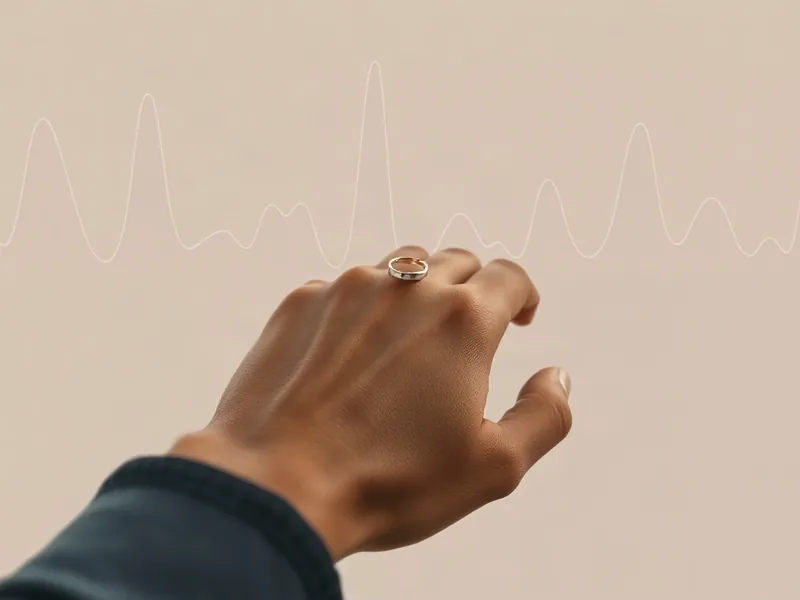
That design choice also explains how the ring sidesteps calibration altogether. Because it accounts for the physiological state of each reading rather than anchoring itself to a single cuff measurement, it does not need that periodic reset that other devices require. Happy Health says it is the first BP-measurement device to work this way, a claim worth noting given how crowded the cuffless monitoring space has become.
Happy Health is not alone in chasing cuffless blood pressure monitoring. Biobeat, maker of a chest patch, already offers 24-hour ambulatory blood pressure tracking paired with a mobile app and automated physician reports. The key difference is calibration. Biobeat's device still requires an initial cuff reading to anchor its measurements, while Happy Health says its ring does not.
To validate its accuracy, Happy Health compared the ring's readings against invasive arterial line measurements, the clinical gold standard for continuous blood pressure monitoring. The company also tested the device across people with different body mass indexes, skin tones, and health conditions, since those factors can all influence how accurately a sensor reads blood pressure. Happy Health reports a mean difference of less than 1 mmHg for both systolic and diastolic readings, a tight margin by any clinical standard.
The company's broader ambitions got a boost in August, when it raised $75 million from ARCH Venture Partners and OpenLoop to expand its home-based care platform. That funding underlines a larger shift in digital health: moving monitoring out of the clinic and into the bedroom, quite literally, without asking patients to do much of anything differently.
Freckleton pointed to sleep apnea as a clear example of why overnight monitoring matters. "It can repeatedly stress the cardiovascular system overnight and contribute to hypertension," he said. When a physician can see blood pressure data alongside what is happening with a patient's breathing during sleep, the two data streams start to tell a more complete story rather than sitting as isolated numbers on separate charts.
The harder question is what happens once this data exists. Having a continuous stream of blood pressure readings does not automatically tell doctors how to act on it. Freckleton acknowledged that translating these patterns into clinical decisions, deciding what counts as a worrying trend versus normal variation, will require more research and more time.
Still, the simplicity of the pitch is part of its appeal. "Our vision is much simpler: put on a ring when you go to bed, take it off when you wake up, and automatically get the health measurements that matter to you and your doctor without having to remember to measure anything," Freckleton said. Rather than asking patients to become more disciplined about checking their own blood pressure, the goal is to let the monitoring disappear into a routine people already follow every night. For a condition that causes so much damage precisely because it hides in plain sight, that kind of quiet, constant vigilance could matter more than any single office visit ever could.
Tags
Original Sources
Happy Health’s Cuffless BP Device Wins FDA Clearance - MedCity News
↗ https://medcitynews.com/2026/10/happy-healths-cuffless-bp-device-wins-fda-clearance
About the author
Amara's entry point into AI was an epidemiology role at a London research hospital, where she spent five years studying how digital health tools reached — or conspicuously failed to reach — underserved communities. Watching early algorithmic systems in healthcare quietly entrench existing inequalities, she redirected her career toward the systemic consequences of AI at scale. She covers AI through an unflinching lens: who benefits, who bears the cost, and what evidence actually says versus what the press release claims. Her writing is calm and precise, but she doesn't mistake balance for neutrality.
More from The Steward →This Week's Edition
14 October 2026
23 articles
Related Articles
Related Articles
More Stories
© 2026 Cedar & Bloom. All rights reserved.