The Drum · Weekly AI news, freeSubscribe →

Share
In a surprising move, mathematician Jacob Tsimerman, fresh off winning the prestigious Fields Medal, announces his new role at OpenAI, signaling a significant shift in the intersection of pure math and AI.
When Jacob Tsimerman accepted the Fields Medal last week, he did so in style-wearing a powder-blue tuxedo with satin lapels. But it was his post-ceremony announcement that truly caught everyone off guard. Among the four winning mathematicians, each sharing their future plans, Tsimerman declared, “I’ll be starting a position at OpenAI.” This move marks a significant shift in the intersection of pure mathematics and artificial intelligence.
Tsimerman’s decision to join OpenAI is not just a personal career change; it reflects broader trends in how academia and industry are collaborating to push the boundaries of AI. OpenAI, known for its groundbreaking work on models like GPT-4, has been at the forefront of AI research, particularly in areas like natural language processing and machine learning. Tsimerman’s expertise in number theory and algebraic geometry could bring new perspectives and techniques to these fields.
Tsimerman's background in pure mathematics is deeply rooted in abstract theories that often find unexpected applications in real-world problems. Number theory, for instance, has played a crucial role in cryptography, which underpins secure communications on the internet. Algebraic geometry, another area of Tsimerman’s expertise, deals with geometric objects defined by polynomial equations and has found applications in computer vision and robotics.
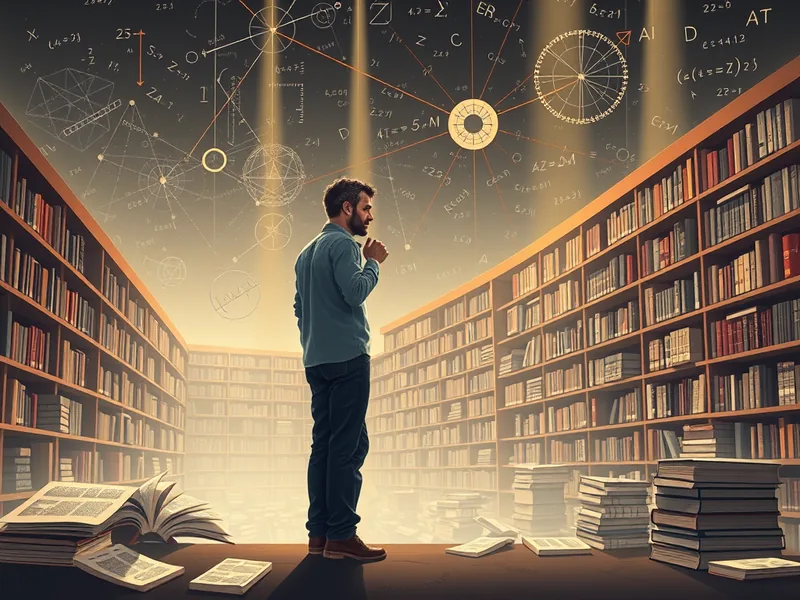
Tsimerman’s move to OpenAI is part of a larger trend where top mathematicians and computer scientists are bridging the gap between theoretical research and practical applications. This convergence is crucial for advancing AI safety, ensuring that AI systems behave as intended and do not pose risks to users or society.
As Tsimerman transitions into his new role at OpenAI, several key areas of focus will likely emerge:
Tsimerman’s journey from the world of pure mathematics to the cutting edge of AI research is a testament to the dynamic nature of modern science and technology. As he begins his new role at OpenAI, the AI community will be watching closely to see how his unique perspective shapes the future of this rapidly evolving field.
Tags
Original Sources
The Math Superstar Who’s Terrified of AI—and Just Took a Job at OpenAI
↗ https://links.tldrnewsletter.com/xWbJWG
About the author
Kai built ML infrastructure at a Bay Area startup before developing an obsession with transformer architectures and inference optimisation that eventually pulled him out of product work entirely. A stint at a compute research lab sharpened his instinct for what actually matters in a model release versus what is marketing. He writes from the inside — from the perspective of someone who has debugged the systems he is describing at three in the morning. He is allergic to hype and instinctively drawn to the unglamorous plumbing questions that everyone else skips over.
More from The Engineer →This Week's Edition
24 August 2026
25 articles
Related Articles
Related Articles
More Stories
© 2026 Cedar & Bloom. All rights reserved.