The Drum · Weekly AI news, freeSubscribe →

Share
A $15 billion AI buildout hits a legal snag as Finnish police investigate whether forest clearing and drainage work at a Google data centre site broke water protection laws before approvals were even final.
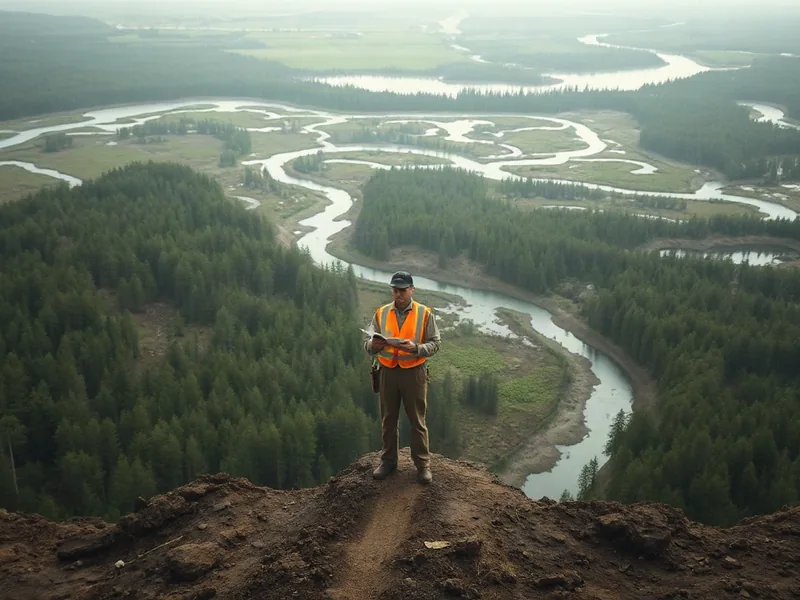
For the people living near Muhos, a small town in northern Finland, the forest and wetlands nearby aren't abstract scenery. They're part of a water system that drains, filters and sustains the surrounding land. So when police say that clearing and drainage work may have started before the required environmental checks were finished, it raises a question that matters well beyond Finland's borders: can the rush to build AI infrastructure outpace the rules meant to protect the places it's built on?
Finnish police announced Thursday they've launched a criminal investigation into suspected breaches of environmental law at a planned Google data centre construction site. The site belongs to Tuike Finland, a subsidiary of Alphabet's Google. Investigators are looking into whether the company's operations violated Finland's water act and caused environmental damage.
"We are investigating whether the company's operations have breached the water act and resulted in environmental damage," Detective Superintendent Kari Pakanen told Reuters. A guilty finding could result in a corporate fine, he said. He declined to say whether individuals might also become targets of the probe.
The timeline here matters. According to police, preliminary findings point to ambiguities and shortcomings in how drainage and water management were handled at the Tuike site. Think of a construction crew digging trenches to reroute water flow before anyone has confirmed those trenches won't flood a neighboring wetland or disrupt a stream that feeds into a protected area. That's roughly the concern regulators are examining: work that altered the land's water systems may have happened before the assessments meant to catch those risks were done.
Police said they'll provide an update in December, but cautioned the investigation will stretch into 2027. That's a long runway for a company eager to move forward on a project it has called its largest single investment in Europe.
This isn't the first sign of friction. On October 6, Finland's Supervisory Agency, known as LVV, ordered Google to halt preparatory work altering the environment at the Muhos site as well as a separate location. LVV oversees environmental permits and impact assessments in Finland, essentially acting as the gatekeeper that decides whether land-altering projects can proceed. It's now up to that same agency to decide when, or if, Google can resume work.
An LVV spokesperson said it remains unclear how long it might take to grant the necessary permits. That uncertainty leaves Google in limbo on a project tied to a much larger $15 billion pledge announced last month to build AI infrastructure across Finland, including data centres, grid upgrades, and clean energy and battery projects meant to power services like Gemini, Search, Maps and YouTube.
Google, for its part, says it intends to cooperate. "We've partnered closely with the government and communities in Finland on infrastructure for over a decade, and are actively responding to enquiries from LVV and other authorities," a company spokesperson said. The company has also said it will cooperate with the police investigation and remains focused on compliance at its sites.
It's worth stepping back to understand why Finland became such an attractive destination for this kind of investment in the first place. The country's cool climate reduces the energy needed to cool massive server farms, something like a natural air conditioner that cuts electricity costs. Its grid runs on low-carbon power, and the government has been consistently supportive of AI infrastructure projects. Add in a population of under 6 million spread across a country roughly the size of Germany, and you get a place where large-scale buildouts have historically faced less public pushback than in other regions, including parts of the United States.
That political backing has been vocal. Finland's Prime Minister Petteri Orpo said last month that the Google deal would boost the country's economy, and he downplayed concerns that the project could strain energy supplies or push up power prices for ordinary Finns. Those concerns aren't hypothetical. Grid operator Fingrid has projected that AI data centres are among the main drivers behind a potential 40% rise in Finland's electricity consumption in coming years, assuming all currently agreed grid connection projects move forward. That's a significant jump for a national grid, and it's the kind of strain that tends to show up first in household energy bills and regional power reliability, not in corporate earnings calls.
The prime minister's office did not immediately respond to a request for comment on the criminal investigation.
This case sits at the intersection of two forces that are rarely in sync: the breakneck pace of AI infrastructure expansion and the slower, deliberate process of environmental oversight. Data centres don't just consume electricity. They reshape land, alter drainage patterns, and can disrupt local ecosystems if construction gets ahead of the assessments designed to catch problems early.
Finland has positioned itself as a welcoming home for this kind of investment, banking on economic benefits and clean energy credentials to offset concerns about resource strain. But a criminal investigation into one of the country's marquee AI projects suggests that welcome mat has limits. Regulators still expect companies, even ones as large as Google, to wait for the green light before altering protected land.
What happens next will likely shape how other countries handle similar AI infrastructure booms. If Finland's enforcement holds firm and the investigation runs its course through 2027, it sends a signal that environmental review isn't just paperwork to be worked around on the way to a groundbreaking. For communities near Muhos, and for anyone watching how fast the AI buildout is reshaping landscapes worldwide, that signal matters more than any single fine or permit delay.
Tags
Original Sources
Finland launches criminal probe into land clearance for Google data centre
↗ https://www.reuters.com/business/environment/finland-launches-criminal-probe-suspected-environmental-damage-google-data-2026-10-29
About the author
Amara's entry point into AI was an epidemiology role at a London research hospital, where she spent five years studying how digital health tools reached — or conspicuously failed to reach — underserved communities. Watching early algorithmic systems in healthcare quietly entrench existing inequalities, she redirected her career toward the systemic consequences of AI at scale. She covers AI through an unflinching lens: who benefits, who bears the cost, and what evidence actually says versus what the press release claims. Her writing is calm and precise, but she doesn't mistake balance for neutrality.
More from The Steward →This Week's Edition
30 October 2026
28 articles
Related Articles

UK Scales Back Green Spending to Cut Bills as India Eyes $220bn Clean Energy Push
Environment & Climate · 6 min

Canada's Voluntary Data Centre Rules Are Signed by the Companies Breaking Them
Environment & Climate · 5 min

What Happens to Science When Scientists Stop Doing the Thinking?
Health & Science · 5 min
Related Articles
UK Scales Back Green Spending to Cut Bills as India Eyes $220bn Clean Energy Push
Environment & Climate · 6 min
Canada's Voluntary Data Centre Rules Are Signed by the Companies Breaking Them
Environment & Climate · 5 min
What Happens to Science When Scientists Stop Doing the Thinking?
Health & Science · 5 min
More Stories
© 2026 Cedar & Bloom. All rights reserved.
