The Drum · Weekly AI news, freeSubscribe →
Share
Scientists revived pig kidneys frozen solid for over a year, a feat that could one day let hospitals bank organs indefinitely. The science is promising, but the leap to human transplants remains untested.
Every day, roughly 17 people in the United States die waiting for an organ transplant. The math is brutal: there simply aren't enough kidneys, livers, and hearts to go around, and the ones that do become available often can't reach the patients who need them most because of a cruel logistical limit. Organs decay fast once removed from a body, which means a kidney harvested in one city might be useless by the time it reaches a hospital across the country. It's a problem of biology colliding with geography, and for decades it's had no good solution.
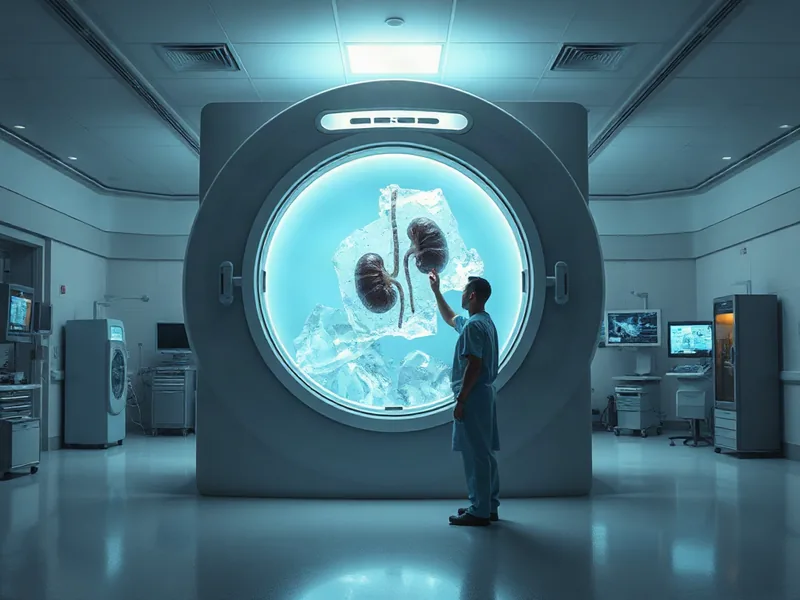
That might be starting to change. Researchers have successfully frozen pig kidneys solid at -150 degrees Celsius, stored them for months (in one case, more than a year), then thawed them out and watched them work again. Once rewarmed and tested, the kidneys were transplanted into living pigs, where they regained their healthy color and began producing urine. That's a simple but telling sign of function: a kidney that makes urine is a kidney that's filtering blood the way it should.
Think of it like freezing a strawberry. Do it carelessly, and the ice crystals that form inside rupture the cell walls, leaving you with mush when it thaws. Do it right, using the kind of careful, glass-like freezing process scientists call vitrification, and you avoid those damaging crystals altogether. That's roughly what happened here. The kidneys were cooled into a glass-like state rather than a crystalline one, which protected the delicate tissue structures that make an organ actually function once it's warmed back up.
The significance here isn't just that a frozen organ worked. It's that this particular organ was pig-sized, comparable to a human kidney, and survived a freeze lasting over a year rather than days or weeks. Previous attempts at organ cryopreservation have struggled to scale past small tissue samples or short storage windows without catastrophic damage. Pulling this off at a size and duration relevant to actual human transplantation is a genuinely different order of achievement.
If the approach eventually translates to people, it could reshape how organ donation works entirely. Right now, a donated organ is a ticking clock: surgeons race against spoilage, and perfectly matched donors and recipients may never connect simply because of timing or distance. A bank of viable, frozen organs would remove that urgency. Hospitals could match organs more carefully, transport them without panic, and stop losing viable tissue to the clock. It's the difference between fighting a fire and planning ahead with a full reservoir of water on hand.
None of this means human kidney banks are imminent. The team behind the work has been explicit that the next step is establishing whether this freezing and rewarming process can be safely applied to human organs, which involves a different set of biological variables, regulatory hurdles, and safety testing than pig-to-pig transplants. Pig kidneys are already at the center of a separate, related frontier in medicine: xenotransplantation, the practice of transplanting animal organs directly into human patients, which has seen its own recent milestones. Cryopreservation and xenotransplantation are different technologies, but progress in one could eventually support the other, particularly if frozen pig organs became a viable bridge therapy while patients wait for better matches.
The research also arrives amid a broader push to squeeze more out of existing medical infrastructure, echoing a parallel trend playing out in the energy sector. Just as nuclear operators like Constellation and Vistra are looking to extract more output from existing reactors rather than building new plants from scratch, organ preservation researchers are looking to extract more value and longevity from existing donor organs rather than simply waiting for donor rates to rise. Constellation recently announced plans to add nearly a gigawatt of capacity across 11 reactors at six plants, and the Department of Energy awarded Vistra a $4.2 billion loan to upgrade three more. The animating idea in both cases is the same: when the supply of a resource is fixed or scarce, get smarter about using what you've already got.
For patients on dialysis, every month on a waiting list carries real health risk. Kidney failure doesn't pause while someone waits for a match; it grinds down the body, and the longer someone waits, the worse their odds become once a transplant finally happens. A future where organs can be frozen, stored, and shipped without a ticking clock could mean shorter waits, better donor-recipient matching, and fewer organs lost to spoilage before they ever reach an operating room.
It's worth being honest about the gap between this result and a working treatment. Pigs are not people, and a kidney that functions after being thawed and placed in another pig doesn't guarantee the same process will be safe or effective in a human body. Immune responses, surgical technique, and organ-specific biology all introduce complications that this study hasn't yet addressed. But as a proof of concept, it's hard to overstate how far this moves the needle. A problem that once seemed almost intractable, freezing a whole organ without destroying it, has just been demonstrated at a clinically relevant scale. That's the kind of result that reshapes what researchers believe is possible, even if the road to a hospital near you is still a long one.
Tags
Original Sources
The Download: reviving frozen pig kidneys and boosting nuclear power
↗ https://www.technologyreview.com/2026/10/15/1146755/the-download-reviving-frozen-pig-kidneys-boosting-nuclear-power
About the author
Amara's entry point into AI was an epidemiology role at a London research hospital, where she spent five years studying how digital health tools reached — or conspicuously failed to reach — underserved communities. Watching early algorithmic systems in healthcare quietly entrench existing inequalities, she redirected her career toward the systemic consequences of AI at scale. She covers AI through an unflinching lens: who benefits, who bears the cost, and what evidence actually says versus what the press release claims. Her writing is calm and precise, but she doesn't mistake balance for neutrality.
More from The Steward →This Week's Edition
16 October 2026
29 articles
Related Articles
Related Articles
More Stories
© 2026 Cedar & Bloom. All rights reserved.