The Drum · Weekly AI news, freeSubscribe →

Share
Oncologists say artificial intelligence has quietly reshaped how cancer is detected, diagnosed, and treated. Three physicians explain what's real, what's hype, and why the technology's quiet wins matter more than its flashy ones.
A few years ago, doctors mostly joked about AI in medicine. The running punchline, as Matthew Matasar, MD, chief of the Division of Blood Disorders at Rutgers Cancer Institute, puts it, was that these tools were "hallucination-prone." Ask a chatbot a medical question and you might get an answer that sounded confident and turned out to be wrong.
That joke doesn't land the same way anymore. Matasar now describes AI as an "increasingly serious" part of oncology care, and he's not alone. For the 40th anniversary of the journal ONCOLOGY, three physicians, Matasar, Arturo Loaiza-Bonilla, MD, MSEd, FACP, of St Luke's University Health Network, and Patrick Borgen, MD, of Maimonides Medical Center, sat down to talk through what's actually changed. Their answer: quite a lot, and mostly in ways patients never see.
This matters because cancer care runs on time and attention, two things that are chronically in short supply. The National Cancer Institute calls AI an "unprecedented opportunity" to understand cancer better and treat it more effectively. That optimism rests on three converging forces: better-trained models, stronger computing hardware, and access to enormous data sets spanning imaging, genomics, and patient records. Put those together and you get tools that can spot patterns no single clinician could ever hold in their head.
But the NCI is careful to add a caveat that deserves equal weight: these systems can also get things wrong in ways that quietly reinforce existing health disparities, especially if the data used to build them doesn't reflect the full diversity of patients who actually get cancer. A model trained mostly on one population can fail, or mislead, when applied to another. That's not a hypothetical risk. It's a design problem that needs real oversight, not just better marketing.
The least glamorous use of AI in oncology may also be the most valuable: documentation. Clinicians spend an enormous share of their day typing notes, filing records, and navigating software instead of talking to patients. Loaiza-Bonilla describes AI as becoming "connective tissue" in cancer care, something that links together scattered tasks like tumor board prep, clinical trial matching, and adherence to treatment guidelines from ASCO and the National Comprehensive Cancer Network.
Some of this runs on what's called agentic AI, a step beyond the chatbots most people are familiar with. Rather than simply generating text, these systems can reach out to other tools and complete multi-step tasks on their own, the way a skilled assistant might handle a whole errand list rather than just answering one question. Loaiza-Bonilla is blunt about what success looks like: "The most meaningful deployments are not going to be flashy or announced in press releases. It is going to be if we can reduce documentation burden, if we can accelerate triage, if we can get access to trials faster."
Specialized AI language models built for clinicians are part of this shift too. One example, OpenEvidence, draws on journals like the New England Journal of Medicine and JAMA, along with NCCN treatment guidelines, to give doctors quick, sourced answers at the point of care. The company says it has supported more than 100 million clinical consultations and meets federal health privacy standards.
Screening is where AI's promise becomes most tangible for patients. In mammography, AI is cutting down on the need for two radiologists to review the same scan, a practice called double review that exists to catch errors but also slows everything down. Early results from Europe and emerging US trials, which account for differences in breast density across populations, are encouraging enough that Loaiza-Bonilla says he's eager to see them deployed more broadly.
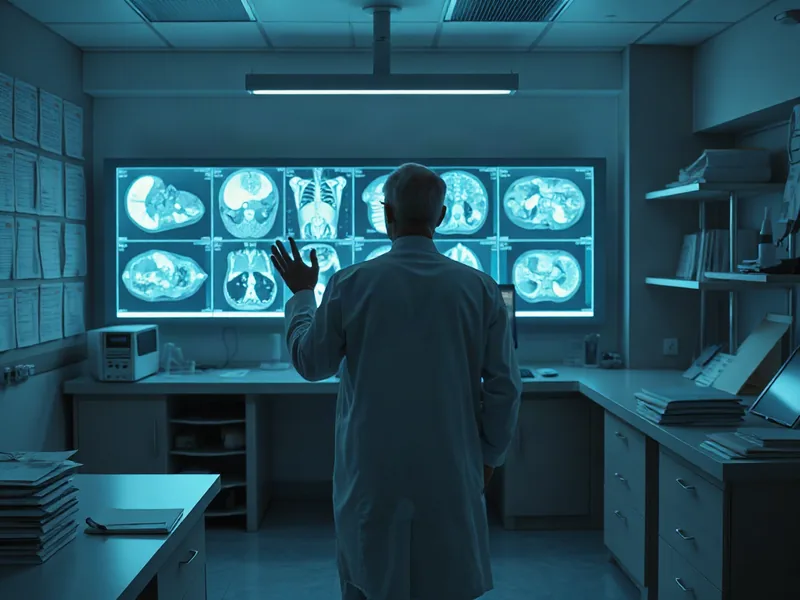
Pancreatic cancer offers a starker example of why early detection matters so much. It's usually caught late, when treatment options are limited and outcomes are poor. The PANORAMA trial, published in The Lancet Oncology, found that AI-assisted CT scans could help identify pancreatic cancer earlier than typical, buying patients time that current screening methods often can't.
Breast cancer recurrence prediction is advancing too. A transformer-based model, the same general architecture that underlies tools like ChatGPT, was shown at the 2025 San Antonio Breast Cancer Symposium to predict recurrence risk more accurately than the widely used Oncotype DX genomic test alone, particularly for patients at low or high genomic risk. That kind of precision could help doctors decide who truly needs aggressive follow-up treatment and who doesn't, sparing some patients unnecessary side effects.
Pathology may see some of the most consequential change, particularly for patients who currently have the least access to care. Loaiza-Bonilla points to a global shortage of pathologists, not just in low- and middle-income countries but in what he calls "deserts of cancer care" within the rural United States. Foundational AI models trained on millions of tissue slide images can now give a preliminary read, flagging a possible EGFR mutation or hormone receptor status, before a human pathologist even looks at the sample. Images can be uploaded from remote clinics and processed by a local computer, effectively letting expert-level screening reach places that have never had it.
Cardiology is entering the picture as well, especially for patients on cancer drugs called tyrosine kinase inhibitors that can carry heart risks. AI models trained on electrocardiograms may help flag dangerous heart rhythm changes early, and because ECGs are cheap and already routine, Loaiza-Bonilla expects these tools to move through FDA approval faster than more complex imaging models.
Loaiza-Bonilla predicts 2026 will be remembered as the year AI in medicine became industrial infrastructure rather than an experimental add-on. Pharmaceutical and health companies are increasingly training these models on their own proprietary data, aiming to shrink drug discovery timelines from years to months, sometimes weeks.
None of this replaces a doctor's judgment, and the physicians interviewed are careful to say so. Borgen notes that AI reading of breast imaging shows real promise but isn't "ready for prime time" as an investment or a replacement for radiologists. Loaiza-Bonilla insists that any AI system touching patient care needs clinical oversight, transparent guardrails, and grounding in actual medical evidence, not just confident-sounding output. The stakes are too high for shortcuts: a missed cancer, a biased model, or an unverified recommendation can cause real harm.
What ties these advances together isn't speed or novelty for its own sake. It's whether a tool helps a patient get diagnosed sooner, get into a clinical trial faster, or get treated with fewer delays. As Loaiza-Bonilla puts it, the question worth asking is simple: did AI help clinicians spend less time fighting paperwork and more time practicing medicine? If the answer is yes, that's how a technology moves from novelty to necessity.
Tags
Original Sources
The Evolution of Artificial Intelligence in Oncology: Impact on Trials, Workflows, and Outcomes | CancerNetwork
↗ https://www.cancernetwork.com/view/the-evolution-of-artificial-intelligence-in-oncology-impact-on-trials-workflows-and-outcomes
About the author
Amara's entry point into AI was an epidemiology role at a London research hospital, where she spent five years studying how digital health tools reached — or conspicuously failed to reach — underserved communities. Watching early algorithmic systems in healthcare quietly entrench existing inequalities, she redirected her career toward the systemic consequences of AI at scale. She covers AI through an unflinching lens: who benefits, who bears the cost, and what evidence actually says versus what the press release claims. Her writing is calm and precise, but she doesn't mistake balance for neutrality.
More from The Steward →This Week's Edition
16 October 2026
29 articles
Related Articles
Related Articles
More Stories
© 2026 Cedar & Bloom. All rights reserved.