The Drum · Weekly AI news, freeSubscribe →

Share
After a decade of negotiation, 128 states agreed on non-binding guidance for "killer robots." Rights groups warn the last-minute compromise stripped out the safeguards civilians most needed.
Imagine a battlefield where the decision to kill isn't made by a person, but by a machine following a set of instructions written months or years earlier. That's not science fiction anymore. It's already happening in conflicts from Ukraine to Sudan to the Middle East, and until this weekend, the international community had no shared rulebook for how far that technology should be allowed to go.
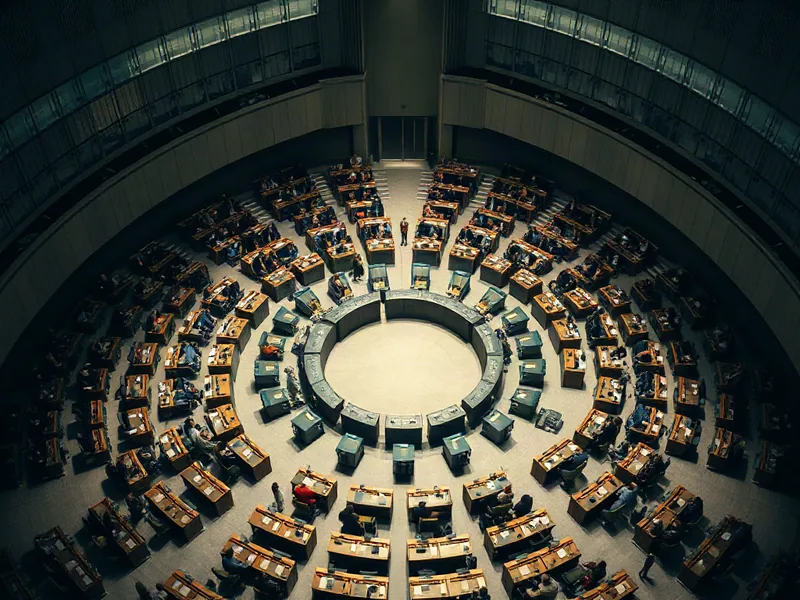
On Saturday, that changed, at least a little. The 128 states party to the Convention on Certain Conventional Weapons, a Geneva-based framework that regulates or bans arms deemed indiscriminate or excessively injurious, reached consensus on a document meant to guide future rules for autonomous weapons systems. It's the product of more than ten years of talks, and negotiators pushed through the night to get there.
Here's the catch: the agreement is non-binding. Think of it less as a law and more as a shared statement of intent, the kind of document that says "we agree this matters" without saying "and here's exactly what you must do about it." Still, in diplomatic terms, that's meaningful. Non-binding declarations have a track record of opening the door to formal treaty negotiations down the line, and that's precisely the hope here.
The weapons at the center of this debate are systems that can identify and engage targets with varying degrees of autonomy, what critics have long called "killer robots." The term sounds dramatic, but the underlying concern is straightforward: when a machine decides who lives and who dies, who's accountable when it gets that decision wrong?
That question is exactly what advocacy groups say got lost in the final hours of negotiation. Nicole van Rooijen, executive director of Stop Killer Robots, told Reuters the text's definition of an autonomous weapon, along with the measures meant to reduce harm to civilians, had been substantially watered down compared to earlier drafts. "It's a real shame that all the work done by states on the text over the past three years has been substantially diluted in the last hours," she said.
That kind of last-minute dilution is a familiar pattern in multilateral talks. Everyone shows up wanting strong language. Then, as the clock runs out and consensus becomes the priority, the sharpest edges get sanded down until something everyone can live with emerges. It's a bit like trying to get a large family to agree on where to eat dinner: you end up somewhere nobody hates, but almost nobody's first choice either.
Much of the resistance came from two of the world's most militarily powerful nations. The United States and Russia both favor national guidelines over internationally binding rules, and reporting from earlier in the week showed their opposition had already raised doubts about whether any agreement would emerge at all. Washington specifically pushed for flexibility in the text, particularly around language governing how and when human judgment must be exercised in targeting decisions.
That last point matters more than it might sound. "Human judgment" is the phrase doing a lot of quiet work in these negotiations. It's the difference between a soldier pulling a trigger and a weapon deciding, on its own, that a target meets its criteria. Advocacy groups wanted firm requirements ensuring humans stay meaningfully involved in life-or-death decisions. Flexible language, by contrast, leaves more room for states to define "meaningful" however suits their own military doctrine.
It's worth stepping back to appreciate the scale of what's being negotiated. This isn't a hypothetical future technology. Autonomous and semi-autonomous weapons are already deployed in active conflicts. Every month that passes without binding international rules is a month where these systems continue to be used, tested, and refined largely according to the standards of whichever country deploys them. The Geneva talks were an attempt to slow that momentum long enough to build shared guardrails, even loose ones.
That's also why the disagreement between rights groups and diplomats isn't just semantic. A weak definition of what counts as an "autonomous weapon" could let entire categories of systems slip through any future treaty untouched. And measures meant to protect civilians, things like requiring human oversight, restricting use in populated areas, or mandating accountability when something goes wrong, only work if they survive the negotiating process intact. Van Rooijen's frustration reflects a broader worry among humanitarian advocates: that the diplomatic process designed to protect civilians is, ironically, most vulnerable to erosion right when consensus is finally within reach.
None of this means the Geneva agreement was pointless. Reaching consensus among 128 states, including ones as fundamentally opposed on this issue as the U.S. and Russia, is not a small thing. It signals that even reluctant major powers see value in staying at the table rather than walking away from multilateral oversight entirely. That's not nothing, especially given how easily these talks could have collapsed altogether, as some observers feared just a day before consensus was reached.
The stakes here go well beyond diplomatic procedure. Autonomous weapons raise a question that regular arms control never quite had to answer: what happens when the actor making a lethal decision isn't a person at all? Landmines and cluster munitions, both previously addressed under this same convention, are dangerous because of where and how they're used. Autonomous weapons are dangerous partly because of how they're designed to think, or rather, to calculate.
For civilians living in or near conflict zones, that distinction isn't academic. It shapes whether a targeting error can be traced back to a person who made a judgment call, or whether it disappears into a black box of algorithmic decision-making with no clear accountability. Weak definitions and flexible human-oversight language don't just annoy advocacy groups. They determine, in very concrete terms, who can be held responsible when something goes wrong on the battlefield.
The Geneva agreement doesn't resolve that tension. It postpones it, kicking the harder questions toward future treaty negotiations that may or may not materialize with any real urgency. Given how quickly this technology is already spreading through active conflicts, that delay carries its own risk. The rules are still being written for a technology that, in practice, is already writing its own rules on the ground.
Tags
Original Sources
States reach agreement at autonomous weapons talks in Geneva
↗ https://www.reuters.com/3fec1b0a85a0/world/states-reach-agreement-autonomous-weapons-talks-geneva-2026-09-05
About the author
Amara's entry point into AI was an epidemiology role at a London research hospital, where she spent five years studying how digital health tools reached — or conspicuously failed to reach — underserved communities. Watching early algorithmic systems in healthcare quietly entrench existing inequalities, she redirected her career toward the systemic consequences of AI at scale. She covers AI through an unflinching lens: who benefits, who bears the cost, and what evidence actually says versus what the press release claims. Her writing is calm and precise, but she doesn't mistake balance for neutrality.
More from The Steward →This Week's Edition
6 September 2026
23 articles
Related Articles

AI Giants Move to Govern Themselves, and Decide Who Gets the Winnings
Policy & Regulation · 5 min

FDA Weighs Treating Generative AI Medical Tools Like Physicians, Not Devices
Policy & Regulation · 5 min

Ottawa Expands AI Funding for B.C. Businesses Under $700-Million National Strategy
Policy & Regulation · 5 min
Related Articles
AI Giants Move to Govern Themselves, and Decide Who Gets the Winnings
Policy & Regulation · 5 min
FDA Weighs Treating Generative AI Medical Tools Like Physicians, Not Devices
Policy & Regulation · 5 min
Ottawa Expands AI Funding for B.C. Businesses Under $700-Million National Strategy
Policy & Regulation · 5 min
More Stories
© 2026 Cedar & Bloom. All rights reserved.
