The Drum · Weekly AI news, freeSubscribe →

Share
A refrigerator-sized satellite carrying four TPUs is about to test whether Google's orbital data center dream can survive launch, radiation, and the brutal physics of cooling in space.
Google is finally putting hardware where its mouth has been. Project Suncatcher, the company's "moonshot" bid to build AI data centers in orbit, moves from slideware to spaceware on October 1, when Google's first experimental satellite launches aboard a SpaceX Falcon 9 as part of the Transporter-18 rideshare mission.
The pitch is one you've probably heard variations of from Elon Musk and Jeff Bezos: terrestrial data centers are power-hungry, land-hungry, and increasingly unpopular with the communities forced to host them. Orbit offers something Earth can't: unfiltered, uninterrupted sunlight. Skip the grid entirely and you skip a huge chunk of the energy problem. That's the theory, anyway. Google announced Suncatcher last year, and this launch is the first real test of whether the theory survives contact with reality.
The satellite, nicknamed MVP, is roughly the size of a refrigerator. Tucked inside are four of Google's custom TPU AI accelerators, the same chip family the company uses on Earth to train models and run inference. On the ground, a data center might run thousands of these chips at once, drawing enormous amounts of power in the process. MVP's solar panels generate about one kilowatt, enough to run a microwave or a hair dryer, according to reporting from the New York Times. This is a proof of concept, not a production system.
Notably, Google didn't build the spacecraft itself. The AI hardware is Google's, but the satellite bus comes from Planet Labs, a satellite imagery company. The original plan called for two custom-built satellites launching in 2027. Google decided it wanted data faster, so it pivoted to integrating its chips into a satellite Planet Labs had already built for an earlier test. That's a pragmatic move: why wait on custom hardware when you can get real flight data sooner using something that already exists.
Eventually Google envisions constellations of satellites linked by high-speed laser communication, likely requiring dedicated launches rather than rideshares. This single satellite is a much smaller ambition: validate a handful of technologies and operate for a few months before its mission ends.
Ground testing only gets you so far. Google says it has already put the hardware through its paces on Earth, but there's no substitute for actually flying it. A few specific unknowns are driving this test:
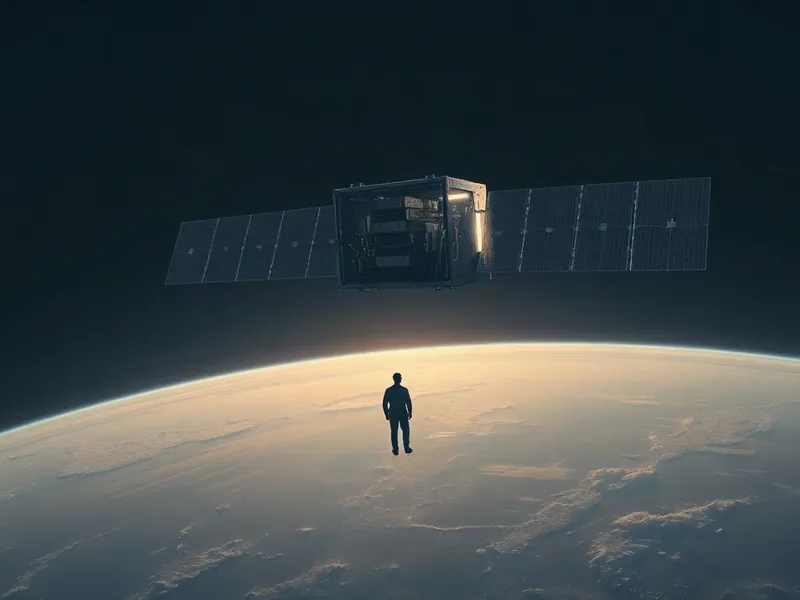
Cooling, though, is the problem that's dogged orbital data center concepts from the start, and it's the one Google spends the most effort addressing. Space has plenty of radiator technology, but it's built to shed modest amounts of heat, nowhere near what a stack of AI accelerators throws off. Google's answer involves a malleable "thermal interface material" that sits between the chips and a network of aluminum and copper heat pipes, which then funnel the heat into a radiator that radiates it into the vacuum.
Even with that setup, the limits are real. Google plans to run Gemini models on the TPUs during testing, but not continuously. The cooling system can only keep up for about 15-minute bursts before the chips have to power down and let the radiators catch up. That's a meaningful constraint if you're imagining orbital data centers running dense inference workloads around the clock. For now, it's stop-and-go.
It's worth putting this in context against the broader skepticism swirling around orbital compute. Critics have questioned whether the economics of space-based data centers pencil out at all, and cooling specifically has been flagged repeatedly as the technical sticking point most likely to sink the concept, or at least delay it by years. Google's thermal interface material approach is a real engineering attempt at that problem, but a 15-minute duty cycle suggests there's a long way to go before this looks anything like a functioning data center.
This is explicitly a learning mission, not a demonstration of a finished product. Google wants to know what breaks, what degrades, and what surprises show up once real hardware meets real orbital conditions, radiation, thermal cycling, launch stress, all of it. The custom satellites originally planned for 2027 are still on the roadmap, and whatever MVP reveals over its few months of operation will feed directly into that next iteration.
The honest framing from Google's own team is that Suncatcher remains years away from graduating from "project" to "product." That's a reasonable timeline given how many fundamentals are still unresolved, especially thermal management. Orbital AI infrastructure is a genuinely interesting bet on solving the energy and land-use problems plaguing terrestrial data centers, but this launch is step one of what looks like a long, methodical validation process rather than a preview of an imminent orbital cloud.
Tags
Original Sources
Google's first Suncatcher orbital data center test launches October 1
↗ https://arstechnica.com/google/2026/09/googles-first-suncatcher-orbital-data-center-test-launches-october-1
Google's first Suncatcher orbital data center test launches October 1
↗ https://arstechnica.com/civis/threads/google%E2%80%99s-first-suncatcher-orbital-data-center-test-launches-october-1.1514930/page-2
About the author
Kai built ML infrastructure at a Bay Area startup before developing an obsession with transformer architectures and inference optimisation that eventually pulled him out of product work entirely. A stint at a compute research lab sharpened his instinct for what actually matters in a model release versus what is marketing. He writes from the inside — from the perspective of someone who has debugged the systems he is describing at three in the morning. He is allergic to hype and instinctively drawn to the unglamorous plumbing questions that everyone else skips over.
More from The Engineer →This Week's Edition
25 September 2026
31 articles
Related Articles

Radiology's AI Turn Is Erasing the Line Between Vendor and Practice
Products & Applications · 5 min

CertifyOS Launches Shared Credentialing Platform With UnitedHealthcare, Cigna, Centene Onboard
Products & Applications · 5 min
Oracle Health Bets on AI-Native Architecture to Take On Epic Across Clinical and Financial Workflows
Products & Applications · 5 min
Related Articles
Radiology's AI Turn Is Erasing the Line Between Vendor and Practice
Products & Applications · 5 min
CertifyOS Launches Shared Credentialing Platform With UnitedHealthcare, Cigna, Centene Onboard
Products & Applications · 5 min
Oracle Health Bets on AI-Native Architecture to Take On Epic Across Clinical and Financial Workflows
Products & Applications · 5 min
More Stories
© 2026 Cedar & Bloom. All rights reserved.
