The Drum · Weekly AI news, freeSubscribe →

Share
Researchers introduce GUI-Actor, a breakthrough VLM method using attention mechanisms to achieve precise spatial-semantic alignment in GUIs, surpassing previous approaches' limitations.
In a recent paper, researchers from various institutions have introduced GUI-Actor, a novel method for visual grounding in graphical user interfaces (GUIs). This VLM-based approach uses attention mechanisms to overcome the limitations of existing methods, which often struggle with spatial-semantic alignment and ambiguous supervision targets. The result is a more efficient and generalizable system for GUI agents.
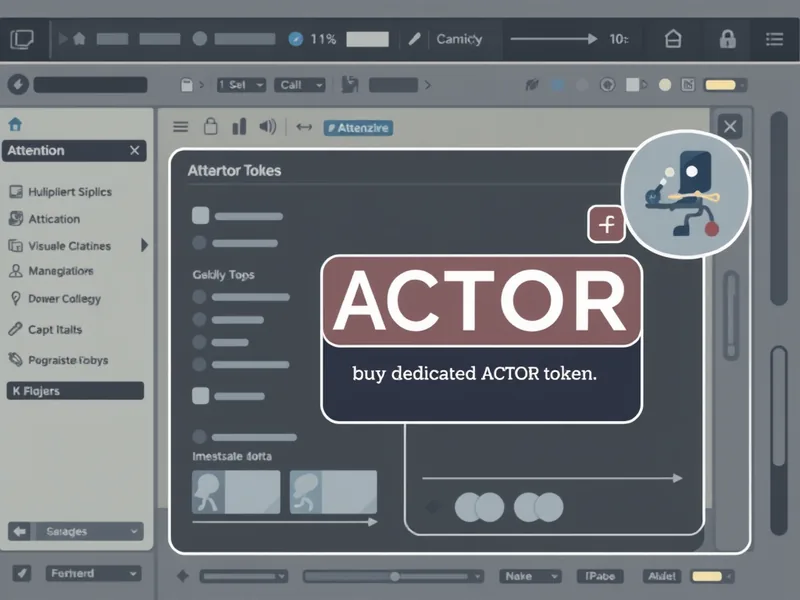
The key innovation in GUI-Actor is its use of an attention-based action head that aligns a dedicated <ACTOR> token with relevant visual patch tokens. This approach allows the model to propose one or more action regions in a single forward pass, without needing to generate specific coordinates. Here are the main technical changes and their implications:
Attention-Based Action Head:
<ACTOR> token is used to focus attention on the most relevant visual patches.Grounding Verifier:
For developers and researchers working on GUI agents, GUI-Actor offers several advantages:
The architecture of GUI-Actor is designed to leverage the strengths of Vision Transformers (ViTs) while addressing their limitations. Here’s a breakdown of the key components:
Vision Transformer (ViT):
Text Encoder:
Attention-Based Action Head:
<ACTOR> token to focus attention on relevant visual patches.Grounding Verifier:
The researchers conducted extensive experiments to validate the effectiveness of GUI-Actor. The results show significant improvements over existing methods:
GUI-Actor represents a significant step forward in the field of visual grounding for GUI agents. By leveraging attention mechanisms and avoiding the limitations of coordinate-based approaches, this method offers better generalization, efficient fine-tuning, and improved spatial-semantic alignment. For practitioners, this means more reliable and adaptable GUI agents that can handle a wider range of tasks.
Tags
Original Sources
About the author
Kai built ML infrastructure at a Bay Area startup before developing an obsession with transformer architectures and inference optimisation that eventually pulled him out of product work entirely. A stint at a compute research lab sharpened his instinct for what actually matters in a model release versus what is marketing. He writes from the inside — from the perspective of someone who has debugged the systems he is describing at three in the morning. He is allergic to hype and instinctively drawn to the unglamorous plumbing questions that everyone else skips over.
More from The Engineer →This Week's Edition
9 June 2025
29 articles
Related Articles

Wharton's Fourth Annual AI Survey: Most Companies See Returns, Few See Big Ones
Models & Research · 6 min
Tensormesh Launches Enterprise KV Cache Platform to Cut Redundant LLM Compute
Models & Research · 6 min

Iambic Therapeutics Raises $150 Million in IPO to Fund AI-Designed Cancer Drugs
Finance & Markets · 5 min
Related Articles
Wharton's Fourth Annual AI Survey: Most Companies See Returns, Few See Big Ones
Models & Research · 6 min
Tensormesh Launches Enterprise KV Cache Platform to Cut Redundant LLM Compute
Models & Research · 6 min
Iambic Therapeutics Raises $150 Million in IPO to Fund AI-Designed Cancer Drugs
Finance & Markets · 5 min
More Stories
© 2026 Cedar & Bloom. All rights reserved.
