The Drum · Weekly AI news, freeSubscribe →

Share
Patients and clinicians both feel the strain of fragmented care, but the culprit isn't automation itself. It's decades of digitizing broken processes without ever fixing what made them broken.
Walk into almost any clinic today and you'll see it: a doctor's eyes fixed on a screen instead of on the patient in front of them. It's become shorthand for everything people fear about technology in healthcare, that the machines are winning and the humans are losing.
That fear is understandable. It's also misplaced.
Clinicians spend enormous chunks of their day on documentation and administrative navigation rather than patient conversation. Staff shuffle between disconnected systems, inboxes, and work queues while patients sit waiting for answers that should arrive instantly. As healthcare technology has grown more sophisticated, the actual experience of giving and receiving care has, in many places, grown more fragmented, not less.
But here's the thing. Technology didn't cause that fragmentation. Friction did.
Think of it like a hospital hallway cluttered with equipment nobody bothered to put away. The hallway isn't broken because it has equipment in it. It's broken because nobody designed a system for where things belong. Healthcare's technology often works the same way: added piece by piece, without anyone stepping back to ask whether the whole system actually serves the people moving through it.
Consider what fills a typical healthcare worker's day. Finding information. Entering the same data into multiple systems. Sorting and routing messages. Checking results. Completing routine paperwork. Starting tasks and following up on them later.
None of that sounds dramatic on its own. Stacked together, hour after hour, it adds up to something that quietly drains one of healthcare's scarcest resources: human attention.
A clinician buried in navigating a clunky workflow cannot simultaneously give full attention to the person sitting across from them. Staff burn valuable time chasing down information that ought to be sitting right in front of them. And patients, caught in the middle, often have to explain their own medical history over and over again, simply because the information never followed them through the system in the first place.
None of that is automation's fault. It's a design failure, plain and simple.
For years, healthcare has taken paper-based processes and turned them into digital ones without asking a harder question: does this process even make sense anymore? A manual workflow becomes an electronic workflow, but the redundant steps, the duplicate data entry, the clumsy handoffs between departments all come along for the ride. We swapped paper for screens. We did not remove the friction underneath.
Layering more technology onto a broken process doesn't fix the process. It just makes the brokenness faster and better documented.
The better question for healthcare leaders isn't how many tasks a new system can eliminate. It's what that elimination actually gives back to the people doing the work.
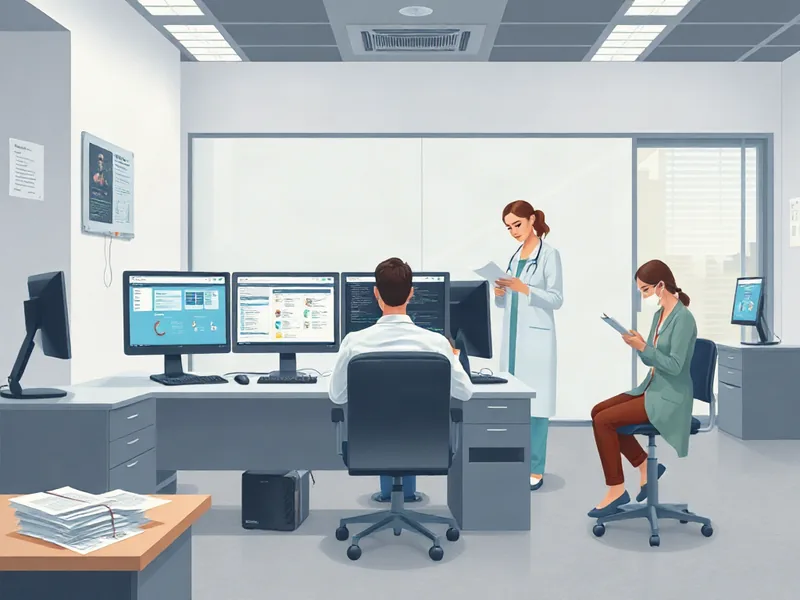
Can a clinician get more uninterrupted minutes with a patient? Can a nurse spend less time chasing paperwork and more time at the bedside? Can a patient get a faster answer without being bounced between three different departments? Can a care team pull up the right information exactly when they need it, instead of hunting for it?
Answering yes to those questions is what separates automation that restores humanity from automation that erodes it. Routine information can surface on its own instead of requiring someone to dig for it. Simple administrative steps can move forward automatically instead of sitting in a queue waiting for a human to push a button. Data can travel through a workflow without being typed in five separate times.
None of this replaces the relationship between a patient and their caregiver. The goal has never been to automate that human connection. It's to clear away the clutter surrounding it, so the connection has room to actually happen.
Automation alone doesn't guarantee a better experience, though. Bad automation creates its own kind of misery. Anyone who has spent twenty minutes navigating an endless phone tree, desperately pressing zero and hoping to reach an actual human being, knows exactly what that feels like.
That's why the people inside a workflow need to be part of designing it, not an afterthought to it. Clinicians usually know precisely where they're losing time. Staff can point to the exact processes that require awkward workarounds just to function. Patients feel the friction in their own way: unnecessary delays, being asked the same question for the third time, gaps between one step of their care and the next.
Paying close attention to each of these experiences reveals something useful. Sometimes technology is the answer. Sometimes the process itself needs to change first, and no amount of automation will fix a fundamentally broken workflow. The point isn't automating for automation's sake. It's making sure people spend their time and energy where it actually matters, and letting technology absorb the rest.
Most healthcare organizations measure new technology the way you'd expect: efficiency gains, productivity numbers, cost savings. Those metrics matter, especially given the financial pressure many health systems face right now. But they only tell part of the story.
There's a harder to quantify kind of return worth paying attention to too. Did cognitive burden go down for the people doing the work? Did staff face fewer disruptive interruptions during their shifts? Did patients experience fewer delays, fewer confusing handoffs, better access to accurate information right when they needed it?
Automation should be judged not just by what it removes from someone's plate, but by what that removal actually makes room for.
For a long time, healthcare has quietly asked its workers to make up for badly designed systems using their own time and mental energy: remembering an extra step nobody streamlined, hunting down information that got lost somewhere between departments, bridging gaps between processes that were never connected to begin with. That's not human-centered care. That's just human beings absorbing the cost of poor design.
The stakes here go beyond convenience. Every minute a clinician spends fighting a clunky system is a minute not spent listening to a patient describe symptoms that matter, or reassuring someone frightened about a diagnosis. Every redundant data entry task is time stolen from decisions that genuinely require human judgment. Automation, done thoughtfully, doesn't threaten the human core of healthcare. It protects it, by clearing away the noise that's been drowning it out for years.
Tags
Original Sources
Automation Didn’t Dehumanize Care. Bad Systems Did. - MedCity News
↗ https://medcitynews.com/2026/09/automation-didnt-dehumanize-care-bad-systems-did
About the author
Amara's entry point into AI was an epidemiology role at a London research hospital, where she spent five years studying how digital health tools reached — or conspicuously failed to reach — underserved communities. Watching early algorithmic systems in healthcare quietly entrench existing inequalities, she redirected her career toward the systemic consequences of AI at scale. She covers AI through an unflinching lens: who benefits, who bears the cost, and what evidence actually says versus what the press release claims. Her writing is calm and precise, but she doesn't mistake balance for neutrality.
More from The Steward →This Week's Edition
4 September 2026
24 articles
Related Articles

Anthropic's Own Workforce Data Shows AI Is Already Reshaping Who Gets Hired
Job Market & Society · 5 min

Relational Intelligence: The Workplace Skill Nobody Is Teaching, and Why AI Can't Replace It
Job Market & Society · 6 min

xAI Launches Grok Bot, an Autonomous Agent That Logs Into Your Tools and Does the Work
Products & Applications · 5 min
Related Articles
Anthropic's Own Workforce Data Shows AI Is Already Reshaping Who Gets Hired
Job Market & Society · 5 min
Relational Intelligence: The Workplace Skill Nobody Is Teaching, and Why AI Can't Replace It
Job Market & Society · 6 min
xAI Launches Grok Bot, an Autonomous Agent That Logs Into Your Tools and Does the Work
Products & Applications · 5 min
More Stories
© 2026 Cedar & Bloom. All rights reserved.
