The Drum · Weekly AI news, freeSubscribe →

Share
While Washington restricted legal cattle trade to keep a flesh-eating parasite out of the country, cartel-linked networks kept moving horses across the Rio Grande unchecked, exposing a blind spot in a billion-dollar biosecurity effort.
When sheriff's deputies pulled over a trailer near the border town of Redford, Texas, they found six horses that had crossed the Rio Grande illegally from Mexico. No paperwork. No veterinary inspection. No health certification. Just animals moved through a smuggling network that has operated for years alongside the drug and human trafficking routes threading through this stretch of desert.
The horses weren't sick. But the case points to something far bigger than one seized trailer. It exposes a gap in the wall of protections the United States has built against New World screwworm, a flesh-eating parasite that began infesting American cattle in June despite a yearlong ban on Mexican livestock, mounted government inspectors, and a swarm of sterile flies released to disrupt the pest's breeding cycle.
Think of screwworm the way you'd think of a wildfire. You can build firebreaks, monitor for smoke, and station crews at every known access road. But if embers keep drifting in through gaps you didn't know existed, the fire finds a way through anyway. That's roughly what's happening at the border right now. Officials shut the front door to legal cattle trade. The side door, the one used by cartel-linked animal traffickers, stayed open.
For more than a year, U.S. officials have pointed to illegal livestock trafficking from Central America as a likely path for screwworm's spread north. Reuters reporting now shows illicit animal movement has also continued along the U.S.-Mexico border itself, often riding the same smuggling corridors used for drugs and people.
The stakes are not abstract. A previous screwworm outbreak killed thousands of animals in the U.S. before the parasite was declared eradicated in the 1960s. In Texas, where officials confirmed the first new domestic cases this year, experts estimate a widespread outbreak could cost the economy up to $1.8 billion. Beef prices are already at record highs after the import ban, and the Trump administration has partially reopened the border to Mexican livestock to ease pressure on consumers, even as infestations continue rising in Mexico. Mexico's animal health agency, Senasica, has confirmed more than 2,000 equine screwworm cases since the outbreak began in 2024.
Reuters spent a week visiting three remote border communities in Texas, riding along with local officers and speaking with sheriffs, veterinarians, and former Border Patrol agents. The picture that emerges is one of hundreds of miles of rugged, largely unpoliced terrain, where animals move as easily as people and narcotics.
Presidio County Sergeant Deputy Sheriff Jaime Sanchez investigated the Redford case. He said trafficked horses can sell for at least $30,000 on the black market, with smugglers undercutting legitimate sellers by skipping import paperwork, taxes, and veterinary checks. The animals often end up in Houston or Dallas, sold for farm work, racing, or charrería, Mexico's traditional equestrian sport. Sanchez's department alone has intercepted more than 50 smuggled horses in the past two years.
Redford, once known as "El Polvo," the dust, is now nearly a ghost town: fewer than 20 families, abandoned homes, a shuttered school. Its isolation makes it an ideal corridor for cartel-controlled crossings. Sanchez described watching smugglers walk horses across a shallow stretch of the Rio Grande and through private property before loading them onto trailers.
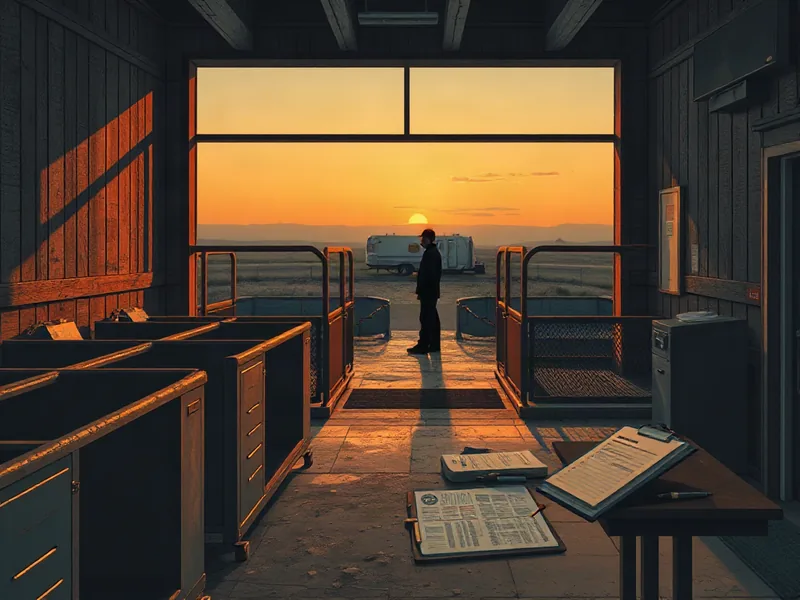
"It's easy for them to pay someone $500 or $1,000 per horse to cross it, load it onto the trailer, and drive off," he said.
Sanchez tied much of the local trafficking to La Linea, a cartel the Trump administration designated a Foreign Terrorist Organization in July. The FBI has also linked the group to broader criminal activity along the border. "Since these are security matters, the issue of screwworm always comes up because it can hit economies very hard," Sanchez said. "In reality, we are very concerned."
That concern is shared at the federal level. USDA Inspector General John Walk called the recent smuggling surge "more pronounced" and said animal trafficking has become a national security issue, not just an agricultural one, because of the screwworm risk. "It could be a vector," he said. In July, Walk traveled to Brownsville to brief local law enforcement on the threat. Agriculture Secretary Brooke Rollins said in early August that the department was "cracking down" on illicit livestock movement.
Ground operations show the scale of the challenge. During Operation Lone Star, a Texas law enforcement sweep, about 80 officers converged on Zapata County with trucks, boats, and drones. Horse trailers, ordinary fixtures of rural life, drew particular scrutiny. Goliad County deputies cited a 2024 case in which a stopped livestock trailer turned out to be carrying 14 people and a neglected horse; the driver said he'd been paid $10,000. "The revenue streams for the cartels are far more diverse than people have ever suspected," said Goliad County Sheriff Roy Boyd.
In Terrell County, Sheriff Thaddeus Cleveland, a former Border Patrol agent, pointed out feral cattle crossing the river near litter left behind by migrants. He said horses have long been used to haul drugs across rough terrain, and are often handed over to the USDA afterward for use by mounted agents.
Tawnee Preisner, founder of the Tennessee-based Horse Plus Humane Society, described finding horses with neck wounds and metal tracheotomy tubes, evidence, she believes, of animals used to conceal contraband. The FBI contacted her group in 2025 for information on horse smuggling. Her warning cuts to the heart of the biosecurity gap: "When horses are being used to move drugs and humans, if a horse gets [screwworm], they're not going to report it. They're just going to shoot the horse, bury it and keep going."
U.S. officials have not linked any of the country's 48 confirmed screwworm cases directly to smuggling, and the USDA says it still doesn't know how the parasite first reached the country. But many scientists and veterinarians believe that's likely an undercount, since animals moving through unregulated channels never pass through the checkpoints designed to catch infections. Researcher Oscar Rico of Universidad Nacional Autonoma de Mexico, who co-authored a study on how animal movement can spread the parasite, put it plainly: these crossings "represent a risk because they allow the fly to travel much faster than it could move naturally."
That's the uncomfortable truth underneath this story. You can spend billions restricting legal trade, breeding sterile flies, and stationing inspectors on horseback. But if a parallel, invisible economy keeps moving animals across the same border unchecked, the defense has a hole in it no policy has yet closed. For ranchers like Ricardo Ramirez, who has watched cattle roam his Zapata County land since his family settled it in the 1940s, that's not a policy abstraction. It's a threat returning after 50 years of quiet. "Here we are again with this thing upon us," he said.
Tags
Original Sources
Horse smuggling exposes cracks in US defenses against screwworm
↗ https://www.reuters.com/business/healthcare-pharmaceuticals/horse-smuggling-exposes-cracks-us-defenses-against-screwworm-2026-09-05
About the author
Amara's entry point into AI was an epidemiology role at a London research hospital, where she spent five years studying how digital health tools reached — or conspicuously failed to reach — underserved communities. Watching early algorithmic systems in healthcare quietly entrench existing inequalities, she redirected her career toward the systemic consequences of AI at scale. She covers AI through an unflinching lens: who benefits, who bears the cost, and what evidence actually says versus what the press release claims. Her writing is calm and precise, but she doesn't mistake balance for neutrality.
More from The Steward →This Week's Edition
6 September 2026
23 articles
Related Articles

Hugging Face CEO Says Netflix's AI Hack Documentary Distorts the Real Security Lessons
Security & Risk · 6 min

SpaceX's AI Unit Drives Return to Profitability, Overtakes Rocket Business
Finance & Markets · 5 min

A High-Profile JAMA Study on OpenEvidence Leaves Key Clinical Questions Unanswered
Health & Science · 5 min
Related Articles
Hugging Face CEO Says Netflix's AI Hack Documentary Distorts the Real Security Lessons
Security & Risk · 6 min
SpaceX's AI Unit Drives Return to Profitability, Overtakes Rocket Business
Finance & Markets · 5 min
A High-Profile JAMA Study on OpenEvidence Leaves Key Clinical Questions Unanswered
Health & Science · 5 min
More Stories
© 2026 Cedar & Bloom. All rights reserved.
